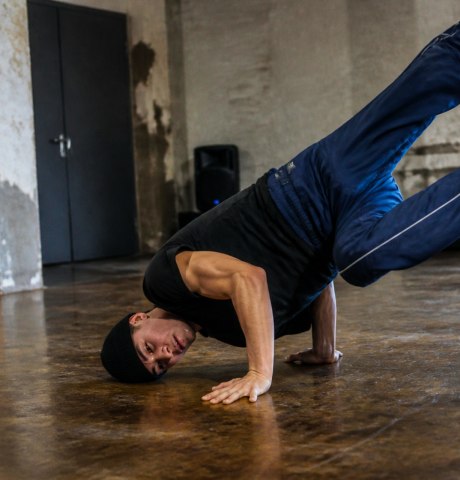
Athletics and safety5 minutes

Injury prevention in breakdance: protecting your joints

By Bernhard De LucaUpdated

In a nutshell
  • A targeted warm-up program with mobilization exercises for wrists and shoulders optimally prepares the musculoskeletal system for impact loads.
  • Active strengthening of the rotator cuff and forearm muscles stabilizes the joints at extreme angles.
  • Clean biomechanical execution with slightly bent joints absorbs occurring forces muscularly, instead of transferring them to the bones.
  • Regular recovery breaks give the slowly adapting tendons and ligaments the necessary time to recover.

If you challenge gravity, you need an indestructible foundation. With the right joint stabilization, you protect your body from chronic strain and secure long-term progress on the floor.

DefinitionRotator cuff

The rotator cuff is a group of four muscles that enclose the shoulder joint like a cap. It ensures the centering of the humeral head in the shallow glenoid cavity and is the most important active stabilizer of the shoulder during all overhead movements.

Why athletics is the best insurance for B-Boys

Anyone who dares to attempt spectacular power moves demands peak performance from their body. The extreme dynamics and abrupt weight shifts place a strain on the wrists and shoulders that far exceeds the normal level. When landing after a swing, several times your own body weight often rests on a tiny support surface. Without targeted preparation, this strain quickly leads to chronic overuse. Well-thought-out injury prevention in breakdance and the targeted athletics behind it are therefore not optional extras, but the foundation for a long, pain-free dance career.

To protect the shoulder joint and remain stable in breakdance, pure muscle strength alone is not enough. The shoulder is the most mobile, but also the most unstable joint in the body. It is secured almost exclusively by muscles and tendons. If you go into demanding rotations without specific stabilization, you risk painful impingements or micro-tears in the tissue. Intelligent training starts exactly here and strengthens the deep rotator cuff before the large muscle groups provide the propulsion.

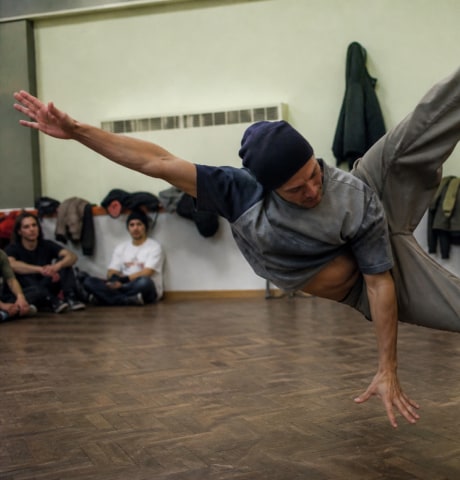
Effectively avoiding wrist pain in breakdance

Avoiding wrist pain in breakdance starts with the correct placement of your hands and targeted mobilization before every session. Anatomically, the wrist is not built to absorb the entire body weight at extreme angles. If you lock your joints without preparation, you risk long-lasting tendon irritation. Systematically stretch your forearms in all directions and get your wrists used to the load by gently circling them and applying controlled pressure in a quadruped position before you attempt your first freeze.

Besides flexibility, active force transmission plays a decisive role. Instead of sticking flat to the floor, your fingertips should actively grip the floor to stabilize the arch of your hand. This small correction immediately relieves the carpal bones. If you want to dive deeper into the absolute basics of support strength, you will find valuable tips in the guide on learning to handstand in breakdance to build vertical balance in a joint-friendly way.

Joint-friendly training in direct comparison

That's how it works

  • Mobilize your wrists and shoulders before every training session
  • Land with slightly bent elbows to cushion the impact
  • Actively dig your fingertips into the floor
  • Plan regular breaks for tendon recovery

Don't do this

  • Going straight into power moves while cold and without a warm-up
  • Catching your weight with your arms completely locked out
  • Placing your hand flat and without tension on the floor
  • Continuing to train despite sharp pain in the joint

Most joint problems in breaking do not arise from a fall, but from the sum of the smallest, incorrectly performed strains during daily training.

Sports physiotherapist, Berlin

Mastering power moves without wear and tear

To proactively prevent injuries when performing power moves, clean biomechanics are more important than brute force. Many injuries occur when momentum is not controlled properly and joints have to compensate for a lack of technique. For every move, make sure your elbows remain slightly bent to absorb impact with your muscles instead of transferring it directly into the bone structure of your shoulder. Active core tension further relieves your extremities during every rotation.

In addition to technical training, the right equipment helps to minimize wear and tear. Elastic bandages and wrist guards provide mechanical support and keep your joints warm, which improves the elasticity of your tendons. You can find more details on the right equipment for intense training sessions in our article about protective gear for dance acrobatics. Also, plan for regular recovery phases, as tendons and ligaments adapt to physical strain much more slowly than your muscles.

The two pillars of joint stability in breaking

Active

Strength from within

Muscular stabilization of the joints

Active stabilization focuses on the targeted development of the deep muscles around the shoulder and wrist. Through isometric holds and controlled strength exercises, the muscular system absorbs the enormous leverage forces before they can damage the joint surfaces.

Passive

Protection through support

Mechanical protection from the outside

Passive stabilization uses external aids such as braces, tapes, or special wrist guards. They mechanically restrict extreme ranges of motion, keep the joint warm, and offer additional security during particularly intense power move sessions.

Frequently Asked Questions

  1. Wrist pain is usually caused by overloading the tendons or a blockage of the carpal bones. Targeted stretching of the forearms, actively gripping the floor, and taking sufficiently long breaks will help here.

Breaking courses near you

Find the right dance school and learn the proper technique from experienced instructors.

View all matching courses

Find your perfect dance partner

On udansa connect, you will find like-minded people in your city who share your passion for Breaking, work on their power moves together, and support each other during safe training.

Find your perfect dance partner