


Find your dancing home
Find first-class dance courses near you on udansa and connect with like-minded people who share your passion for contemporary movement.

By Mary De LucaUpdated
Find first-class dance courses near you on udansa and connect with like-minded people who share your passion for contemporary movement.
Prepare your body optimally for the fluid movements and rapid dynamic shifts of contemporary dance. With this simple routine, you activate your muscles injury-free within your own four walls.
A thorough warm-up is the foundation for every movement session in contemporary dance. Warming up solo at home for modern dance is primarily about focusing your mind on your own body and gently mobilizing your joints. In contrast to classical styles, which often start in a very linear way, the contemporary warm-up uses organic, three-dimensional movements. You prepare your muscles for typical changes in dynamics without overexerting yourself right at the beginning with complex acrobatics or strenuous floorwork elements. Anyone who starts a session with cold muscles risks injury and wastes valuable potential for dance expression.
This preparatory training can be carried out perfectly within your own four walls. You only need a little space and a non-slip mat. If you are wondering how best to equip yourself for your first session, our guide on contemporary dance clothing will help you. Warming up at home gives you the necessary peace to concentrate entirely on your breathing and the alignment of your body, so that you can start at full speed in the subsequent udansa course.
Stand with your feet hip-width apart, close your eyes, and breathe in and out deeply. Let your head sink forward slowly and roll down halfway, vertebra by vertebra, to gently wake up your spine.
Rotate your shoulders individually and together, backwards and forwards. Let the movement grow until your whole arms flow through the room like soft waves and open up your chest.
Place your feet a little further apart and shift your weight smoothly from one leg to the other. Bend your knees deeply while doing so and feel the strength in your thighs.
While standing with your feet hip-width apart, alternately lift your heels and consciously roll your feet over the balls of your toes. This strengthens your ankles and prepares you for balance exercises.
Gently pull one knee towards your chest while standing and hold your balance for a few seconds. Switch sides to open your hip joints and activate your core.
Find the right course and take your new warm-up routine straight to the dance floor.
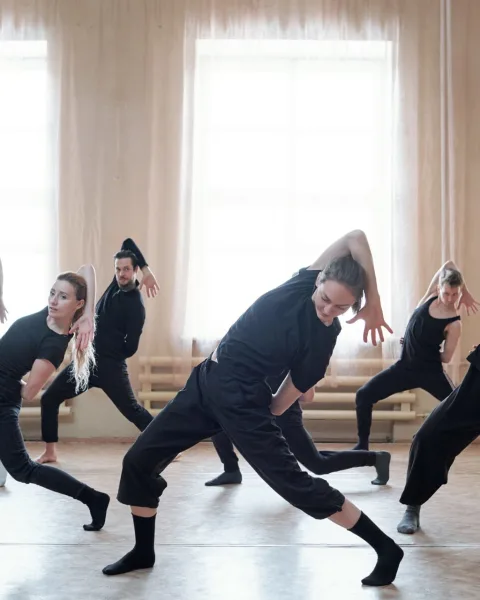 festivalOnly 5 spots leftModern Dance
Like this
Don't do this
Preparation
Meanwhile
Follow-up
A duration of 10 to 15 minutes is ideal for a warm-up at home. During this time, your heart rate increases gently, joint lubrication is activated, and your muscles receive optimal blood flow without causing fatigue.
No, socks or training barefoot are best for this routine. Being barefoot gives you the best grip on the floor and allows you to optimally mobilize your ankles and toes, which is especially important in Contemporary.
No, static stretching should be avoided before dancing because it reduces muscle tension. Instead, use dynamic, fluid movements to make your muscles elastic and prepare your joints for their full range of motion.
 Learning Contemporary Dance as an adult: Your easy start
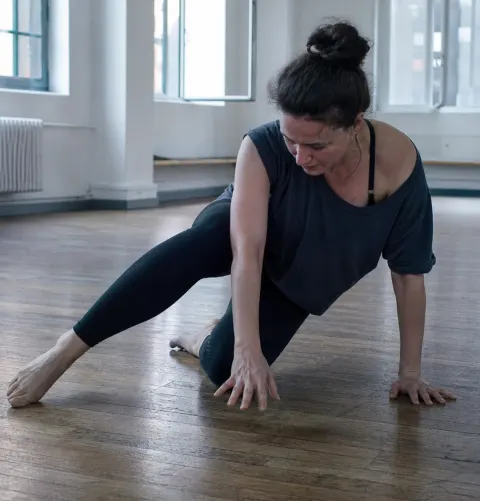 Modern or Contemporary Quiz: What dance type are you?
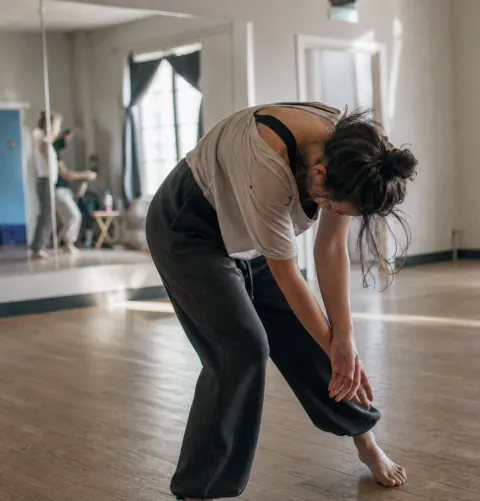 Breathing in Contemporary: More flow in your movements
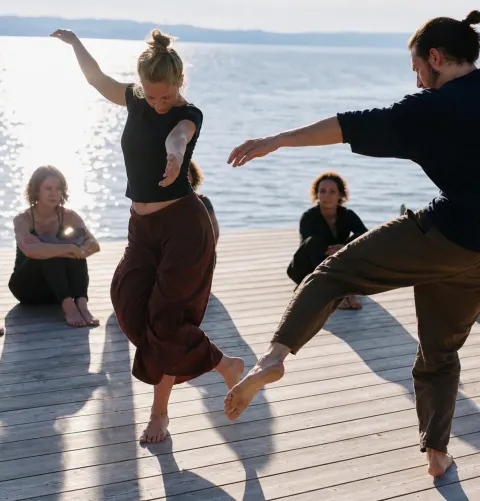 Modern vs. Contemporary Dance: The Differences Explained
 Contemporary Dance: Preparing for your first class
 The 7 most common mistakes when starting Contemporary Dance
 Contemporary Level Test: Which entry point is right for you?

