
Find your rhythm with udansa
On udansa you will find like-minded people who share your passion for Brazilian solo dance, as well as the right courses in your area. Sign up and start your Samba journey.



By Bernhard De LucaUpdated
On udansa you will find like-minded people who share your passion for Brazilian solo dance, as well as the right courses in your area. Sign up and start your Samba journey.
The fiery rhythms of the Brazilian carnival demand everything from your feet. With the right Samba heels, you will master the fast pace effortlessly, without risking your health.
Samba no Pé refers to the traditional Brazilian solo dance, which is primarily known for its fast, rhythmic basic step in the carnival. Unlike the partner dance Samba de Gafieira, it is danced completely without a partner.
Anyone who has ever watched a professional dancer at the Brazilian Carnival knows: learning Samba no Pé requires peak performance from your feet. The extremely fast basic step, where body weight is shifted onto the balls of the feet in a flash, demands specialized shoes. Classic Latin or ballroom dance shoes, as known from competitive sports, fail to meet the extreme demands of the street and the show stage. They often lack the necessary ankle support or the robust sole that is equally suitable for asphalt and wooden stages.
If you want to buy Samba heels, stability is the top priority. Samba solo dance shoes for the carnival style are characterized by a sophisticated strap system that firmly encloses the foot. Since there is no protective guidance in solo Samba, unlike in partner dance, the shoe must support all the balance work. A secure fit prevents you from twisting your ankle in the heat of the fast tempo or sliding back and forth in the shoe, which would cause painful blisters.

Heel height is one of the most important decisions when buying Samba solo dance shoes. For beginners, heels between 5 and 7 centimeters are recommended, while experienced passistas often choose heights of 8 to 10 centimeters. However, it is not just the height that matters, but the shape of the heel. A thin stiletto heel may look elegant, but it significantly increases the risk of injury on uneven ground. Wide flare heels or specially reinforced block heels offer a much larger contact area and thus the necessary security for quick changes of direction.
In addition, the straps play a crucial role in the stability of your Samba carnival shoes. Models with a T-strap that runs over the instep, or elastic cross-straps that are wrapped firmly around the ankle, are ideal. They distribute pressure evenly and relieve the tendons. When buying, make sure that the straps are made of soft but tear-resistant leather or reinforced synthetic material so that they do not cut uncomfortably into the skin when you sweat.
Correct
Wrong
The right shoe for solo Samba is not an accessory, it is your most important piece of sports equipment. It determines whether you can channel the energy of Samba without injury.
Unlike classic indoor shoes with chrome leather soles, which would be ruined immediately on the street, Samba no Pé shoes require a durable outsole. Many dancers opt for firm leather soles or special synthetic blends that offer enough glide for turns, but at the same time do not slip on smooth indoor floors or damp asphalt. The sole must be neither too sticky nor too slippery, so as not to stop the rapid flow of movement.
If you want to dance Samba solo, you should also pay attention to excellent cushioning in the forefoot area. Since the entire weight during Samba no Pé is on the ball of the foot, a padded insole absorbs the hard impacts and protects the joints. A well-worn shoe thus becomes a reliable partner in training and during the show. Don't forget to break in your new heels extensively at home before your first big performance, in order to adapt the material to your individual foot shape.
The elegant classic for professionals
A slim heel visually elongates the leg and ensures an elegant silhouette on the stage. However, it requires extremely strong foot muscles and perfect balance during fast turns.
The secure base for long nights
A wider flare heel offers a larger surface area and significantly more stability on uneven ground. It is perfectly suited for long training sessions and street carnivals.
For beginners, heels between 5 and 7 centimeters are ideal. They offer a good compromise between the typical elongated Samba aesthetic and sufficient stability for untrained ankles.
No, conventional dance shoes usually have a soft chrome leather sole for indoor parquet floors. During street Carnival, this sole would be destroyed immediately and, furthermore, it offers no protection against stones or moisture.
Look for genuine leather that adapts to your foot, as well as a T-strap or crossed straps. Thick padding under the ball of the foot is also essential for pain-free dancing.
Find the right course now and learn Samba no Pé from the pros.
BallroomMeißen · Germany
Tanzkreis | PROFESSIONALTuesday · 20:15 · Oct 27, 2026 - Jan 5, 2027
“Ein Haus für Vieles” - Saal Tanzkurse
BallroomMeißen · Germany
Fortgeschrittenen-Kurs | ADVANCEDTuesday · 18:30 · Nov 10, 2026 - Jan 19, 2027
“Ein Haus für Vieles” - Saal Tanzkurse
BallroomMeißen · Germany
Tanzkreis | PROFESSIONALThursday · 19:20 · Jan 7 - Mar 25, 2027
"Atelier Federleicht" - Saal Tanzkurse
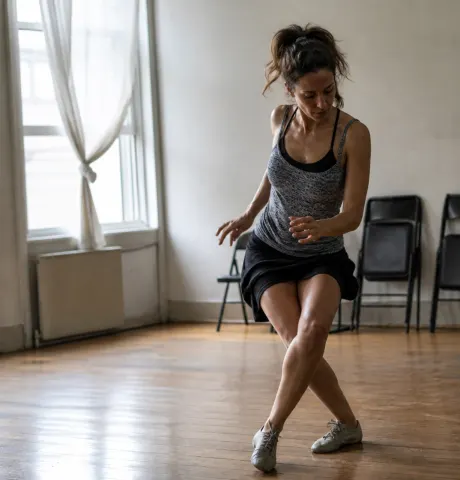 Learn Samba no Pé: Your start in solo danceSamba no Pé is Brazil's most famous solo dance. Learn here how to systematically build the basic step and master the fast tempo.
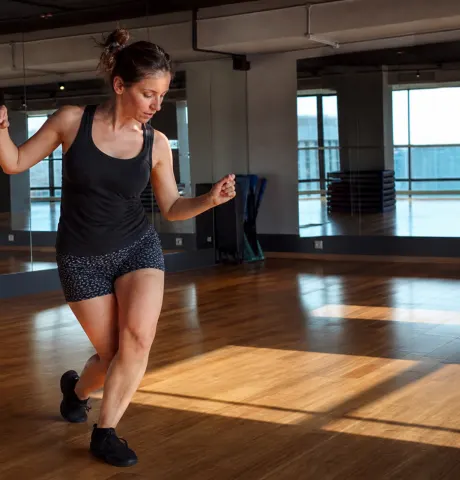 Dancing Samba solo: The guide for Samba no Pé and show danceDancing Samba solo brings the pure joy of life from Brazil directly to you. Learn everything about the technique of Samba no Pé and how to master the carnival dance.Dancing Samba solo: The guide for Samba no Pé and show danceDancing Samba solo brings the pure joy of life from Brazil directly to you. Learn everything about the technique of Samba no Pé and how to master the carnival dance.
 Samba Solo Warm-up: Guide for home trainingPrepare your body optimally for the fast pace of this Brazilian solo dance. This structured warm-up guide protects your joints and activates your muscles for training at home.
 Samba Fitness Workout: Solo dance as cardio trainingSamba Fitness combines the joy of Brazilian dance with a sweat-inducing cardio workout. Learn how to train solo and effectively improve your endurance.
 Dancing Samba at high speed: 5 tips for fast temposDancing Samba at high speed requires the perfect blend of precise technique and mental calm. Learn how to master the rapid pace.
 Samba Carnival Makeup: Guide to the perfect lookWith the right samba carnival makeup, you will shine on stage without anything smudging. Learn here how to make your solo look completely sweat-proof and stage-ready.
 Samba Rainha de Bateria: The role of the solo queenThe Samba Rainha de Bateria is the queen of the drummers and the energetic center of every parade. Our guide explores the fascinating demands of this challenging solo role.Learn Samba no Pé: Your start in solo danceSamba no Pé is Brazil's most famous solo dance. Learn here how to systematically build the basic step and master the fast tempo.