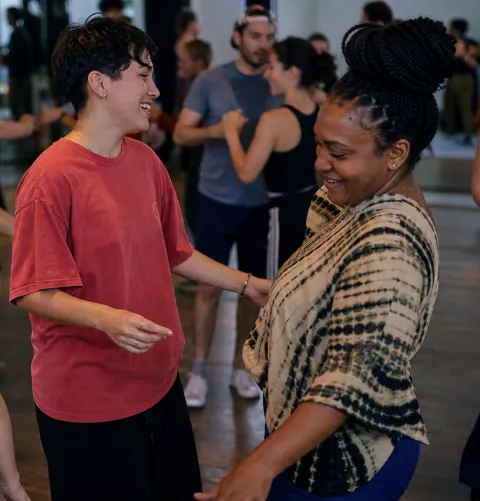
Get started together on the dance floor
On udansa you will find like-minded people who share your passion for this team sport, as well as the right dance schools and clubs in your area.

By Mary De LucaUpdated
On udansa you will find like-minded people who share your passion for this team sport, as well as the right dance schools and clubs in your area.
Breathing together, moving in sync, and shining as one unit on the floor: formation dancing combines the athletic elegance of partner dance with the unbeatable energy of a true team sport.
Formation dancing refers to the synchronous dancing of several couples, usually six or eight, to a fixed choreography in the ballroom or Latin style. The goal is to appear as a visual unit and to create complex geometric patterns on the dance floor.
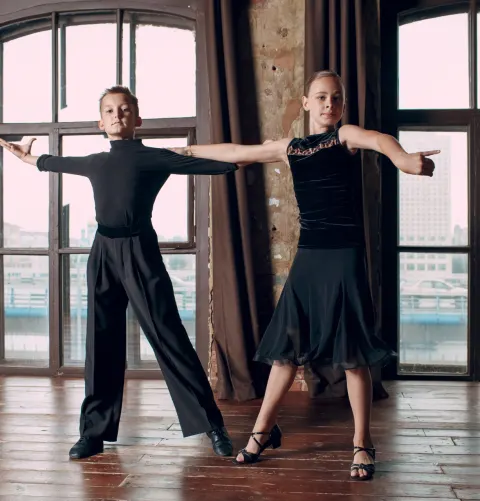
When you think of partner dance, you usually have the classic image in mind: two people moving across the dance floor together, focused on themselves and their partner. Formation dancing for teenagers breaks this familiar pattern in a spectacular way. Here, it is not two, but usually eight couples on the floor at the same time. They do not move individually, but as part of a precisely coordinated community.
The special thing about a dance formation for students is the interplay of top athletic performance and absolute team spirit. Every movement, every step, and every bit of eye contact must be accurate to a fraction of a second. While individual dance focuses on the personal touch and the couple's individual interpretation, the harmonious overall picture is what counts in a formation. A single couple must not stand out, but must merge with the others to create complex images and patterns on the dance floor.
The path into a team usually leads teenagers through two different channels: the classic dance school or the specialized dance sports club. A formation in a dance school for teenagers is often the first, non-binding point of contact. Many teams emerge directly from advanced youth courses or a youth dance club at the dance school. Here, the focus is on the fun of the community and learning a show together, which is then presented at balls or city festivals.
Those who want to dive deeper and compete in sports will find the right structure in a club. In particular, the Latin formation offers teenagers a dynamic entry into competitive sports. In the club, training is aimed specifically at tournaments. The training is more intensive, the choreographies are more demanding, and the focus is on technical precision. Both paths have their appeal: the dance school offers the perfect, relaxed start, while the club awakens sporting ambition and can pave the way to the national league.
Benefits of being in a formation
Disadvantages for loners
Discover suitable courses and clubs for young people on udansa and become part of a strong community.
Student DanceBurgstädt · Germany
Aufbaukurs Burgstädt Montag Schuljahr 2026/27Monday · 13:30 · Nov 9, 2026 - Jan 25, 2027
Burgstädt
BallroomMeissen · Germany
Fortgeschrittenen-Kurs | ADVANCEDTuesday · 18:30 · Nov 10, 2026 - Jan 19, 2027
“Ein Haus für Vieles” - Saal Tanzkurse
Student DancePenig · Germany
Aufbaukurs Penig Schuljahr 2026/27Monday · 14:30 · Nov 9, 2026 - Jan 25, 2027
Penig
In a formation, you always win and lose as a team. This experience shapes young people for life and creates friendships that go far beyond the dance floor.
Unlike individual dance tournaments, where each couple dances for the judges' favor on their own, formation tournaments are a true team experience. A Latin or Standard formation presents a six-minute show, consisting of the entrance, the actual choreography of exactly four and a half minutes, and the exit. What is judged is not only the dancing quality of the individual couples, but above all the synchronicity, the precision of the transitions, and the variety of the formations shown, such as diamonds, lines, or circles.
For young people, this format offers a decisive advantage: the pressure is distributed across many shoulders. Anyone who is nervous or afraid of making mistakes feels supported and protected within the team. A slip-up is absorbed by the group, and celebrating a success together brings the group incredibly close. In addition, traveling to tournaments together and supporting each other in the dressing room make this hobby particularly appealing at udansa.
Community and show performances
Here, the focus is on shared experiences, the joy of movement, and casual shows. Perfect for everyone who wants to put together a choreography with friends without any pressure to perform.
Competitive sports and tournaments
Here, training for league operations is disciplined. The focus is on technique, athleticism, and absolute synchronicity. Ideal for young people who have sporting ambition and want to compete in tournaments.
To get started in a youth formation, solid basic knowledge of standard or Latin dances, such as what you learn in a bronze course, is ideal. More important than perfect technique, however, are a sense of rhythm, a willingness to learn, and the ability to adapt to a group.
As a rule, a standard or Latin formation consists of exactly eight couples, meaning 16 dancers. Often, however, substitute couples train with the team to be able to step in flexibly in case of absences or injuries.
In a Latin formation, the five Latin American dances Samba, Cha-Cha-Cha, Rumba, Paso Doble, and Jive are presented. For the choreography, these are edited into a thematic music mix and connected by transitions.
 Dancing as a hobby for teens: Your path to the club
 Setting up dance training for teens: Your stress-free plan
 Youth dance scene trends: New formats in club life
 First dance competition for teenagers: Your path to the floor
 Common mistakes for teens starting dance sport: How to join a club successfully
 Find a dance partner for your youth club on udansa
 Dance Studio vs. Dance Club: Where should teens train?