Dance the afternoon together
On udansa connect, you'll find people in London who enjoy ballroom dancing in the afternoon and would like to join you for a tea dance.

By Mary De LucaUpdated
On udansa connect, you'll find people in London who enjoy ballroom dancing in the afternoon and would like to join you for a tea dance.
A table set for tea can be part of a dance afternoon, but it can also be the whole event. So if you want to spend your free afternoons dancing, the program matters more than the atmospheric photo.
Social dance refers to dances that people perform together at social gatherings, often as partner dances and without competitive scoring. These may include Waltz, Foxtrot or Quickstep.
When you search for a Tea Dance in London, you’ll come across English terms with different meanings. Afternoon Tea initially refers to a food and drink offering. Tea, pastries and music do not necessarily make an afternoon of dancing. Tea Dance, by contrast, generally describes a social dance format, but leaves open which dances are offered and how much time is set aside for open dancing.
A phrase such as ballroom dancing means social dancing, not simply a room called a Ballroom. If Waltz, Foxtrot or Quickstep are on the programme, the musical and dance offering becomes more specific. Live music, on the other hand, only tells you that music is played live. It could be for listening, dining or dancing. A dance performance by others is also not an invitation to dance yourself.
What matters is whether guests are explicitly expected to dance. An open dance floor and named dance sessions make this role clear. A photo of couples alone does not prove it. The overview of dance formats in London places the tea dance alongside other options. For your choice, this distinction is enough: social dancing, a performance or dining with music.
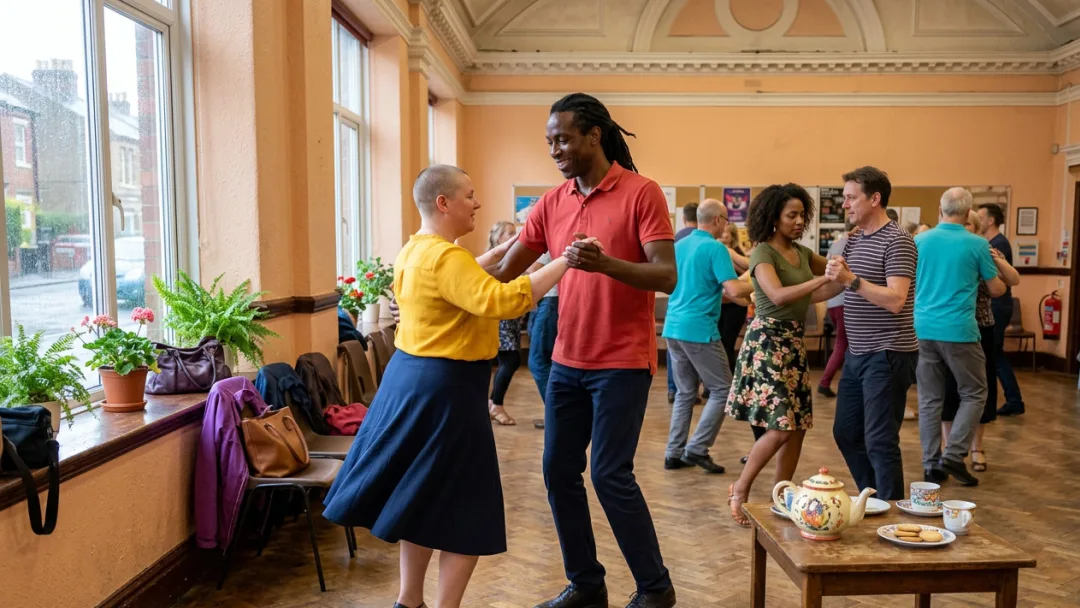
At a tea dance, music and refreshments can come together in different ways. A programme can combine longer dance sets with a shared tea break. It can also offer open dancing, while you decide for yourself when to sit down. These differences affect the flow more than whether the music is played by a band or recorded.
A shared break creates a stretch of time when conversations don’t compete with the next dance. With continuous dance music, on the other hand, you set your own limits: a slower song can also be tiring if you dance over a large area or have little experience with posture. The time of day doesn’t reliably indicate the physical intensity. A Quickstep is still energetic, even when it’s played in the afternoon.
Interval means a break, not necessarily that refreshments are included. An advertised tea service describes what is served, but not how long the dance sets last. Together, these details give you a picture of the afternoon: does the group sit down for tea together, or do people move between the table and dance floor individually? Both can work well. If you prefer conversations between clearly separate dance sets, you’ll experience a different rhythm than someone who chooses individual songs as they feel like it.
Correct
Myths
You can tell a dance afternoon by how much room there is for joining in, not by how beautifully the tea is served.
A single ticket means you get access as an individual. It does not promise an assigned dance partner or regular partner rotation. Conversely, an offer for couples may provide for attending together without requiring you to dance exclusively with each other all afternoon. These terms initially describe registration, not every social interaction on the dance floor.
Social dancing is not a synonym for organized matching either. It means dancing socially, and invitations may arise among the guests. An expressly announced partner rotation or hosted dance rounds are more specific details. If you would like to arrange a dance partner in advance, you can find people on udansa who are looking for a suitable dance partner in London. However, such an arrangement does not turn the event format into a class.
When it comes to experience, the distinction is between open dancing opportunities and guided segments. Freestyle social dancing assumes that you can connect at least a few simple steps to the music with your dance partner. An introduction, on the other hand, offers a shared starting point. Details such as members only, couples registration, or explicitly stated age limits describe additional entry requirements. If these details are missing, the friendly term Tea Dance does not tell you exactly how you can participate. This keeps your choice focused on what is actually offered rather than on an idea of having tea.
Music structures encounters and movement
You come mainly to dance and sit down between songs or dance blocks. The refreshments complement the afternoon, while your attention is on the music, your dance partner and the open floor.
Hospitality and sitting together take center stage
You're here mainly for tea, food, and conversation around the table. Music can accompany this afternoon without you having to know any steps or even get up.
The term tea dance describes a format and does not, by itself, set an age limit. A more relaxed afternoon with breaks to sit down can appeal to people from different generations. If an event explicitly names a particular age group, that is an additional participation requirement, not a general feature of every tea dance.
If no dress code is specified, neat, comfortable everyday clothes and secure shoes are a good choice. Your skirt or trousers should not get in the way of taking a wide step. On a dance floor, shoes with soles you can control matter more than a formal look, and street shoes with very grippy soles can make turns harder.
At a free-form social dance, you can sit out individual songs. You do not have to justify taking a break, and a polite decline is enough if someone asks you to dance. A guided group dance is structured differently: set starts and finishes can shape how people take part.
A tea dance is first and foremost a social event, not a dance class. An advertised introduction may teach basic steps, but it does not automatically replace systematic instruction. Without an instructional component, “suitable for beginners” means the setting is accessible, not that someone will explain every dance to you.