Your evening needs Salsa
On udansa, you’ll find Salsa events in London. The listings help you choose a social that suits the kind of evening you’re looking for.

By Bernhard De LucaUpdated
On udansa, you’ll find Salsa events in London. The listings help you choose a social that suits the kind of evening you’re looking for.
You feel like dancing Salsa several times in a row, then suddenly find yourself on the sidelines as a different rhythm plays. Breaks like this can be part of the evening, but they should match your expectations.
A social is part of an event, or an event in its own right, for free dancing without a continuously guided sequence of steps. The term describes the format, not necessarily the dance styles played.
At a Salsa party in London, the name alone tells you little about how many suitable songs you’ll get in a row. A Salsa focus is a statement about the music, while Latin is initially just a broad umbrella term. A mixed program can include Salsa, Bachata, Merengue or Reggaeton. These styles of music call for different movements and are not simply interchangeable accompaniment for your basic Salsa step.
An explicitly announced Salsa Social combines the open dance format with a musical focus. Even then, there may be occasional changes of style. Phrases like “Salsa and Bachata” name both elements, but without further details, they don’t reveal the proportions. The order of the words is not a reliable indication of how much of each you can expect.
There’s variety within Salsa too: one song may leave more room for relaxed steps, while another, with denser percussion or distinctive brass breaks, invites you to accent the music. So a difference in energy doesn’t automatically mean a change in dance style. It’s important to distinguish between musical variety within Salsa and a mix of different dances when making your choice. The overview of dance formats in London explains how these nights differ from other options.
An event title can combine a workshop, party and show into a single offering. It sounds like a long evening of dancing, even though during a guided segment you follow a shared activity, and during a performance you watch. Both can be welcome, but they fulfill a different desire than choosing your own dances to a variety of songs.
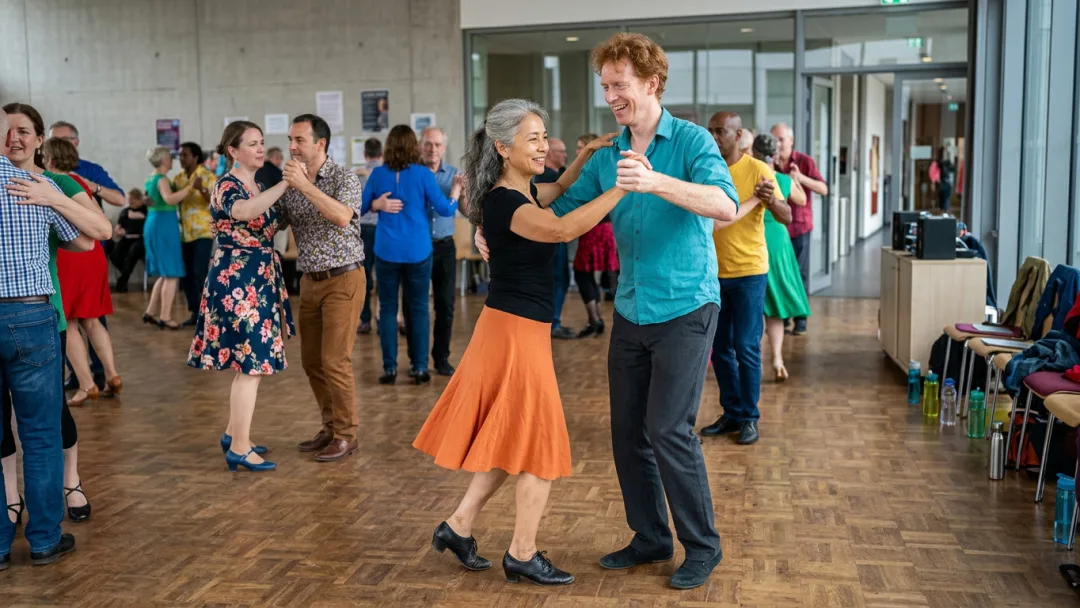
The social dancing begins where you can dance freely. You then decide for yourself when to take breaks, whether to dance simple or more challenging figures, and whether to skip a song. An announced show interrupts this time even if it takes place right in the middle of the dance floor. A short group animation, on the other hand, can invite everyone to join in without being free partner dancing.
For lots of Salsa, the musical focus and the free dance time need to go together. A Salsa-only workshop with a short social offers little social dancing; a long social with a broad Latin mix offers lots of free time, but not necessarily lots of Salsa. If details about the balance are missing, that remains unclear instead of automatically counting in favor of the most generous interpretation. If the announcement is unclear, one specific question to the organizer is enough: Which part is free dancing, and what music will be playing? That gives you the crucial information without confusing lessons with a party.
Correct
Myths
A long evening can include very little time for open dancing when classes, shows, and music changes make up a large part of the program.
A mixed Latin night doesn’t have to rule out the Salsa you’re looking for. What matters is whether all the music changes on the same floor or different dance floors have their own focus. On a shared floor, the changes in style determine your Salsa breaks. But if a Salsa floor is explicitly announced, you can stay there while other music plays elsewhere.
However, having multiple rooms doesn’t necessarily mean the music is separated. They may also be used to separate classes, socializing, and the party. Only assigning a floor to Salsa addresses your wish for a continuous dance offering. The time period of that assignment matters just as much: a room may host a workshop at first and only later be used for open dancing.
This gives you three independent factors: music, open dancing time, and the venue layout. If they match what you’re looking for, even a broadly titled night can be a good choice. Without a designated floor, “Latin” promises variety, not a certain amount of Salsa. The overview of dancing in London places this event visit alongside other ways to get started. For a specific night, the current event listings on udansa will show you the announced formats, without inferring a particular music mix from the city name.
For an Uninterrupted Salsa Dance Session
A salsa-focused social gives you the chance to dance to several songs with the same basic rhythm. You can experience the musical differences within Salsa without constantly changing dance styles. You decide when to take breaks, unless the program includes scheduled breaks.
For variety during a party
A mixed Latin night brings different music and dance styles together. If you dance several styles or like to listen in between, the changes can be a good fit. If you have your heart set on Salsa, it depends on how the music or dance floors are divided.
Yes, confident basic steps can be enough for simple dances at a social. However, a social is not a continuous lesson. You don't need a long sequence of figures, but you should be able to keep the rhythm, take small steps, and stop a movement if there isn't enough space on the floor.
No, Cuban Salsa describes a dance or musical style, but it doesn't guarantee what proportion of the evening will feature it. The music announcement may also mention Timba, which is closely associated with Cuban dance music. Whether other dance styles are included is a separate question of the event format.
A live band isn't automatically better than a DJ for your Salsa preferences. With a band, sets and breaks also shape the evening; a DJ can play music continuously without set breaks. Both can provide suitable Salsa music, and both can be part of a larger mixed program.
Well-fitting shoes that allow controlled turns on the floor are suitable. Soles with a lot of grip can put strain on your knees when turning; very slippery soles make it difficult to stop. You should be able to stand securely and control your steps, even when other couples are dancing nearby.