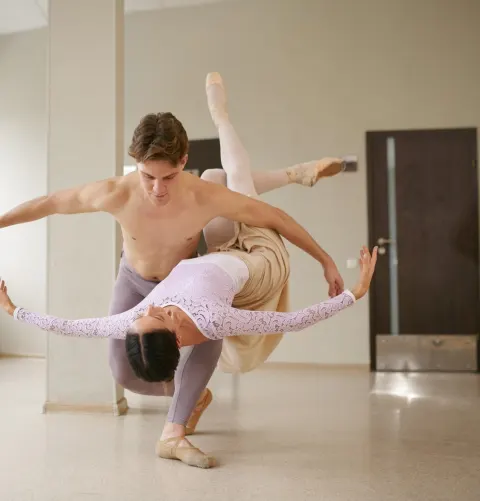
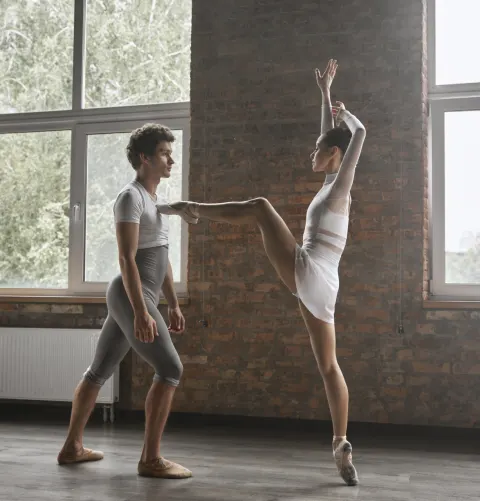
Take a closer look together
On udansa connect, you’ll find people in London to attend dance performances with and share your thoughts on what you’ve seen.

By Bernhard De LucaUpdated
On udansa connect, you’ll find people in London to attend dance performances with and share your thoughts on what you’ve seen.
A spectacular move immediately catches your eye. It gets more interesting when you notice why it appears at exactly this point and what changes between the people on stage.
Dramaturgy refers to the shaping of a performance’s progression, giving coherence to movements, scenes and other stage elements. For example, it determines when tension builds, a motif recurs or a situation takes a turn.
The story of Breakin' Convention began in 2004 at Sadler's Wells in London. Founder Jonzi D brought together the experiences of an MC, dancer and director. This combination helps explain the approach: rhythm, physical expression and theatrical design do not have to be separate fields. They can work together to carry a performance.
The festival presented Hip-Hop as a theatrical art form. This gave the movement a framework in which not only execution and skill matter, but also arrangement and meaning. A step can open up an encounter; the same movement can later express distance. Light, sound and the position of the bodies influence how you perceive it.
Moving onto a theater stage does not create a new cultural origin. Hip-Hop brings its forms of expression and experiences into this space. Theater turns them into a shaped encounter with an audience. This is a helpful distinction when you place Breakin' Convention within the history of London's stages and dance: what matters here is not just the venue, but the artistic approach to movement.
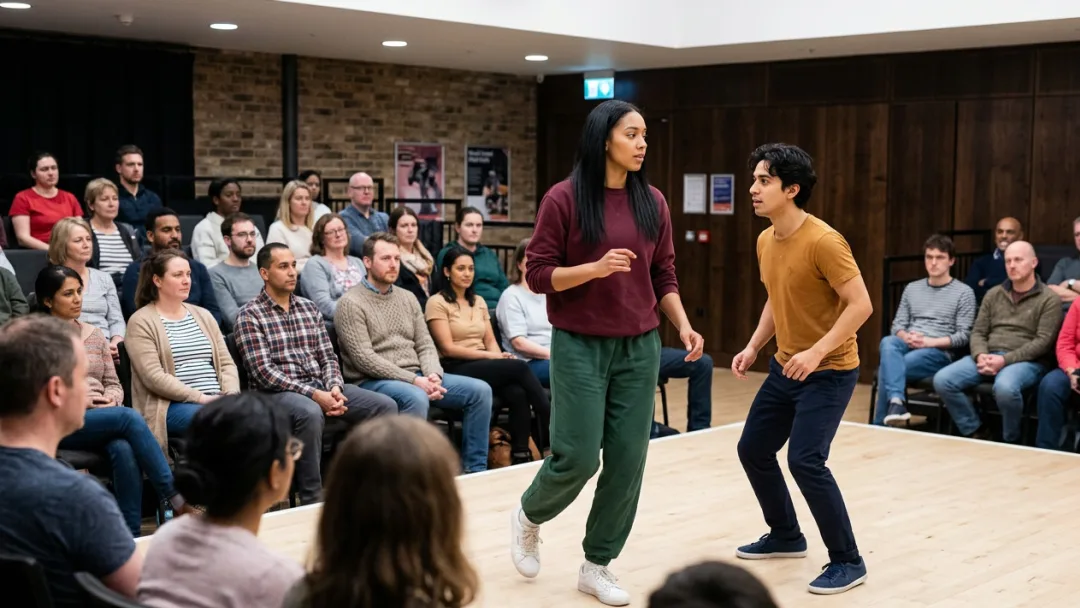
Hip-Hop on stage is easy to reduce to technical highlights. Fast footwork, abrupt stops, or controlled floorwork are immediately visible. But their difficulty alone does not tell you what role they play within a piece. Dramaturgy emerges from the relationships: Who moves, who responds, and what is different afterward?
Imagine a short scene: A dancer reaches out her hand, and a dancer steps back. On the second try, he stays put; on the third, he responds with the same gesture. Without a spoken word, their relationship has changed. This example does not describe a specific festival production, but shows how dance material can become scenic action.
Musical accents also serve several purposes. A stop can mark a beat while also expressing hesitation or refusal. A repetition can seem funny at first and later feel oppressive. You understand the scene better when you consider effect and technique together. If you usually focus mainly on steps, the guide to common mistakes when observing dance movements offers a complementary perspective on looking closely.
So, yes
Not like this
A pause can tell just as much on stage as a move, if it changes a relationship.
In addition to performances, Breakin' Convention's documented work included education, support for emerging talent, youth projects and international tours. This meant its approach went beyond presenting finished stage works. The origins and development of hip-hop culture also became a focus of its work. This historical context describes the concept, not the programme of a current festival edition.
In this context, education means opening up access to art. It can explain how movement material is created, what experiences it contains and why a particular form is chosen. Supporting emerging talent also focuses on those who develop their own artistic choices. Youth projects can give young people access to these forms of expression, rather than addressing them exclusively as an audience.
As a viewer, this does not mean you have to learn all the style terms in advance. You can first take it in, then make sense of it in more detail later. A scene can move you before you can explain how it works. Context then makes your perception more precise: you might recognize a deliberate repetition, a cultural reference or the difference between personal expression and a defined stage persona. Performance and education thus serve different purposes that complement each other.
The stage condenses movement into a statement
As a spectator, you experience a carefully composed sequence of images, sounds and actions. You can experience a scene directly, even if you can’t yet name its dance elements.
Context makes the choices easier to understand
Audience engagement work offers a way to explore a performance’s origins, intentions, and creation. It can show you why the same movement can feel humorous, defiant, or vulnerable depending on the context.
You don't need any dance experience to perceive the relationships and moods in a performance. Directions of gaze, distances, rhythm, and repetition give you clues. Knowledge of Hip-Hop adds to this understanding, for example when a movement refers to specific cultural experiences or forms of expression.
Hip-Hop theatre doesn't have to use spoken text. A situation can be understood through movement, music, silence, and spatial relationships alone. Language is one possible stage tool, but it isn't required for dance to take on a dramatic function.
Breakin' Convention was founded as a festival, not as a single dance group. Its documented development also included international tours, support for emerging artists, and youth projects. The name therefore refers to a broader artistic context than a fixed cast or a single stage work.
Hip-Hop theatre doesn't need a continuous plot with a clear beginning and end. A sequence of situations, a recurring motif, or a conflict between bodies can also hold it together. So you can recognize a development without having to translate every scene into a literal story.