Going to shows with company
On udansa, you can find people in London to attend dance events with. Describe that you’d like to watch and what trip you’re looking for a companion for.

By Bernhard De LucaUpdated
On udansa, you can find people in London to attend dance events with. Describe that you’d like to watch and what trip you’re looking for a companion for.
A night at the theater doesn't begin when you take your seat. If your travel plans, luggage, and return trip aren't sorted, a free afternoon can quickly turn into a race to get through the doors, even if you already know London.
For planning your routes in London, you need specific buildings. A company name, on the other hand, identifies the performing group, not necessarily the place you will visit. Even a shared organizational name does not guarantee a shared entrance. That’s why your day plan needs one venue per visit, not just a theatre association.
As a first way to sort locations, you can look at the Royal Opera House in Covent Garden and the Peacock Theatre in the West End side by side on your map. Another group to start with is Sadler's Wells Theatre in Islington and The Place in Camden near Euston. These are planning groups, not a guarantee of short walks. Sadler's Wells East in Stratford gets its own route section, the venue opened in January 2025.
For now, keep London Coliseum and Royal Albert Hall as separate map points until you have placed them in your specific itinerary. The fact that ballet has been documented there does not replace current visit planning. For background on the venues, see the overview of dance theatres in London. The history of The Place explains the location, but does not determine whether two visits fit together time-wise. This distinction also helps when planning a ballet trip to London: building history and today’s travel itinerary are different kinds of information.
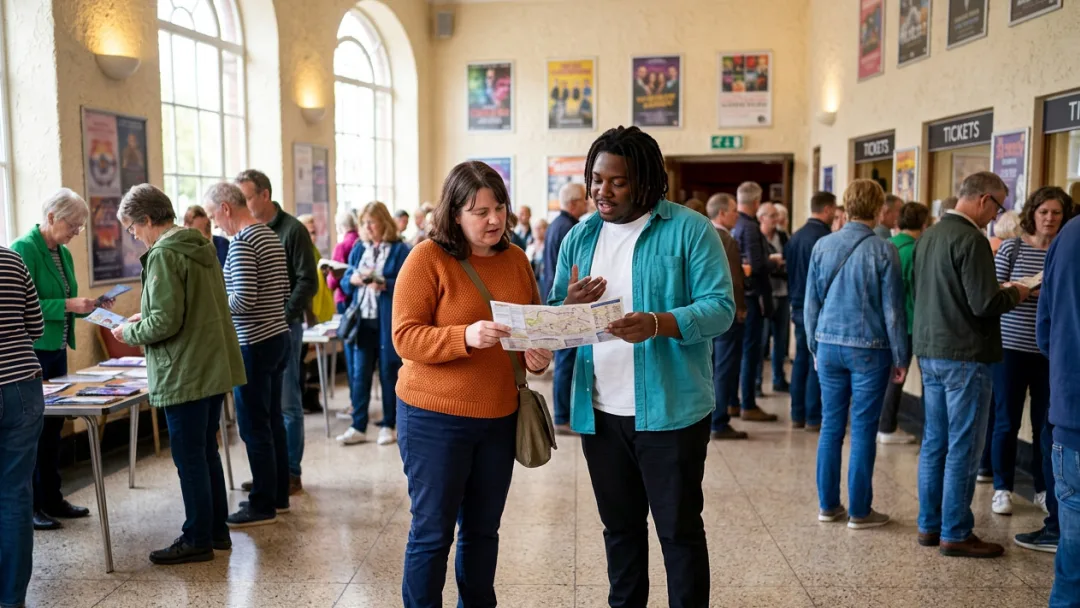
Write down your arrival, departure, and where you’re staying overnight. Mark which time is truly free: dropping off your luggage and getting to your accommodation are part of the journey, not available sightseeing time. For a day trip, your journey home takes the place of an overnight stay.
Mark the named venues as individual points and group them according to the described city areas. Treat the groups as a draft. Venues without a neighborhood assignment documented here should remain individual, rather than being assigned to a supposedly suitable area based on their name.
Choose a planned performance as a fixed point and let other activities take shape around it. Don’t automatically treat your arrival and departure days as full days. Your plan works if you have no other commitments around the performance.
Map both journeys, including walking sections, transfers, and the final leg to the entrance. A ride between two stops is not yet a door-to-door connection. Also note an alternative route, so a disruption doesn’t derail your entire plan.
Use the published visitor information for the specific venue to check the entrance, admission, duration, accessibility, luggage rules, and late entry. At the same time, check your planned transport connections. Include confirmed details in your plan and mark any missing information as unknown instead of guessing.
Set aside free time before doors open and after the expected end. Don't plan meals during an intermission: the duration and schedule may make that impractical. For two visits, allow time for both complete journeys and a proper recovery break in between.
Save your ticket, entrance, directions, and return trip details so you can find them without internet access. Write the essential information down on a piece of paper as well. The plan is complete when you know how to get from the last event to your accommodation or the way home.
Yes, like this
Not like this
Basis
Documents
Arrival
Yes, if the performance lengths, full journey between venues, and rest break all fit into your day. Don’t just count the time from the end of the first performance to the start of the second. Leaving the auditorium, possible cloakroom stops, and admission to the next venue also take time. Planning for just one performance is the more reliable option.
No, accommodation that works well with your journey there and back can be just as suitable. Staying near one theater doesn’t automatically make it easy to get to other venues. What matters is whether you can get back after the performance without a tight connection and have somewhere practical to store your luggage.
Your time buffer should account for uncertainty about your route and the steps you need to take before reaching your seat. There’s no fixed number of minutes that works for every trip. Allow separate time for finding your way, possible queues, and personal breaks, in addition to transport. An unfamiliar route with transfers needs more leeway than a familiar walk.
If you arrive late, follow the venue’s admission rules and staff instructions. A ticket doesn’t guarantee that you can enter the auditorium immediately during a scene. Don’t go in on your own. Have your ticket ready and wait for the designated entrance.
Yes, you don’t need a tour group or a dance partner to organize a trip to attend performances on your own. Keep track of your routes and documents so you can manage your stay independently. If you’d like occasional company, connect with someone whose dates of stay are clearly stated. Contacts for a short stay are another option.