Dance history brings people together
On udansa, you can find dance partners in London who you can also talk to about the origins of dances.

By Mary De LucaUpdated
On udansa, you can find dance partners in London who you can also talk to about the origins of dances.
A familiar walk can suddenly look like a fully formed dance idea on stage. With the Lambeth Walk in particular, it is worth distinguishing between the everyday life it portrays and what theatre and dance classes made of it.
A dance craze is a dance that becomes especially popular for a limited time and is taken up by many people.
The Lambeth Walk originated in London, but its best-known dance story begins with a musical number. The Lambeth Walk is from Me and My Girl, a 1937 musical. The name refers to a street in Lambeth, known for its street market and working-class culture. The song thus brought a concrete everyday reference to the stage. However, the street name alone does not prove that a fully formed dance already existed there under that name.
A strutting walking dance grew out of the stage choreography. Performer Lupino Lane described the movement as an exaggerated imitation of the way Cockneys walk. The word exaggerated is important: theatre makes an everyday movement stand out so you can recognize a character and their attitude in it. Through deliberate shaping, walking becomes a form of expressive movement.
This origin explains why the Lambeth Walk should not be understood simply as a collection of neutral steps. In its stage form, the walk conveys something about the people being portrayed. If you are interested in theatres and dance history in London, this example shows how closely a dance can be tied to its original theatrical purpose.
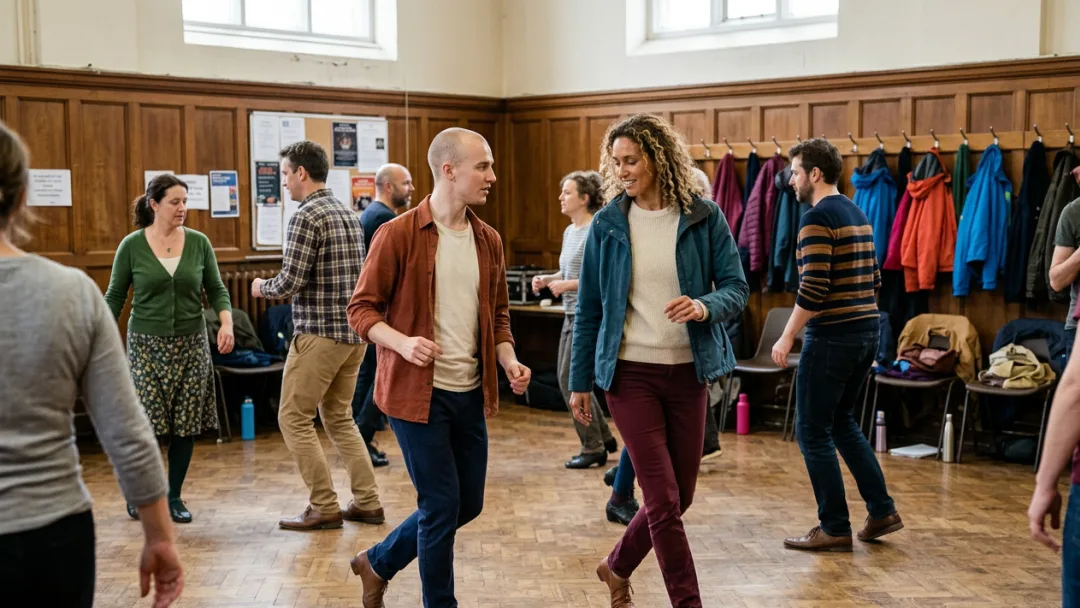
An effective stage movement is not yet a finished social dance version. On stage, what matters is what an audience sees. On a dance floor, it also matters whether people can take up and repeat a movement together. Dance teacher Adele England turned the Lambeth Walk into a social dance. Her role should therefore be distinguished from that of performer Lupino Lane.
The adaptation for the dance floor was a contribution to its spread in its own right. It transformed a performative idea into a form for participants. However, you shouldn’t infer a specific sequence of steps from this: the documented history explains the change in format, not every movement detail of every historical version.
This distinction is easy to overlook with dances from stage productions. A familiar title can make different performances seem like the same work. But a scene may be designed for a performer, while a dance version is meant to let people join in together. When watching and imitating dance movements, it also matters what kind of performance you’re looking at. A striking pose alone doesn’t explain its function in a group dance.
England’s adaptation makes it clear why the history of the Lambeth Walk includes both theater work and dance instruction. Mentioning only one of these sides shortens the journey from performance to participation.
Correct
Myth
If you'd like to dance yourself after learning about dance history, you can find classes in London on udansa.
The story of Lambeth Walk involves not only the street name, but also its adaptation for the stage and dance floor.
From the Locarno Dance Hall in Streatham, Adele England's dance adaptation spread throughout the United Kingdom in the late 1930s. The historic dance hall is therefore part of the story as the starting point for its spread. This account does not say anything about individual evenings, visitor numbers or the exact events there. To trace the dance's journey, the documented connection is enough: an idea created for the stage and adapted for social dancing was embraced beyond its place of origin.
In 1938, the Lambeth Walk reached the United States and was also danced in Paris and Prague. The name retained its London connection, even though the dancers no longer came from the community referenced by the original number. This highlights an important difference between origin and spread: a dance can be shaped by a particular place and still be adopted elsewhere.
This gives you a more precise picture than the shorthand “street gang becomes a dance.” Between everyday life and international fashion were a song, Lupino Lane's stage choreography and Adele England's social dance adaptation. None of these stages replaces the others. The Lambeth Walk shows how cultural connections can be preserved as a dance spreads, while the purpose of a movement changes: from character portrayal on stage to dancing together.
Watching and Recognizing
On stage, an exaggerated walk can represent social belonging and self-confidence. The movement is made so clear that you understand its effect even without any dance experience of your own. Lupino Lane's version belongs in this context.
Join In and Repeat
A social dance adaptation needs to be picked up by several people. Recognizable movements need a form that makes it possible to dance together. Adele England's adaptation represents this shift from a depicted walk to taking part on the dance floor.
Lambeth Walk refers both to the song from Me and My Girl and to the novelty dance that grew out of it. When reading historical accounts, this distinction matters: a reference to the song does not automatically describe the stage choreography or the later ballroom version.
Here, Cockney refers to a London cultural identity, whose characteristic walk Lupino Lane exaggerated on stage. The term explains the reference behind his portrayal, but it does not describe a uniform movement shared by all Londoners. A theatrical character condenses recognizable traits and is therefore not an unaltered reflection of everyday life.
No, the Lambeth Walk and Lambada are different dances, and their similar-sounding names do not indicate a shared origin. The Lambeth Walk belongs to the history of the London musical Me and My Girl and the novelty dance that grew out of it. Lambada is not part of this history.
A regular dance partner is not a defining feature of the Lambeth Walk. Its historical context is defined by the strutting walking dance and its transition into a ballroom version. So, from the name alone, you cannot infer a particular partner hold or a fixed formation for every performance.