Room for little dance ideas
On udansa, you can find children's dance classes in Rome and sort them by your child's age and movement interests.

By Mary De LucaUpdated
On udansa, you can find children's dance classes in Rome and sort them by your child's age and movement interests.
When your child pretends to be a frog while dancing, they may be learning how to land properly. From the outside, a class can sometimes look like a lot of running around, even though there is a precise movement exercise behind it.
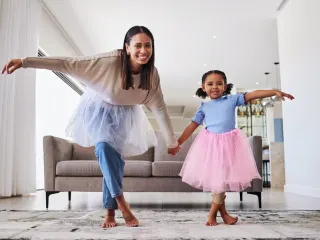
Creative dance for children is a class where children develop dance fundamentals through movement activities, music, and their own ideas. These include spatial awareness, rhythm, balance, and different movement qualities.
If you’re looking for children’s dance classes in Rome, the word “playful” alone doesn’t tell you much about the lessons. What matters is which movements an activity encourages. For example, in freeze dance, a child practices responding to a musical cue and stopping their movement in a controlled way. By switching between big and small steps, they discover how much space their body needs.
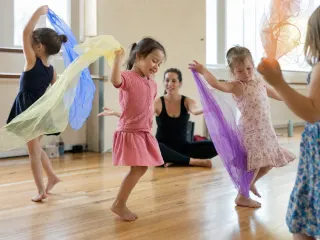
A good activity has a clear framework while still allowing room for individual solutions. “Move like a leaf in the wind” allows for different arm movements and paths. “Stay within your own space” also makes it an exercise in spatial awareness. Free exploration needs clear boundaries so children can dance safely together.
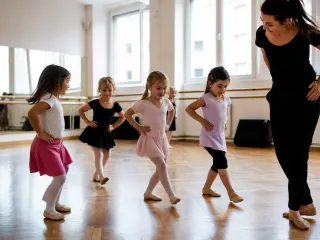
For younger children, images and short transitions help hold their attention. At primary school age, step sequences and deliberate repetition can become more prominent. These transitions don’t happen at the same pace for every child. So a child with a vivid imagination doesn’t necessarily need to move to a more structured class too soon. The overview of dance classes in Rome explains the different lesson formats; for the children’s group, what matters is what your child can actually do with an activity.
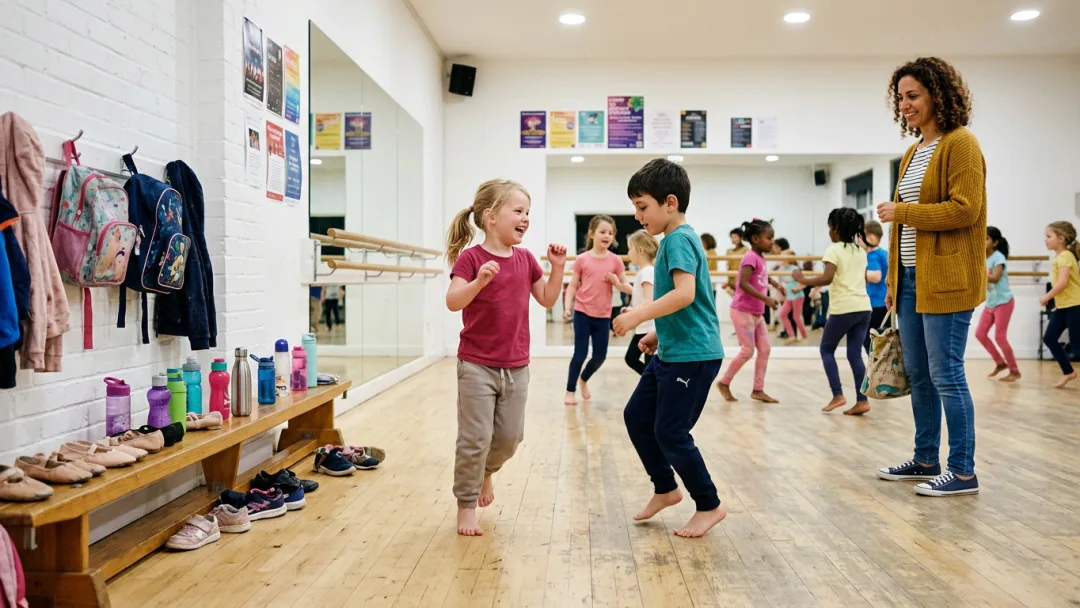
Technique lessons don’t begin at a ballet barre. Even a small jump involves technical tasks: pushing off the floor, softening the landing, and then finding your balance. A side step requires a shift of weight. A turn needs enough space and a controlled finish. These fundamentals can be part of a story or practiced explicitly.
Technique becomes confusing when it is mistaken for outward perfection. A straight line and arms raised at the same time don’t prove that every child has understood the movement. Conversely, a group that isn’t moving in unison doesn’t automatically mean the teaching is poor. Children may be trying out different solutions or need different levels of support.
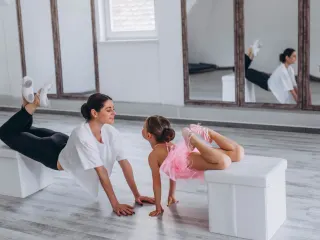
Helpful corrections name something achievable: “Place your foot closer to the other one” is clearer than “Be more precise.” The teacher demonstrates slowly and directs attention to one detail. This also helps avoid common difficulties when observing and imitating dance movements, for example when the feet and arms are given new tasks at the same time. Forced stretching, painful positions, and externally pushed turnout do not belong in children’s first technique exercises.
Like this
Not like this
In the course filter on udansa, you'll find offerings in Rome with the age groups, dates, and fees listed for each.
A helpful correction gives the child a movement idea they can try out on their own next time.
When choosing a dance class for your child, it matters how the teacher handles differences. A group includes children who pick up movements quickly and others who prefer to watch first. Good teaching offers a simple basic task and an extension, without turning them into a ranking. When balancing, one child might lift their free foot just slightly, while another holds it up for longer.
Feedback also shapes learning. “You found your balance after the jump” describes progress. Judgments about body shape, weight, or supposed talent do not help with the next attempt. Children also need a reliable boundary: pain, exhaustion, and a no to physical touch are taken seriously.
For families in Rome, the stage can spark an interest in dance. Teatro Costanzi opened in 1880 and later hosted performances by the Ballets Russes. However, this history does not tell you whether a children's class is the right fit. Dance performances in Rome and dance classes serve different purposes. If your child understands a movement after class, was able to contribute an idea of their own, and could make corrections without being put on the spot, those are more meaningful signs than a performance to show off.
Images give movement a purpose
A child sneaks like a cat and stomps like a giant. Along the way, they experience quiet and powerful steps without having to learn technical terms first. The teacher connects the story to a clear task for the feet, tempo or pathway.
One detail gets all the attention
A child repeats a side step and tries to place their foot down with more control. They can explore how the movement changes. The teacher limits the task to one clear detail, so repetition leads to greater awareness.
Dance lessons can begin before school, as long as the activities are suited to your child’s stage of development. Your child does not need to know any steps before joining a group class. What matters more is that they can follow a shared activity for a while and find their way around the room with support.
Comfortable sportswear without long ties or distracting jewelry is a good choice to start with. It should allow your child to squat, stretch, and make small jumps. Whether they dance barefoot, in dance slippers, or in sneakers depends on the dance style and the floor; slippery socks alone do not provide reliable grip.
A performance is not necessary for learning to dance. A group presentation can be a goal, but learning should not be reduced to rehearsed routines over time. What matters is whether your child understands the movements and feels comfortable performing, even if they do not want to go on stage.
Dance class can also be a good fit for shy children if they can watch and join in gradually. Activities that do not require them to dance solo right away can make it easier to get started. A child should not be pushed to be brave in front of the group; joining in from the side at first can already be a meaningful way to take part.