Your dance night needs clarity
On udansa, you can find dance events in Rome with details about each evening. This gives you a clear point of reference for whether people your age are welcome to attend.

By Bernhard De LucaUpdated
On udansa, you can find dance events in Rome with details about each evening. This gives you a clear point of reference for whether people your age are welcome to attend.
Sometimes, a conversation at the entrance comes before the dance floor. If you're not yet of legal age, your excitement shouldn't depend on whether an offhand yes also applies to your visit.
Age eligibility refers to the specified age limit or permitted age group for attending an event. By itself, it does not say anything about required documentation or supervision.
If you want to go dancing in Rome while under 18, the name of the event does not tell you its age restriction. Words like disco, dance party, or open dance night first describe the type of event. They do not mean that minors are welcome, nor that only adults can attend. An afternoon event is not, by itself, an invitation to young people.
The relevant unit is the specific event, not just the venue. A venue can host different formats. So a friend's experience at a different event does not answer your question about admission. Likewise, attending a dance class does not tell you whether you can go to a party: lessons and nights out work differently and may have different requirements.
Three separate topics can help you make sense of things: your age, proof of your age, and the role of an accompanying person. A clear statement about one of these topics does not automatically answer the others. The overview of going dancing in Rome gives you a framework for your search, but it does not establish a citywide age rule for every dance event you can find there.

A ticket documents a booking or intended access. Proof of age, on the other hand, links your date of birth to your identity. That is why the two are not interchangeable. Just because you were able to complete a booking without being asked for your age does not mean you will be admitted without an age check.
Several features matter for a document: it must identify you, contain the required age information, and be in an accepted format. A student card, a copy, and a photo of an official ID are not automatically equivalent just because a date of birth is visible somewhere. Without documented requirements, it is not possible to provide a definitive list of accepted documents for Rome.
It is just as important to distinguish between proof of age and permission. Your ID can prove your age, but it cannot express parental consent. Written consent, in turn, is not an identity document. The documents of the person accompanying you do not replace your own proof either. If several documents are required, they serve different purposes.
If there is a check, show your own documents. A booking in the name of an older person or their ID does not make you older or change any participation requirements.
Do this
Not like this
An RSVP is only helpful if it reflects your age and who you actually want to come with.
In everyday life, the word accompanying can simply mean that someone comes along. In participation requirements, however, it may refer to a specific role: for example, a parent with legal custody or another adult who is explicitly accepted. These roles are not interchangeable. Your parents’ consent and the actual presence of an accompanying person are also two different things.
Duration matters, too. A person who drops you off at the entrance is not accompanying you throughout the dance evening. If participation depends on having someone accompany you throughout, it also matters whether that person stays. Conversely, it would be unjustified to claim that the same presence requirement applies to every dance evening.
Before attending, ask the organizer these questions all at once: Is this specific evening open to someone exactly your age, what form of personal proof of age is accepted, who is allowed to accompany you, and does that person have to stay while you are there? If written consent is required, include the required format in the same inquiry.
State your actual age and your relationship to the person who is meant to accompany you. That way, the answer will relate to your visit rather than an unspecified case. On udansa, you can find dance events in Rome, but being able to find an event does not guarantee admission.
The family role is clearly defined
A parent who has custody accompanies you in a different role than an older friend. When the conditions explicitly require this role, the distinction matters. Still, a parent's presence does not replace age-based admission requirements.
Being of legal age is only part of the assessment
An adult sister or an older friend can accompany you without being your legal guardian. Whether this arrangement is permitted depends on the applicable conditions. A close personal relationship does not automatically authorize them to act on your behalf at the entrance.
A photo does not automatically count as proof of age. The accepted form depends on the conditions for the specific evening, and an image on your phone is not the same as an original document. This also applies to copies and other cards that may show your date of birth.
An adult sister is not automatically an approved accompanying person. What matters is whether the conditions require an adult, a parent with legal custody, or another explicitly accepted companion. Your family relationship alone does not answer this question, and any age limit still applies separately.
Written permission is not a blanket entry requirement or authorization for all dance evenings in Rome. Whether it is required and what form is accepted depends on the applicable conditions. So a note you write yourself does not automatically replace the required companion.
If your participation depends on having a companion, their leaving early may mean you no longer meet the requirement to stay. That is why the duration of their presence is part of the accompanying-person rule, not just arriving together at the entrance. However, without a specific requirement, you cannot infer a general obligation to be picked up.
 Dancing in Rome: Dance freely or join in?
 Tanzveranstaltungen in Rom finden: Bühne oder Tanzfläche?
 Dancing Alone in Rome: Plan Your Night Out
 Dancing on Holiday in Rome: Plan Your Night
 How to Dance in Rome Without Speaking Italian
 Experience Rome by Dancing Along: What Animazione Means
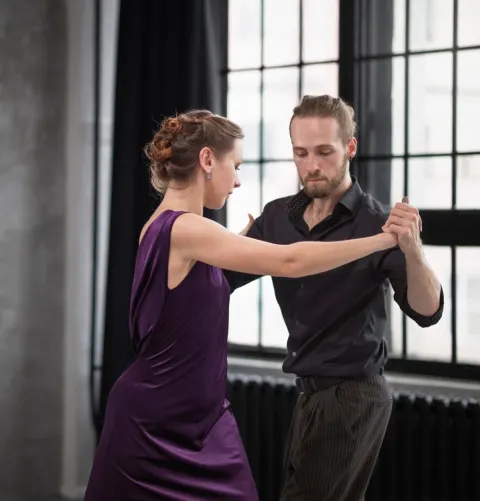 A dance practice in Rome isn't a dance party