Turn a dance into a connection
On udansa connect, you can find people in Rome who are also looking for someone to dance with. Tell them whether you'd like to practise regularly or only have time while you're visiting.

By Mary De LucaUpdated
On udansa connect, you can find people in Rome who are also looking for someone to dance with. Tell them whether you'd like to practise regularly or only have time while you're visiting.
When you first arrive, you often lack someone to keep practicing a step you have started learning with. A friendly encounter can be the beginning, even without a shared native language or the same daily routine.
A practice partnership is an arrangement between people who want to review and improve specific dance skills together. It requires neither a personal relationship nor performing together.
When you’re looking for a dance partner in Rome, a clear goal helps more than “I like dancing.” On udansa, you can bring together your dance style, preferred role and learning goal in your profile. One possible text is: “I follow, know the basic step and want to get more confident with direction changes. I speak German and a little Italian for making plans. I’m looking for someone to meet for occasional practice.” This is an example, not a local listing.
Your time frame matters too. If you’ve recently moved here, you may be looking for an ongoing connection, while as a visitor you may want to meet someone for the duration of your stay. For students, available time can vary between classes and exams. Describe when you’re available instead of promising a regular schedule you can’t keep.
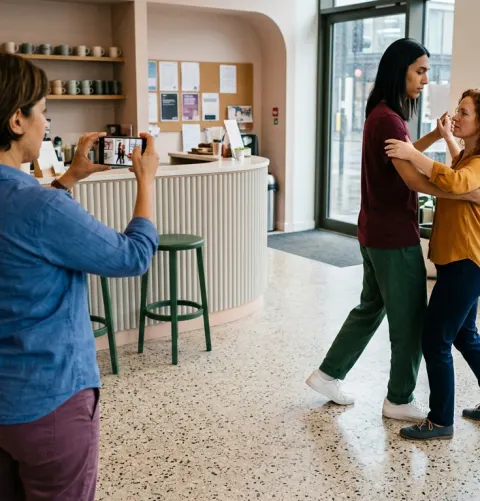
Meeting in person can complement your search: After dancing together, you can refer to something specific, such as a direction change that went well. “I’d love to practice that move with you again” is clearer than an open-ended request to keep in touch. An invitation explicitly gives the other person the option to politely decline.

Having the same experience does not automatically mean that two people are good at practicing together. One person knows many figures but loses the basic step when the music starts. Another knows only a few moves but keeps the rhythm reliably. That is why the description “the basic step and a simple turn work, but transitions are still a challenge” says more than a broad rating. Practicing together shows whether both want to work on the same problem.
Likewise, dance roles are not determined by gender or age. Leading means making movement suggestions in good time and in a way that is easy to understand. Following requires your own balance and attention. If you want to switch roles, make it a shared learning goal. By contrast, switching without warning in the middle of a figure can easily send mixed signals.
Language is especially useful for feedback: both of you should understand “smaller,” “slower,” “pause” and “no turn.” Demonstrating can help, but it does not replace consent to touch. When observing and imitating dance movements, the weight shift matters too, not just the visible leg. So a more experienced person is not automatically the teacher at the practice session.
A good fit
Remains unclear
In the course filter, you can find current classes and dates in Rome if you want to combine practice time together with instruction.
A dance meetup is truly set when both know what they’ll practice together and when they’ll go their separate ways.
A pleasant dance is first and foremost a shared experience. A practice partnership only begins when both of you agree to meet again. The place, start time, end time, and practice goal make that agreement concrete. A first meetup stays manageable: a few familiar moves, breaks, and an ending that no one has to justify. Challenging lifts or support figures you have not practiced do not belong in a first private tryout.
For new connections, a public place suitable for movement makes more sense than a private home. You can let someone you trust know where you are and arrange your own way home. Your home address, personal routines, or extensive personal details are not necessary for a dance meetup. Touch, closeness, and recordings each require consent. If you would like to record a move, a short, easy-to-follow practice video can help, as long as you both agree.
Meeting repeatedly gives conversations a natural starting point. Commitment also means canceling in good time instead of keeping someone waiting. If you do not want to meet again, you can say so. Continuing to meet is voluntary, even if dancing together worked well.
For your everyday life in Rome
If you’ve recently moved here, a recurring meetup can help you find your bearings. A manageable shared activity leaves room to get to know each other’s names, habits, and interests alongside dancing. A practice partnership doesn’t have to become a friendship, though.
For a clearly defined time together
As a guest, you can find a suitable practice partner without promising a long-term partnership. Share the dates of your stay and a specific dance goal. A time-limited meetup can work well for both of you, even if you don't share everyday life afterward.
You don't necessarily need to speak Italian, but you do need a way to communicate about consent, breaks, and plans. German or English may be enough if you can both get by in one of those languages. Short cues and demonstrating slowly can help with the movements, but you still need to be able to express personal boundaries clearly.
Yes, if you have a shared practice goal and the more experienced person doesn't teach without being asked. Practicing repeatable basics can benefit you both. As soon as one person is constantly explaining and the other is only following along, the meeting is more like a lesson than an equal practice partnership.
An age difference doesn't rule out dancing together. What matters more is a comfortable pace, suitable breaks, and an approach that works for both of you. Height alone doesn't determine whether you're a good fit either. The guide to dancing as a couple with an age difference puts the question into context for course registrations.
A short, clear decline is enough: “Thanks for practicing together, but I don't want to make this a regular arrangement.” You don't need to judge anyone's physical traits or make up an excuse. Another meeting only happens if you both agree to it, not because you were polite when saying goodbye.