Watch Sacre together
On udansa connect, you can find people in Rome to attend dance performances with and discuss specific scenes on stage afterward.

By Bernhard De LucaUpdated
On udansa connect, you can find people in Rome to attend dance performances with and discuss specific scenes on stage afterward.
You don't have to decipher every gesture to take something away from this piece. It's more helpful to look closely at one moment and sit with the fact that closeness, fear, and physical exertion can all be present in it at once.
In summer 2025, the Rome Opera Ballet staged Le Sacre du printemps in Pina Bausch’s choreography at the Baths of Caracalla. This is a historically documented performance, not an announcement for your next night at the theater. Bausch’s version was created in 1975 to music by Igor Stravinsky. His composition had already premiered in 1913 with a different choreography. So if you choose a recording, the choreographer’s name matters: the same musical title does not automatically refer to the same stage work.
The score is divided into two large sections, usually called Adoration of the Earth and The Sacrifice. Bausch turns them into a physically intense group event. You see approach, resistance, selection, and the growing strain on a single woman. The description of a sacrificial ritual is part of the work’s artistic conception, not documentation of a community actually observed.
The following viewing guide applies to Bausch’s choreography, not to a claimed reconstruction of every detail of the 2025 evening. For the broader context, you’ll find an introduction to how dance performances show Rome from different perspectives. If you’re first interested in the different movement languages, the self-test on ballet and contemporary dance complements your observations without reducing Sacre to a style category.

Watch the sequence through once without interruption, and leave unfamiliar gestures open to interpretation. Then briefly note when your gaze shifted from the group to one person; this gives you a starting point without having to explain every scene.
Listen to a short excerpt again, first without looking at the image. Pay attention to recurring blocks of sound, unexpected accents, and changes in density: you can't count along to Stravinsky's music all the way through as if it were a steady basic dance step.
Now watch the same excerpt with the image and note whether a sound coincides with a stomp, a contraction of the upper body, or a change of direction. A movement that continues beyond the accent is also a relationship to the music.
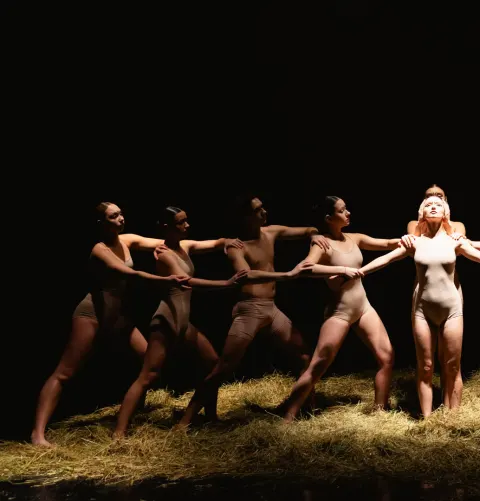
Choose a group scene and observe distances, directions of gaze, and shared impulses. Describe who is given space and who steps back; this way, you can recognize power dynamics in the arrangement without reading a supposedly clear emotional message into every face.
Look at the feet, the disturbed earth, and the traces left after a movement. The earth-covered ground is stage material, not merely a backdrop: it makes contact visible and changes the impression of weight, while earth clings to bodies and clothing.
Notice how the red dress first appears as an object and eventually marks the chosen woman. Then follow the repetition and the waning strength in her dance; you can recognize the climax in the body, not just in the signal color.
Write one sentence describing an observable action and a second giving your interpretation, for example: “The group steps back. I read this as exclusion.” Add the historical reference to Rome separately, so the performance venue, the work’s history, and your personal interpretation do not blur together.
Yes, like that
Not like this
Impression
Connection
You only need the basic idea of a sacrificial ritual, not a detailed plot summary. The development of the group, the selection, and the individual already provide some context. A retelling with too much detail can even be distracting if, while watching, you start looking only for events that have been announced instead of focusing on movement and relationships.
Bausch’s version uses a movement language that differs from classical narrative ballet. Grounded steps, bent bodies, and repeated group impulses shape the impression. The fact that an opera ballet company performed the choreography in Rome describes the performing ensemble and does not automatically make the movement language classical.
Changing accents and overlapping rhythms disrupt the expectation of a steady pulse. Repetitions remain audible, but they can be weighted differently or overlaid by other voices. You don’t need to read a score: first listen for where you expect an accent and where the sound actually creates tension.
The red dress identifies a role in the choreography, not automatically Pina Bausch as a performer. Choreographer and performer are different roles. For a specific recording, the cast matters; the dancer’s name can’t be inferred from the costume or role alone.
You can explore simple weight shifts, but you shouldn’t copy the exhausting sequences without training. Repeated stomping, deep bends, and quick changes of direction require physical preparation. The guide to Contemporary Dance classes in Rome explains the fundamentals you learn in class; analyzing a video is no substitute for that preparation.
The earth can’t be reduced to a single meaning. The title suggests a connection to spring, while the ground also makes physical contact, dirt, and traces visible. You can read fertility or transience into it, but you should distinguish that interpretation from the material effects that are actually visible.