Plan your theater evening together
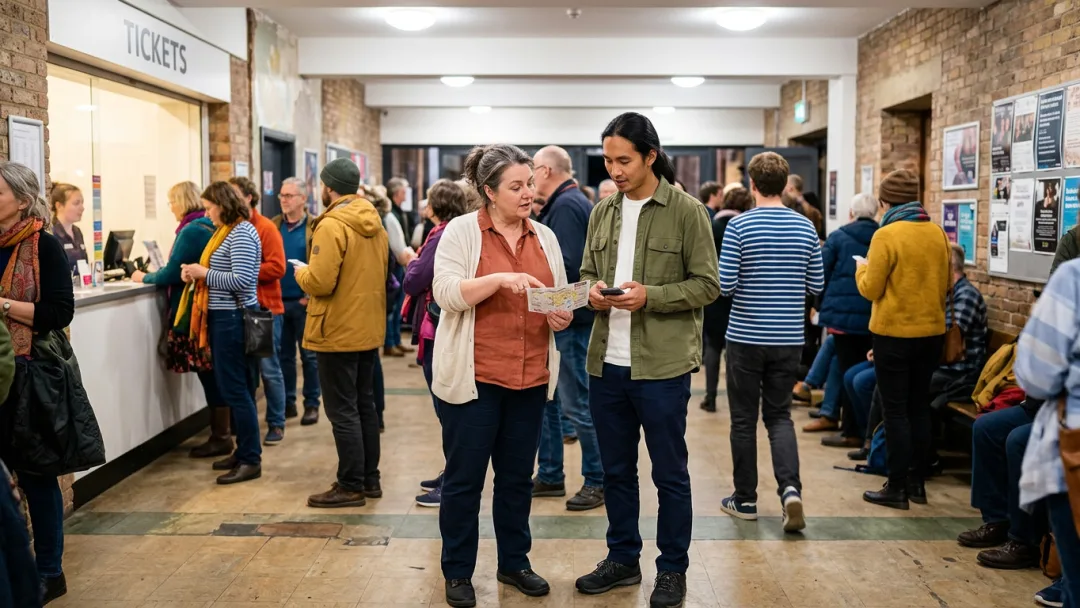
On udansa connect, you can find people in Rome to arrange a performance visit with. Tell them which performance you've already chosen and where to meet outside the entrance queue.

By Mary De LucaUpdated
On udansa connect, you can find people in Rome to arrange a performance visit with. Tell them which performance you've already chosen and where to meet outside the entrance queue.
A performance ends onstage, but your journey to the next place only begins once you’re outside. An evening with two performances is much more relaxed when you give the time in between as much thought as the advertised start time.
For the Romäuropa Festival in Rome, Mattatoio, Teatro Argentina and Teatro Costanzi are listed as venues. These names do not confirm that your chosen performance is taking place there. What matters is the venue listed in the information for your specific event. You can find the historical context in the overview of dance performances in Rome; for your visit, though, you need a route between entrances you can actually reach.
A map usually shows the way to the building. But your seat is beyond that: showing your ticket, using the cloakroom if needed, and reaching the auditorium. The next journey also does not begin with the last movement on stage. The applause, leaving your row and a possible stop at the cloakroom all still take time after the first performance.
A connection only works if the entire chain through to the next admission works. That is why the stated performance length is not an exact departure time. Add a buffer to your plan rather than counting the same spare minutes for both the cloakroom and transport delays. If you are planning an evening in Rome on your own, you can leave out the meeting point, but not the route from the entrance to your seat. This guide assumes you have already chosen your performances and does not replace the current festival program.
Transfer the title, date, start time, duration, venue, hall, and admission notes from the event documents into one row per performance. Clearly distinguish the admission time from the performance start time; leave a missing duration visibly unspecified instead of replacing it with an estimate.
Place a map pin at the specified visitor entrance for each performance. Add the building section or hall from your documents: a result for the venue as a whole is not enough if your ticket specifies a particular entrance. Save the map for offline use.
Set your desired arrival time before the event starts, and allow time for ticket checks, the cloakroom, and getting to your seat. Any stated admission deadline is a cutoff, not your arrival target. Then subtract your travel time and an extra buffer for delays: that gives you your departure time.
For an additional performance, calculate from the first start time: performance duration plus time to the exit, door-to-door travel time, and the next admission time. Add a disruption buffer separately. If the duration is missing, treat the connection as uncertain and don't make it a fixed part of your evening.
Decide in advance which performance takes priority if you can no longer make it to both. Set the latest time to leave for the second entrance. If you miss this time, skip the changeover; late admission is not a reliable fallback unless explicitly stated.
Save the complete tickets locally in the required format, not just the booking number. Agree on a clear meeting point away from the queue with your companion. If you have separate tickets, each person keeps their own ticket; make sure your screen is bright enough and your battery has enough charge for the check.
Plan from the exit of the last performance to your actual destination. Check the connection for your expected departure time, not for the outbound journey. Save a practical alternative and decide when to use it, rather than waiting until the performance ends to look for a solution.
Do it this way
Don't do this
Ready to Go
Arrival
Switch
Yes, if there is enough time between them for all the steps needed to get into the second performance. A short walk between venues alone is not enough. Especially when the performance duration is unknown, there is no reliable basis for making the connection. In that case, the second performance remains an option, but not a confirmed follow-up in your plan.
Follow the late admission policy for your performance and wait outside the auditorium until you are allowed in. Some performances allow admission only at certain points, or not at all after they have started. An empty seat is no reason to enter on your own: light from your phone and movement along the row disturb the audience and the performers.
Plan the route all the way to the seat, not just to the building address. Use available access information about step-free routes and allow an appropriate amount of time to walk. Stairs, waiting areas and standing for a long time can affect the visit more than the distance alone. If essential access details are missing, the route in question is not yet reliably planned.
Ingresso means entrance or admission, sala means auditorium and durata means duration. The context matters: a word next to a time may indicate an admission time, while a room name tells you where to go. Copy the complete details into your plan so you don't mistake an admission time for the start of the performance.
Yes, but don't automatically use the travel time from your usual commute. The starting point, travel day and planned departure time need to match this visit. Even a familiar route might end at a different entrance this time. If you're going from one performance to another, the first venue is also your starting point, not your home.
How much buffer time you need depends on the uncertainties of your specific route. A familiar walk calls for a different amount of extra time than a journey with a transfer followed by an unfamiliar entrance. Keep extra time separate from the time you've set aside for the cloakroom. If you're already cutting it close even without delays, you don't have a buffer, you have a tight connection.