Watch stage performances together
On udansa, you can find people in Rome to go to dance performances with and talk about individual scenes afterward.

By Mary De LucaUpdated
On udansa, you can find people in Rome to go to dance performances with and talk about individual scenes afterward.
An outstretched hand can seem like an invitation on stage, then just moments later like a boundary. When you watch dance in Rome, the theatrical setting also changes the meaning of seemingly insignificant gestures.
Scenic context refers to the meaning a movement takes on through its connection with space, time, sound and other actions. The same step can therefore have a different effect in different scenes.
The Teatro Argentina in Rome is documented as an important stage for major dance productions at the Romaeuropa Festival. The available information about the 2026 edition named, among others, Sasha Waltz and Wim Vandekeybus with his company Ultima Vez. These are historical program details: they establish the connection between this theater and dance without confirming a currently available date or a permanent offering.
This distinction matters if you live in Rome and associate the venue’s name with a particular art form. A venue and a production are not the same thing. The theater is the place where the performance takes place; the festival provides the event context; the individual production determines what you actually see. A documented role in a festival therefore implies neither a permanent dance company nor a single, consistent movement style.
You don’t need a history of all Roman theaters to understand the Teatro Argentina from this perspective. What matters is the documented connection between the theater space and dance productions. The overview of dance performances in Rome from different perspectives shows how to place this connection alongside other forms of performance. Historical information cannot tell you what the venue’s current program is.

In the theater, a movement is not perceived only in terms of its difficulty. Imagine two dancers standing opposite each other. One person raises a hand, the other does not react. Even the absence of a response can carry a scene. As the lighting, sound or distance changes, the same gesture takes on a different theatrical context.
This also explains a common misconception: dance in the theater does not have to work like a play with dialogue replaced by movement. A performance can show relationships without naming roles. But it can also work with patterns, repetitions and interruptions without telling a story. Your attention might then follow a movement that is first performed alone, and later by several bodies at the same time.
Music does not necessarily provide a steady beat. A noticeable breath, an impact or silence can also shape how you perceive the performance. Meaning comes from the interaction, not from the step alone. This is a general explanation of the theatrical context, not a description of a specific production at Teatro Argentina. The form presented there in any particular guest performance can only be determined from information about that specific piece.
Yes, like that
Not like this
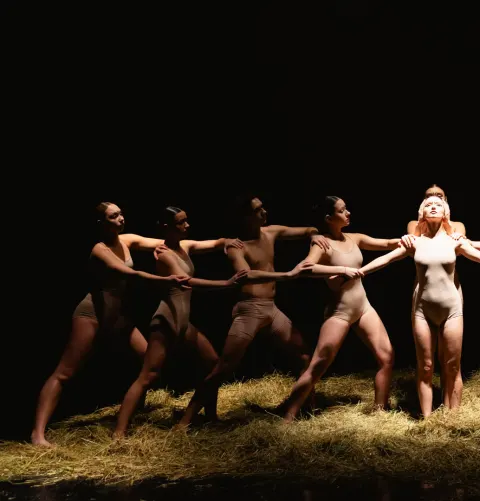
A movement becomes legible on stage when you see it alongside another movement.
When you dance yourself, you feel weight, balance and effort directly. In the audience, these sensations are not directly accessible. You recognize them through visible effects: A foot stays on the floor longer, an upper body yields, a landing interrupts the flow of movement. The theater setting invites you to follow these effects over the course of a scene.
You don't need a ready-made explanation for this. It helps to distinguish between observation and interpretation: Two people move apart, and you can see that. That they are acting out a conflict is one possible reading. Perhaps the piece instead emphasizes opposing directions. Both perceptions can be based on the same visible arrangement.
If you're looking to connect with dance in Rome, watching and dancing along are different forms of participation. An evening at the theater gives you something to talk about, but no shared practice time. To understand the difference, take a look at events with a stage or dance floor in Rome. At Teatro Argentina, the documented connection is to festival productions at the theater. Which movements engage you there depends on the individual performance, not the name of the venue.
Closeness, distance, and reactions take center stage
You notice who moves closer to whom and who pulls away. A delayed response can create tension for you, even without recognizable figures or a named story. This perspective helps you notice changes between the dancers.
Rhythm, direction, and repetition guide the eye
You pay attention to how movements are distributed and changed. A shared turn may hold your attention because of its rhythm, without you wanting to read it as an encounter. This way of looking helps you notice the timing and spatial design.
You don't need to be able to name dance steps to experience a stage performance. Directions, tempo, proximity and reactions are visible even without specialist vocabulary. Technical knowledge can help you notice details, but it isn't a requirement for following a scene attentively or developing a reasoned interpretation of your own.
Standing still can be part of a dance performance. A held position changes the rhythm and draws your attention to breathing, tension or other bodies. Whether you experience the pause as calm, resistance or anticipation depends on its duration and on what happens before and after it.
At an ordinary stage performance, you remain an audience member unless the piece explicitly invites you to participate. The open space on stage is part of the staging, not an open dance floor. You can respond to movements without entering the performance space yourself.
You can describe a specific observation and how it affected you. For example: When the group moved apart, I felt that the individual had been left behind. This distinguishes the visible event from your interpretation and leaves room for others to experience the same scene differently.