Contemporary Dance5 minutes

Your dance audition in Vienna: Improvising under pressure

By Bernhard De LucaUpdated

In short
  • At an improvisational dance audition in Vienna, you translate given tasks into your own, clear movement choices.
  • A clear response to the task is more helpful than doing as many difficult movements as possible.
  • Preparation means practicing changing prompts and observation, rather than relying on a fixed sequence.
  • ImPulsTanz and Tanzquartier provide a cultural reference point, but no current audition requirements can be inferred from that.

When people are watching, a simple instruction can suddenly seem complicated. If the only things that come to mind are your familiar favorite moves, what you need most is experience in treating a limitation as a starting point for your own decisions.

DefinitionScore

A score is an agreed-upon task that structures an improvisation through rules, images, or conditions. It sets a framework without prescribing every movement.

A task gives your improvisation a direction

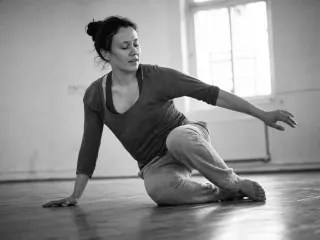
At a dance audition in Vienna, an improvisation task might be: Let your elbow initiate the movement, while your feet respond only later. This is a training example, not a claimed audition task from any particular institution. You don't have to develop a spectacular sequence from it. What matters is whether the elbow really triggers an impulse and how that impulse travels through your body.

An improvisation score can involve body parts, pathways through space, tempo or relationships. The constraint makes your decisions clear: You could keep the impulse small, change its direction or interrupt it with a pause. The instruction remains recognizable, even when your response is open-ended. Range of motion and flexibility are two different things; the article about flexibility through dance explains this distinction for your training.

The local connection is contemporary dance: ImPulsTanz began in 1984 as Internationale Tanzwochen. Tanzquartier Wien opened in 2001 as a venue for contemporary dance and performance. This history explains the cultural context, but it provides neither current audition calls nor a binding set of tasks for your application. What matters is the specific task, not an assumed Viennese style norm.

Even just by watching, you can tell whether a movement choice actually responds to the prompt.

Under Pressure, Attention Becomes a Scarce Resource

When you are dancing, listening to a new instruction and being watched at the same time, several things compete for your attention. You want to understand the task, organize your body and make a good impression. It is then tempting to fall back on familiar turns or big movements. They feel reassuring, but can obscure the actual instruction.

A useful training situation therefore does not change everything at once. For example, you might begin with the quality heavy and later receive the prompt to be springy. The question is not how many movements you know. You explore how the same path changes: Do you give up your weight for longer? Does a different rhythm emerge? Does a pause become shorter? That is what distinguishes responsiveness from simply switching up your step repertoire.

Music can also draw your attention. Without music, you hear your breathing and foot contacts; with music, you can relate the same rule to an external rhythm. Both make for useful practice conditions. Being observed is another condition, not a constant judgment of your worth. You can work with a moment of hesitation as a pause, as long as you return to the task. This way, your run-through remains an exploration rather than a frantic search for the supposedly right effect.

How to tell that a task is being worked on

Yes, like this

  • Let the named body part initiate the movement
  • When a new instruction is given, visibly change the quality of the movement
  • Use a pause consciously within the given prompt
  • In group tasks, help shape the spacing and direction of gaze

Not like this

  • Add the body part as decoration to your favorite sequence
  • Keep going unchanged after a new cue
  • When in doubt, frantically add extra movements
  • Treat others as obstacles in your way

A small movement can be a clear answer when its beginning, direction, and change arise from the task.

udansa editorial team for dance training

Your response provides the next training impulse

After an improvisation task, the most helpful reflection is specific: At what point was my decision visible, and when did I lose track of the rule? This distinction turns the run-through into material for further training. If you forget the specified body part at every change of direction, that transition is exactly what you need to work on. You don't need a finished stage sequence for that.

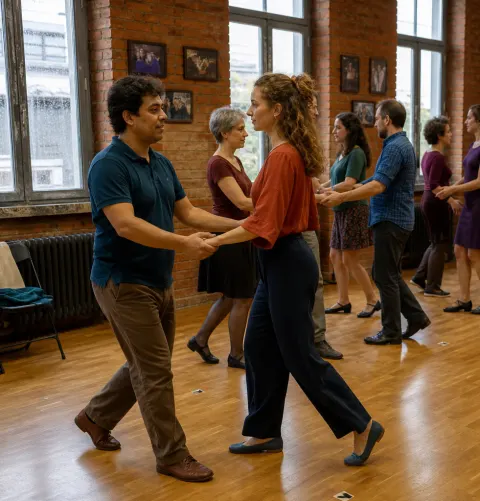
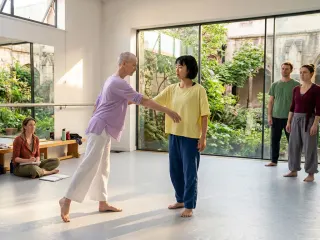
In a group task, awareness of others comes into play, too. Distance, direction of gaze and shared timing can create relationships, even without touch. Agreed contact requires consent; risky lifts are no substitute for attentive collaboration. Flexible training clothes support free joint movement and safe contact with the floor, but they should not get caught under hands or feet.

For classes with multiple sessions, a coherent structure is more helpful than simply covering as much material as possible. The article on structuring an intensive dance course explains this difference. For your audition preparation, this means that experiences with changing tasks need to connect with each other. You can't infer that you'll be accepted from this, because selection also depends on the particular project. But you can learn to notice your decisions more precisely and respond flexibly to a new condition while being observed.

Two conditions, two experiences

Alone

Hear your own decision

A score without external feedback

On your own, you notice when you move away from an instruction and fall back on familiar patterns. You can work on the same task from different starting positions and notice differences in weight, direction and rhythm.

Observed

Making the Decision Visible

A score with attention from others

In front of others, you also feel the desire to come across convincingly. You try following through on an idea anyway and taking up a new cue, without measuring every movement against the faces of those watching.

Frequently Asked Questions

  1. For improvisation tasks, choose flexible training clothes that allow you to make contact with the floor and move your joints freely. Loose layers should not slip over your hands or feet. Whether you dance barefoot or in shoes depends on the published requirements; a particular look will not make your performance of the tasks more convincing.

Classes for Dance Improvisation in Vienna

You can try out open-ended movement exercises in class before working on them under observation.

Practice with changing prompts

On udansa, you can find classes in Vienna and people to practice open movement exercises with. Together, you can also explore the experience of being watched while dancing.

Practice with changing prompts