Choosing a Class5 minutes

Contemporary Dance: Choose the Right Class in Zurich

By Bernhard De LucaUpdated

In brief
  • Contemporary dance classes in Zurich differ mainly in their use of floorwork, improvisation and the movement experience they expect.
  • Floorwork can include both gentle transitions and fast, physically demanding movement sequences.
  • Guided improvisation gives you specific movement tasks instead of leaving you to dance freely without direction.
  • Suitable classes clearly state their prerequisites and offer understandable learning steps for your level of experience.

A movement close to the floor can look calm and still require a lot of coordination. Conversely, an open-ended exercise can be more accessible than a short sequence you're expected to follow along with right away.

DefinitionMovement phrase

A movement phrase is a continuous sequence of movements with a clear beginning and end. In class, it can be set by the instructor or emerge from an improvisation exercise.

The course name does not determine the lesson

If you are looking for a contemporary dance course in Zurich, you may also come across the terms Contemporary Dance and Modern Dance. They are not used in the same way everywhere. Modern Dance has its own historical traditions, while Contemporary Dance can combine different movement techniques and artistic approaches. A name alone therefore tells you neither how challenging a class is nor how it is structured.

Three details are more helpful when choosing: how much work is done on the floor, what role improvisation plays, and what movement experience is expected. After the warm-up, one class may focus mainly on teaching set movement phrases. Another may develop material through sensory exercises and leave more room for your own ideas. Both can be contemporary dance classes, but they feel different to learn.

Dance also has a historical presence in Zurich: around 1915, Rudolf von Laban founded a school for movement arts here. However, this does not tell you anything about current courses. What matters for your classes is the movement material described, not how closely a name is associated with a dance tradition. A course focused on improvisation is also not automatically a complete technique class in Contemporary Dance.

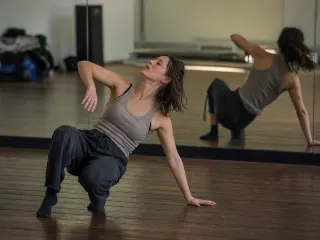
Clothing for floorwork needs to allow freedom of movement and shouldn't get in the way when supporting yourself or rolling.

Floorwork describes a task, not a course level

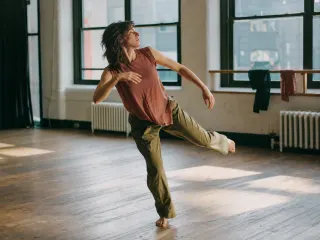
Floorwork initially means that movements take place in close contact with the floor. This can include sitting, lying down, supporting yourself, rolling and transitions to standing. What matters is how these elements are connected. Transitions introduced individually and slowly place different demands on you than a continuous phrase with rapid changes of direction.

That is why terms like close to the floor or flowing are not reliable indicators of difficulty. Flowing movement may already require you to shift your weight with control, maintain a sense of spatial direction and connect several transitions without interruption. References to dynamic floor phrases, getting up quickly or extended periods of supporting yourself describe a more specific challenge than the word floorwork alone.

An accessible introduction gives you time to get familiar with unfamiliar points of contact and movement pathways. Variations can let you explore the same idea with less depth, a smaller range of motion or additional points of support. This is not simply a break from the actual material, but a different way of working on the same task.

Mobility and resilience are not the same thing. Being able to reach low says little about how accustomed you are to supporting yourself repeatedly. Learning how to gradually increase the load when dancing can also help you assess intensive floorwork realistically.

How to recognize informative course details

Informative

  • Identify slow floor transitions as an introduction
  • Describe improvisation exercises with clear boundaries
  • Specify prior experience with movement sequences
  • Mention variations for different ranges of movement

Unclear

  • Describe floorwork as easy across the board
  • Promise only free dancing without further context
  • Equate athleticism with dance experience
  • Claim it is suitable for everyone without adaptations

A course title says little about how much explanation, repetition, and independent exploration a class includes.

udansa editorial team

Improvisation and experience work hand in hand

Guided improvisation begins with a task, such as tracing the path of a hand through the room or switching between small and large movements. You are not creating something out of nothing. The prompt limits your options and gives you a starting point. The instructor can then discuss these choices or use them to develop a repeatable phrase.

An open-ended task is therefore not automatically advanced. It becomes more challenging when you have to manage several conditions at once: a path through the room, changing tempos and awareness of other people. Conversely, a short prescribed sequence can require a lot of experience if it is shown only once and then you are asked to change it independently.

Required movement experience therefore means more than general fitness. It may involve remembering movement sequences, familiar weight shifts, orientation during turns or experience with independent tasks. Yoga or other sports can help develop body awareness, but they do not replace all of these learning habits. For ongoing courses, the guide to joining later and missing the basics explains this difference in more detail.

When choosing a course in Zurich, descriptions that name these kinds of experience and connect them to the focus of the class are especially useful. This makes it clear whether you will be learning new movements for the first time or independently developing material you are already familiar with.

Two approaches to the same movement material

Repeat

Understanding a Set Phrase

You learn through a recurring structure

A fixed sequence of movements lets you experience details multiple times: direction, tempo and transitions remain comparable. This provides orientation and makes changes noticeable. You can also develop personal qualities within it, such as a softer or more defined execution.

Explore

Developing movement from a task

You learn through different solutions

An open-ended task allows for several ways of moving while its theme stays the same. You experience how your own choice changes the course. Structure also emerges here, for example through a set duration or a shared beginning and ending.

Frequently Asked Questions

  1. Ballet experience is not generally required, but it may be a prerequisite for a particular class. Contemporary classes can use a variety of technical approaches. Ballet terminology, turns, or complex movement phrases suggest different requirements than an introduction based on awareness and simple movement tasks.

Courses with improvisation in Zurich

On udansa, you can find course listings and dates in Zurich, which you can sort by focus and movement requirements.

Your movement goal sets the direction

On udansa, you can find classes in Zurich for your interest in improvisation and contemporary movement. Use the listed prerequisites to choose a course with a learning focus that suits you.

Your movement goal sets the direction