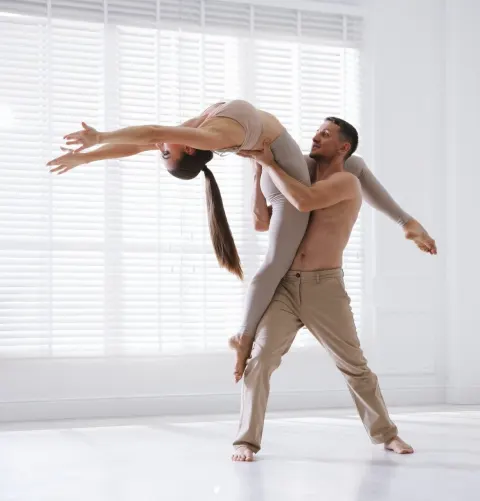
Learn in bite-sized chunks, reinforce it together
On udansa connect, you can find dance partners in Paris to practice a short course sequence with. Just name the move and the role you want to practice.

By Mary De LucaUpdated
On udansa connect, you can find dance partners in Paris to practice a short course sequence with. Just name the move and the role you want to practice.
After a focused period of instruction, a new sequence often feels surprisingly familiar. But you only find out whether you can recall it on your own later, when the instructor's voice and demonstration are no longer there.
Distributed practice means repeating the same learning material in several practice sessions spaced apart over time. There are breaks between these sessions, rather than doing all the repetitions one after another.
An intensive dance course in Paris is primarily a decision about how to distribute your learning time. Several lessons take place close together. This can help you avoid having to rebuild a connection from scratch at every meeting: for example, you work on the basic step, the transition into a turn, and the return to the basic step.
The useful limit lies in the outcome. “I want to dance better” leaves open what the lessons are meant to achieve. “I want to dance this short sequence in time without being shown” describes an observable skill. The more specific the goal, the better you can use focused lesson time to achieve it.
The prerequisites are part of the same idea. If a sequence requires a confident shift of weight, an unsteady foundation will not suddenly become stable at a faster tempo. A beginner format needs to build that foundation first; an advanced format can build on it. So intensive does not automatically mean a certain difficulty level. For context on how it fits into other learning paths, the overview of dance courses in Paris gives you the right framework. What matters is how much content is matched with how much genuine repetition.

In class, you get several memory aids at the same time: the teacher counts, shows the direction and cues the next move. This can help you dance a sequence correctly even though you cannot yet recall it on your own. This guided success is a useful learning moment, but it does not prove that the movement is already firmly established.
Intensive learning sessions also add to the strain. New footwork, rhythm and body alignment all compete for your attention. In partner dancing, you also have to coordinate with the other person. If, during a turn, you are only moving your arms but losing the weight shift, another quick run-through is rarely the best solution.
A solid block of classes includes time for review, not just new figures. Short breaks give you a chance to process an explanation and recover physically. When choosing a course, take a moment to check what prior knowledge is expected and how practice sessions and breaks are structured. The number of class hours alone tells you very little. Even a smaller amount of material can be challenging if you are expected to dance it to music, without cues and with a suitable transition into the next move.
Do it this way
Not like this
On udansa, you can find classes and dates in Paris that you can match to your learning goal and available practice time.
A useful learning goal describes what you can dance without being shown, not just which move you’ve seen in class.
A compact course ends on the calendar before the learning process does. After class, the task changes: You get fewer prompts from outside and have to put the sequence together yourself. That is why free practice time should already be part of your decision about the format. A packed schedule right afterward can limit the benefits, even if the class itself is well structured.
Practice afterward does not have to be another layer of instruction. A short run-through with a specific task may be enough to reveal a gap: Start at a different point in the sequence, or connect the difficult transition to what comes next. This helps you notice whether you can really recall a movement or are simply repeating the sequence from the beginning of class by rote. In partner dancing, a shared practice routine in Paris helps both of you work on the same small section.
Repeat what you already know before adding variations. A different tempo can later show whether your timing has become flexible enough. If the connection still makes sense without cues, the compact format has achieved its limited goal. For new topics, you will then need suitable practice time again, not just a longer list of figures.
A few elements, explained from the start
You want to combine a basic step with a simple follow-up move. A beginner class gives you enough time to work on these building blocks without assuming knowledge you don't have yet. The benefit is a manageable foundation that you can build on in future classes.
Make Targeted Use of What You Already Know
You know the steps, but you're still missing a particular transition. A short, focused lesson can revisit this connection and link it to music. The benefit is being able to apply what you already know in a clearly defined new situation.
You don’t need to be in peak athletic shape, but you should be able to handle the planned physical activity with breaks. Longer class sessions also demand concentration and put strain on your feet. If fatigue makes you less precise, shorter practice sessions are more helpful than doing additional repetitions.
Several short practice sessions are a good starting point, but a set number of minutes won’t suit every learning goal. What matters is that you can recall the material repeatedly without a demonstration. Stop practicing before fatigue noticeably affects your movement, and come back to the difficult transition later.
Start with the last part you remember confidently and first work out only the transition that follows. You can recall the footwork, weight changes, and direction separately. Writing a short note of your own can help; repeatedly starting the whole combination from the beginning often hides the actual gap.
You can learn the material in less calendar time, but that doesn’t automatically mean you’ll master it faster. A regular course spreads classes and practice over a longer period. The right option depends on whether you need focused input right now or more time between learning sessions.