You can join the class solo, too
On udansa, you can find partner dance classes in Paris and search for options that welcome solo participants. That way, you can start lessons without needing to bring your own partner.

By Bernhard De LucaUpdated
On udansa, you can find partner dance classes in Paris and search for options that welcome solo participants. That way, you can start lessons without needing to bring your own partner.
The first hurdle often comes before the first step: You want to book a class, but the form asks you to choose a dance role or only shows a waiting list. These details explain how the class is organized, not whether you’re suited to dance.
Role balance refers to the ratio of leading and following participants in a partner dance class. A balanced distribution makes it easier to form complete pairs for partner exercises.
If you want to learn partner dancing in Paris without a partner, you need a class format that accepts individuals. The phrase “without a partner” initially only means that you don’t have to bring anyone with you. It doesn’t promise that someone will be assigned to you on an ongoing basis or that a spot will be available right away. A group class may also only accept bookings in pairs.
With individual booking, you register on your own. If booking depends on dance role, you’ll also need to specify “Lead” or “Follow.” If one role is already overrepresented, your registration may remain provisional. A confirmation of receipt then only documents your request, while a participation confirmation guarantees your spot. This distinction also explains why a registration may only be confirmed once an additional condition is met.
What matters is the specific confirmation, not just the offer’s heading. If any details are missing, ask all your questions before booking: Can you register individually, when will your spot be confirmed, do partners switch, and which dance role are you booking? This covers the practical arrangements without you having to find a dance partner yourself.
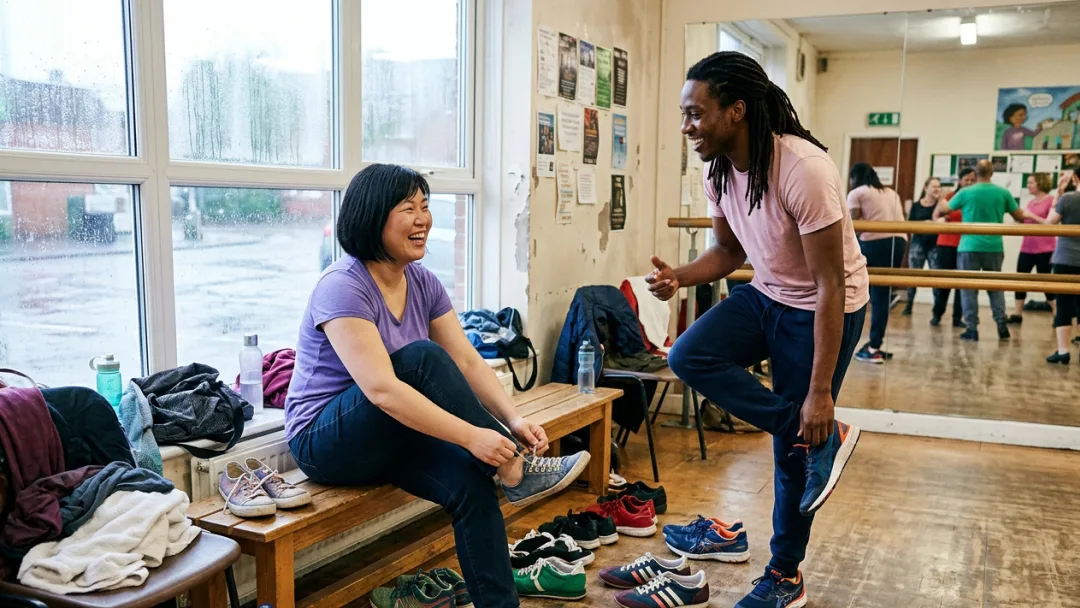
Partner rotation means the instructor rearranges practice pairs according to a set routine. This can happen after a practice round or an explained movement section. The person opposite you changes, but your dance role does not automatically change. If you lead, you continue to lead in this arrangement; if you follow, you continue practicing following.
The benefit lies in the feedback: a figure that happens to work with one person may not yet work with another. Different step lengths and reaction times show you whether your weight shift is clear and whether you sense the shared start of the movement. This is not a judgment of the other person. It reveals which parts you can perform reliably yourself.
However, rotation does not guarantee that everyone gets to practice with a partner at all times. If the roles are unevenly distributed, participants may take turns sitting out. A brief solo repetition can be used to work on rhythm and balance; longer waits, on the other hand, reduce partner practice. A class without rotation can also include individual participants if practice pairs are assigned. The label “single dance class” alone does not determine how any of this works. For an overview of different class formats, the guide to dance classes in Paris offers a broader perspective.
Correct
Myth
At udansa, you'll find classes in Paris to get started and can search for lessons without bringing a partner.
A spot for a person and a spot in a dance role do not always mean the same thing.
Leading and following are different tasks within the same movement. Leaders give the movement impulse and suggest a direction or figure. Followers perceive this impulse and respond to it using their own balance. Both keep their own rhythm, support their own weight, and adapt their movements to each other. Following therefore does not mean being pulled along passively.
Registering for a specific role helps the teacher organize exercises and pairings. Your role is not necessarily determined by your gender. A course may allow free choice of role, assign roles, or explicitly teach both roles. None of these arrangements can be inferred from “without a partner” alone. Free choice also does not automatically mean that you can switch roles whenever you like during every exercise.
Changing roles requires a clear restart of the task. If you learn both roles, for example, after a turn you need to know whether to offer or respond to the next impulse. Otherwise, two people may start leading at the same time or both wait. So, when you are starting out, it helps to have a clearly guided process: an understandable role assignment for the current exercise, and an announced switch when the roles are exchanged. This keeps your solo registration clear both logistically and in terms of the dancing.
More varied feedback on the same move
With each new practice partner, step length and timing change slightly. You learn to keep your lead clear or to notice different signals. This makes repetitions less predictable.
More repetitions together without starting over
A practice partner assigned for the class lets you work on the same detail for longer. You can repeat a transition that didn’t go well right away. This builds familiarity without requiring you to become regular partners outside class.
Not necessarily, unless the class explicitly specifies a target group requirement. In the context of partner dancing, the term may refer to individual participants rather than a particular relationship status. The name alone therefore does not imply either an eligibility restriction or a matchmaking format.
Yes, if the class allows individual bookings and places are available for the roles you choose. However, two individual registrations do not automatically make you a fixed practice pair. If partners rotate, you will also practice with other people; if there are role-specific waiting lists, your confirmations may differ.
Partner exercises may involve physical contact, but you do not have to accept contact that makes you uncomfortable. Hand contact and distance depend on the exercise. You can release a hand, keep more distance, or pause an exercise; you can also practice turns beforehand by shifting your own weight.
This may result in temporary waiting periods, solo exercises, or a different arrangement. How this is handled depends on the class's teaching approach. Voluntarily switching roles can help, but it does not replace an explanation of the new task and should not be an automatic requirement resulting from your individual registration.