Room for little dance steps
On udansa, you can find children's classes in Paris and filter them by age and dance style. That turns a general search into a selection for your child.

By Mary De LucaUpdated
On udansa, you can find children's classes in Paris and filter them by age and dance style. That turns a general search into a selection for your child.
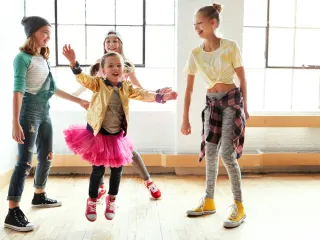
When your child hops around the room like a frog, serious learning can be taking place. A neatly arranged line, on the other hand, tells you little about whether the children understand their movements.
Creative dance for children is movement instruction in which children develop dance skills through music, imagery, and their own ideas. The activities combine free exploration with a specific movement goal.
When looking for a dance class for your child in Paris, “playful” might sound like preparation for the actual lesson. But a game can already teach the basics of dance. When children move around the room to music and stop when it pauses, they practice listening, reacting and balancing. The activity doesn't need a long choreography to have a clear purpose.
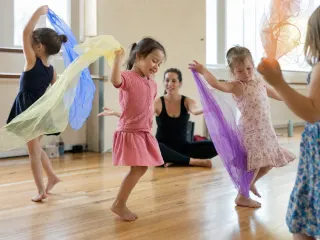
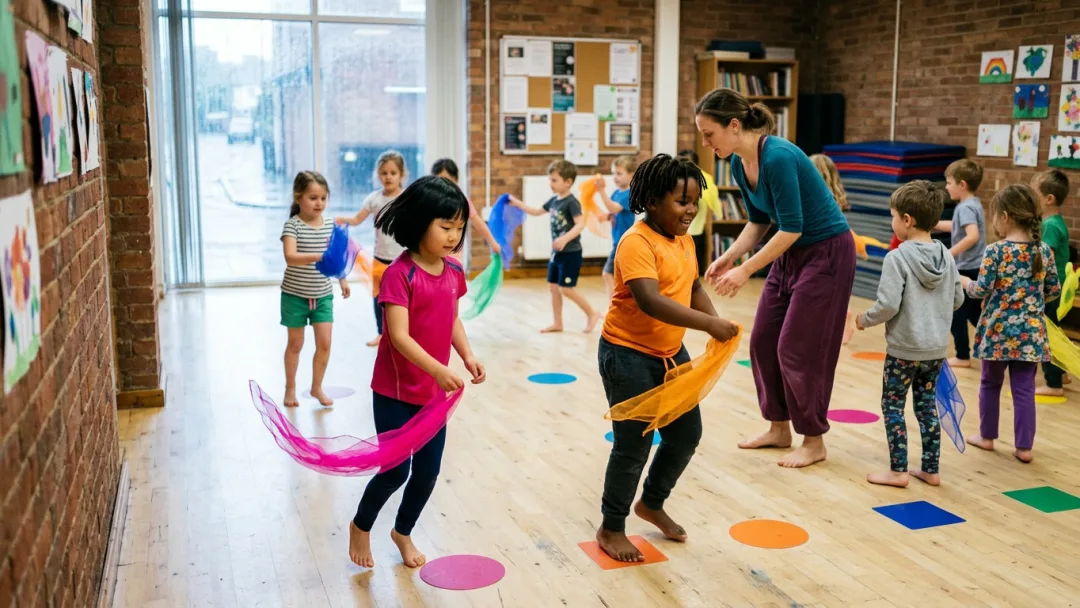
Images can also be used intentionally: taking small steps through an imaginary puddle changes the length of each step. A floating scarf makes a slow arm movement visible. What matters is that the teacher connects the image to a movement and gives the children a chance to try it out. By contrast, simply keeping them occupied would mean switching between games with no clear connection to movement.
Paris's ballet history, whose opera company traces its roots back to 1661, can shape expectations about early dance classes. However, it isn't a measure of how your young child has to get started. You can learn more in Paris's dance traditions. When choosing a class, the first thing to consider is whether your child can understand the activity and manage it physically.
Technique lessons make a movement repeatable: for example, your child learns to shift their weight consciously or land steadily after a small jump. This can start with imagery and later be supplemented with more precise explanations. Play and technique are therefore not opposing teaching approaches. An imaginative task can be taught with technical precision; a set exercise can leave room for curiosity.
Technique is often misunderstood as imitating adult body lines as early as possible. But for younger children, the goal is not the greatest possible range of motion. Controlled movements, short repetitions, and instructions they can put into practice right away are more useful. “Put your foot down more quietly” describes an action. “You’re too clumsy” judges the child and does not help them try again.
Demonstrations also need to be clear. A child may recognize the general shape while weight shifts or the direction of movement remain unclear. The general observation errors when imitating dance movements explain this difference. In children’s classes, a few visible details are more helpful than an entire sequence all at once. Forced stretching, pain, or publicly pointing out mistakes are not necessary parts of thorough learning.
Do it this way
Not like this
In the course filter on udansa, you'll find current classes and dates in Paris to help your child get started.
A good movement game has a clear learning objective, even if the children are just thinking about frogs and puddles.
You can tell whether a class is right for your child by how they can take part. A younger child who enjoys coming up with movement ideas does not automatically need only open-ended activities. Familiar routines can help them feel secure. Conversely, a child who likes to copy movements precisely does not have to give up finding their own solutions. Good instruction provides a shared framework and adjusts the difficulty when needed.
You can see this, for example, in a balance activity: some children briefly stand on one leg, while others still tap the floor with the tip of their free foot. Both are working toward the same goal. Manageable waiting times, enough space to move, and a balance between listening and trying things out are also part of good teaching. Loudness or a perfectly synchronized group alone do not prove that learning is taking place.
So when looking for a class, the label “children’s dance” is not enough to describe its teaching approach. Asking specifically how the class accommodates different stages of development is more useful than asking about the longest choreography the children have learned. For a broader overview, visit the page on learning pathways in dance classes in Paris. The main thing for your child is that they get a challenge they can understand, are allowed to show their limits, and experience how another try can make a difference.
Open-ended task, different solutions
Your child explores how to dance in big or small ways, quickly or slowly. Different answers are welcome, as long as the shared task remains recognizable. This gives rise to original movement ideas and a sense of space.
A clear goal, repeatable execution
For example, your child practices landing securely on one leg after a step. The teacher demonstrates one detail and gives them time to try again. This makes movements more reliable, without requiring all the children to look the same.
Your child can get started as soon as the class format suits their stage of development. For younger children, the focus is on simple movement activities, music and familiar routines. The age range describes the intended group, but it does not guarantee that every child in it can already manage the same activities.
No, a beginner class can help develop a sense of rhythm. Walking to an audible beat, clapping and responding to pauses in the music are all possible learning activities. If your child initially falls behind or watches others, that does not mean they are unsuited to dancing, and it is no reason to add extra practice drills.
For playful movement classes, comfortable sportswear and the shoes specified for the class, or bare feet, are suitable. Clothing should allow your child to bend their knees, raise their arms and move close to the floor. Long necklaces, loose jewelry and slippery socks are not a good choice. Some technical dance styles may have their own clothing and shoe requirements.
Yes, watching at first can be a normal way for a younger child to get their bearings. It takes time to get used to new rooms, music and group rules. A gentle introduction offers small ways to participate, such as moving a scarf, without putting the child on the spot or immediately expecting them to do the whole activity.