Plan a dance evening that suits you
On udansa connect, you can find dance partners in Paris and coordinate space needs, the support you’d like, and breaks before attending together.

By Bernhard De LucaUpdated
On udansa connect, you can find dance partners in Paris and coordinate space needs, the support you’d like, and breaks before attending together.
A great evening begins before the first song. When you can choose your own space to move and take breaks when you like, you can focus more on the music and connecting with others while dancing.
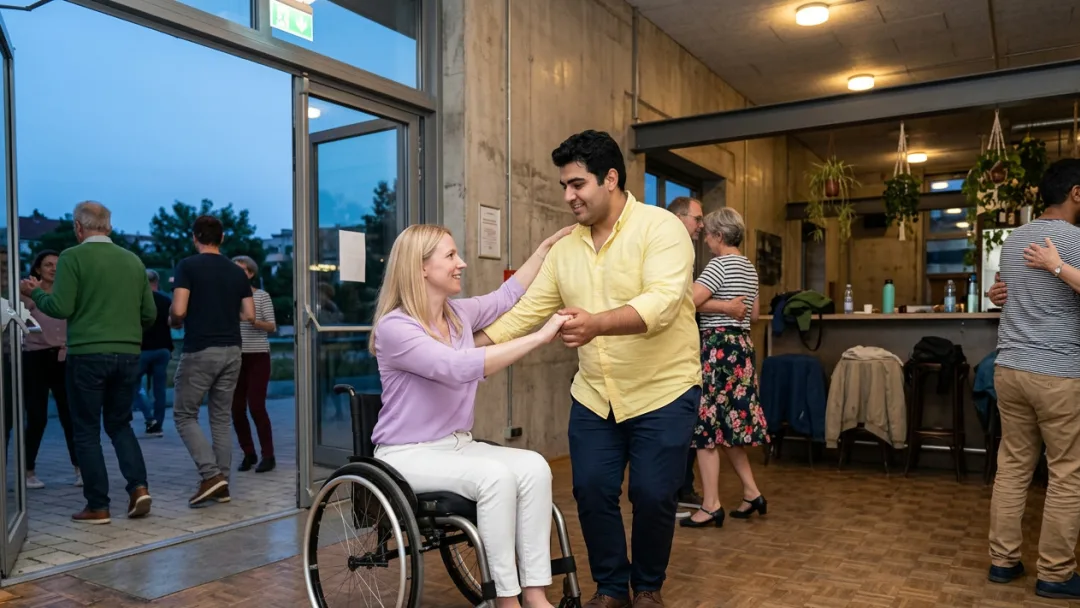
At a dance evening in Paris, the entire route matters, from the entrance to the place where you take a break. A step-free entrance is of little use if you can only reach the dance floor by going up a step. Likewise, the presence of an elevator tells you nothing about whether you can fit inside with your mobility aid or turn around in front of it. One accessible point does not replace a route that is usable all the way through.
When dancing, you also need room to move: space for your movements, your partner and changes of direction. A floor may seem spacious enough when empty, but become too cramped between chairs, bags and other dancers. A firm, level floor makes controlled movements easier. Loose rugs, cables and sticky patches can get in the way. How much space you need and what kind of floor works for you depend on the way you dance and your mobility aid.
Terms such as “accessible” or “accès PMR” may indicate access for people with reduced mobility. But they do not automatically describe every route or sensory condition. For help understanding the language, see the tips for a dance evening without French. The guide to going dancing in Paris can help you understand the evening’s format, but it does not replace specific accessibility information. This guide therefore does not assess any individual venue as accessible.
Write down what’s essential for you: such as step-free routes, adequate maneuvering space, an accessible toilet, or a break away from loud music. Separate essential requirements from nice-to-have extras, so your decision later doesn’t hinge on a single positive detail.
Transfer event details to your notes template. Treat only explicitly described features as confirmed; general terms remain unclear. Relate the details to the announced room and event, not just the building.
Write your access section: Are there steps or thresholds between the entrance and the dance floor? How wide are the narrowest passageways? If there’s a ramp or lift, include its incline, usable dimensions, how it works, and whether it’s available during the evening in the same section.
Complete the dance floor section: Is the floor solid, level and free of loose coverings or cables? How much clear space remains while dancing? Describe the space you need for turns and dancing together, instead of simply asking whether there is “enough room.”
Add questions about the step-free route to the restroom, door width, maneuvering space and features such as grab bars. For breaks, include an accessible quiet area, seating and a way back to the dance floor. For sensory needs, include volume, changes in lighting and advance notice of strobe lights.
Send all your outstanding questions together to the event organizer and explain what you actually need. Ask for specific descriptions instead of a blanket yes; measurements or photos can provide additional information about the space. You don’t need to disclose a diagnosis to describe your requirements clearly.
Match the answers to your minimum requirements: confirmed, unclear, or unsuitable. Descriptions only support your decision if they actually meet your needs. If an essential requirement remains unresolved, don't treat the visit as a confirmed fit, and choose another evening if appropriate.
Do this
Not like this
Preparation
Assessment
Orientation
No, “accès PMR” alone does not guarantee full accessibility for your dance visit. The term refers to access for people with reduced mobility, without describing all spatial or sensory conditions. What matters is the actual routes, maneuvering space, restrooms and places to take a break, based on your personal needs.
For a straightforward inquiry, it’s enough to describe your specific access needs. For example, you can mention the width of your mobility aid, the turning space you need or whether you need low-stimulation breaks. Medical details are usually less helpful to the event team than a clear description of what needs to work in terms of space or organization.
Photos alone are not enough to reliably assess the dance floor. The angle and framing can hide distances, thresholds and narrow routes. An empty room also doesn’t show the setup during the event. Use photos alongside measurements, a description of the floor and details about areas kept clear for movement.
A restroom is usable for you if the route, door, maneuvering space and facilities meet your needs. For example, a wheelchair symbol doesn’t tell you which side allows for a transfer or whether an inward-opening door takes up space. Grab bars and a sink you can reach can also be essential.
A seat at the edge is enough only if it meets your actual need for breaks. Next to the dance floor, music, changing lights and people walking by may still be overwhelming. For a low-stimulation break, you need an accessible area with fewer triggers, where you can take a break and return to the dance floor during the event.
If an essential promised condition is missing, you don’t have to continue your dance visit. First, pause somewhere safe and decide without pressure whether a solution you’re comfortable with is possible. Pushing, lifting or carrying you without asking is not an alternative, support requires your explicit consent.