Even without French, dance along
On udansa connect, you’ll find dance partners in Paris who speak a language you both understand.

By Mary De LucaUpdated
On udansa connect, you’ll find dance partners in Paris who speak a language you both understand.
An unfamiliar word in an event listing can feel more intimidating than your first turn. If you live in Paris or have just moved there, you don't need a complete vocabulary, just a sense of which details actually tell you something about communication.
Instructions are directions that explain what you should do in an exercise or situation. In dancing, they may concern the start signal, direction of movement, or an interruption.
French announcements for Paris may use several terms side by side. Bal refers to a dance event and does not automatically mean a formal ball with evening dress. The history of the Bal musette already makes this broader meaning clear: it became popular in Paris in the 1880s, when people danced in cafés to the cabrette and later to the accordion.
Soirée initially means evening or evening event. Only an addition such as dansante explicitly makes it a dance evening. The word alone does not refer to a particular dance style or language.
Initiation means an introduction, such as learning a basic step. In a dance context, stage refers to a compact workshop, not a stage. It may focus on technique, figures, or something else, and it does not have to be for beginners.
The example combination initiation suivie d'une soirée dansante means: introduction, followed by a dance evening. So the words describe parts of the program, not a guarantee about the language. What matters for your language needs is whether you are expected to follow an explanation or dance freely to the music.

Débutants means beginners, intermédiaire refers to an intermediate level, and tous niveaux means all levels. These additions describe dance experience. They don't say whether explanations are accessible to people who don't speak French. Ouvert à tous, meaning open to everyone, is also no guarantee of multilingual instruction.
Phrases such as en français, in French, or en anglais, in English, are more precise. What matters is what they refer to: Initiation en anglais indicates the language of this introduction. It doesn't mean that all announcements later in the evening will also be in English. An announcement written in English alone is also no proof that explanations will be given in English at the event.
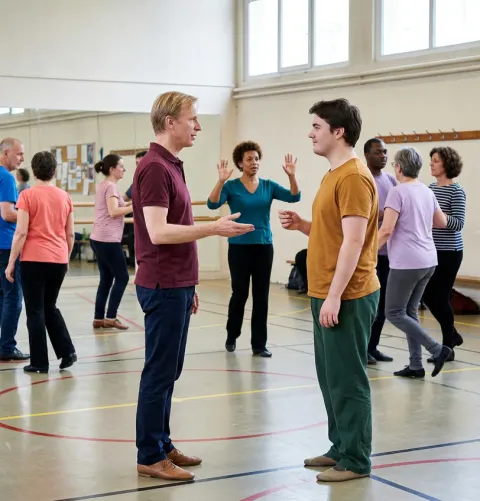
You can understand a lot by observing during guided sections. Difficulties arise when it's explained only verbally whether a movement should be mirrored or performed in the same direction. The article about common mistakes when copying dance moves explains how these mix-ups happen.
If no language is specified for the introduction or workshop, simply ask the organizers: L'initiation est-elle aussi expliquée en anglais? This means: Is the introduction also explained in English?
Correct
Misconception
A visible movement shows you the direction, but not necessarily whether you should start, wait, or stop.
In social dancing, not every weight shift is explained verbally. An invitation to dance, an affirmative nod and a thank-you at the end can work without a longer conversation. But that does not mean every gesture is unambiguous: an outstretched hand can be an invitation, while a raised hand signals a pause.
For guided sections, individual cue words can help. On commence means we begin, on arrête means we stop, à droite means to the right and à gauche means to the left. Encore une fois announces a repeat. The words make it easier to find your bearings, but they don't replace an explanation of an unfamiliar or physically challenging movement.
If you don't understand something, staying still is better than carrying out a guessed movement with momentum. Je n'ai pas compris means: I didn't understand. With Plus lentement, s'il vous plaît, you ask for a slower explanation.
You can also name your dance role briefly: Je guide means I lead, and je suis means I follow in the right dance context. For more on why this agreement matters, see the article about Leading and following with dance partners in Paris. A brief exchange prevents both people from taking on the same role.
You can take your time figuring out a text
You can translate a written announcement and read it several times. That way, the context stays clear: an introduction before the dance evening is just one part of the program, not automatically the whole visit.
Music and movement happen at the same time
A spoken instruction can disappear while you’re still thinking about what it means. Repetition, visible demonstrations, and clear signals can help you follow along without translating every sentence.
In a French dance listing, stage usually means workshop or intensive course, not stage. The word looks English, but it has a different meaning here. A stage can consist of several instructor-led sessions; only the specific time information tells you how long it lasts.
Tous niveaux means all levels and describes the dance experience of the intended audience, not the languages available. Even an event for different experience levels may have explanations exclusively in French. So this phrase does not tell you whether you will understand the spoken instructions.
Je ne parle pas français means: I don't speak French. Parlez-vous anglais? means: Do you speak English? This polite form also works when talking to dance guests you don't know. To ask someone to repeat something specific, you can say Pouvez-vous montrer encore une fois?: Can you show it one more time?