With company to the live band
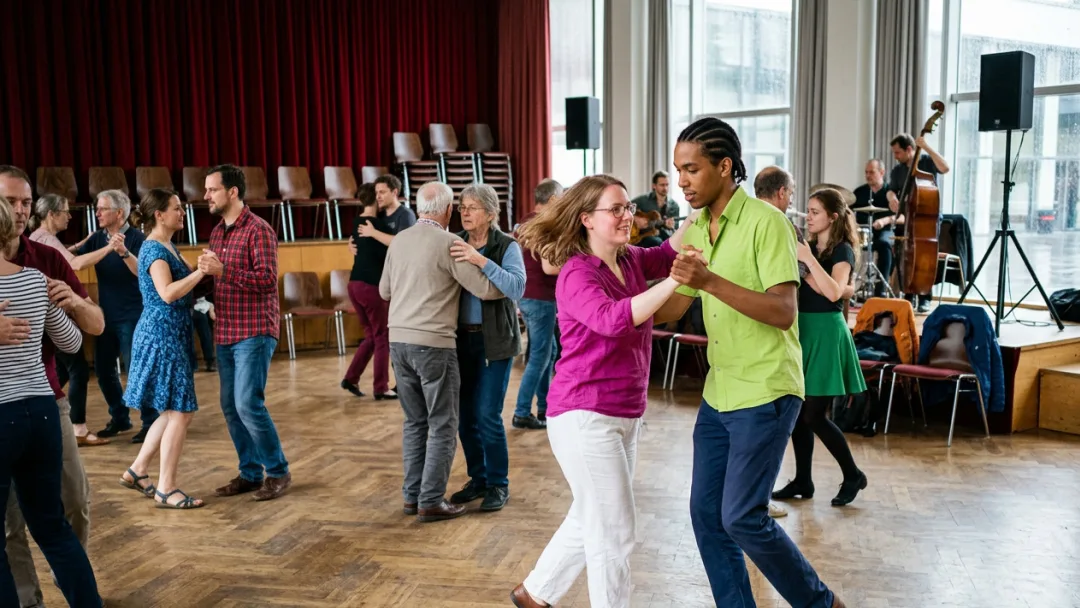
On udansa, you can find dance partners in Paris to join you for an evening with a live band and open dancing.

By Mary De LucaUpdated
On udansa, you can find dance partners in Paris to join you for an evening with a live band and open dancing.
After work, you want to do more than just tap your foot along to the beat. Whether you can dance among the other guests or listen to the musicians from your seat changes the whole evening.
Audience dancing means that guests at an event can dance themselves, with space set aside for it in the schedule and venue. It differs from a dance performance, where the audience watches.
If you’re looking for an evening of dancing in Paris, the term live music initially tells you only where the music comes from: people are playing it on site. It doesn’t tell you what role you have as a guest. The same lineup can accompany a concert or play music for an open dance floor.
A reliable indication connects the music with an explicit invitation to the audience. Phrases such as open dancing to a live band, dance floor for guests, or concert followed by dancing make this participation clear. The word followed by makes an important difference: listening may be expected during the concert, with dancing only afterward.
An advertised dance show isn’t enough either. It could mean a stage performance where you stay in your seat. An admission ticket likewise tells you about access, not how the room is used. If only the lineup, repertoire, and concert start time are mentioned, it remains unclear whether you can join in the dancing.
For a general overview of the formats, the guide to dance evenings in Paris offers more context. What matters most here is whether guests are explicitly addressed as dancers.
A clear pulse, a familiar rhythm, or a song you have danced to before can instantly make you want to move. But that does not give you the right to take up space. At a concert, the same music may be arranged for focused listening, for example with longer solos, open introductions, or deliberately changing dynamics.
To dance along, you need an audible sense of timing. The bass, drums, or accompaniment often provide it more clearly than the melody. An extended solo does not have to change the basic pulse, but a free ending can dissolve it. You can then make your movements smaller or let them wind down, instead of carrying a familiar sequence of figures through to the last step.
Musical suitability and spatial suitability are two separate requirements. A dense crowd in front of the stage may allow you to sway, but not to turn safely. A narrow aisle between tables is no substitute for a dance floor. Open spots right next to speakers or cables are not automatically intended for dancing either.
That is why the statement “danceable live music” is less informative than a description that also mentions a contiguous, usable area for dancing guests.
Informative
Not sufficient
The band describes what you hear; the room layout and schedule show whether you can dance yourself.
A compelling description answers three distinct questions: who dances, where dancing takes place, and during which parts of the program. Dancing by the audience identifies the participants, an open dance floor indicates the location, and dancing to the band or between sets indicates the timing. Together, these details give you a useful picture of the evening.
In a mixed format, the stage may first host a concert segment and later accompany a dance section. This is neither better nor worse than an evening devoted entirely to dancing. But it makes a difference to you whether you mainly want to listen or spend as much time as possible on the dance floor. A note about breaks between sets also helps you avoid mistaking an interruption for the end of the dancing.
If the key connection is missing, a specific question for the organizer is enough: Is an open area provided for guests to dance during the live music, or is the space in front of the stage filled with seats? This question is about how the space is actually used, not just whether dancing is allowed in principle.
For individual French terms, the guide to event notices without French can help you understand. Ultimately, a clear event description lets you distinguish between listening, joining in the dancing, and an evening with both.
A concert can be just the thing
You hear the solos, the different sounds and how the band plays together, without also having to think about your next step. A seat or a quiet standing area helps you focus. The urge to move alone doesn't make it a dance area.
The space belongs to the dancing guests too
You respond physically to the rhythm and share the floor with others. The band remains present, but your line of sight also needs room to take in movement and spacing. You can take listening breaks without losing the character of the dance evening.
At a standing concert, dancing is reliably expected only when audience dancing is explicitly part of the event. Standing tickets first of all let you listen without a seat. In a tightly packed crowd, there is no room for turns and side steps, even if many people are swaying to the beat.
Dancing continues during the band's breaks only if additional music and a dedicated dance segment are planned. Some schedules include recorded music between sets, while others have a real break. The term live music does not tell you which applies, and it does not promise an uninterrupted evening of dancing.
Seats do not rule out a dance evening. Chairs around the edge give you a chance to rest and listen between dances. What matters is whether there is also a continuous dance floor. Rows of chairs directly in front of the stage are more likely to indicate a setup focused on listening.
You can dance the same familiar steps to a live band, but you should respond to the tempo actually being played. The intro, ending, or length of a song may differ from a familiar recording. Small steps and a simple figure give you room to adapt to these changes.