Meet up to Practice
On udansa connect, you can find dance partners in Paris to work on a specific move. Just name your dance style and what you’d like to practice together.

By Mary De LucaUpdated
On udansa connect, you can find dance partners in Paris to work on a specific move. Just name your dance style and what you’d like to practice together.
A faltering turn can be a good opportunity for a conversation or unnecessarily disrupt your dance together. What matters is whether you're working on a move or want to enjoy a song together.
Practica refers to an open practice session, especially in Tango, where you try out movements of your own choosing alone or with others.
If you’re looking for a practice evening in Paris, the description of the schedule is more helpful than a friendly event name. You’ll encounter the word Practica especially in Tango. It describes a setting where you can work on a familiar movement without having to dance through every song in full. It requires neither a set sequence of figures nor a shared task for everyone.
Phrases such as free practice, guided practice or open practice session are informative. Free practice leaves the topics up to the participants. Guided practice suggests support, but doesn’t automatically promise ongoing lessons. By contrast, references to free dancing, a dance floor and musical programming are more likely to indicate a party segment.
An introduction before the party doesn’t turn the dancing that follows into a practice evening. An event can combine several segments with different expectations. The time alone won’t tell you when this changes, but the announced order will. The word Milonga is also not a synonym for Practica; the conventions for attending this Tango evening are a topic of their own. For a broader overview of the formats, see Dance evenings in Paris.
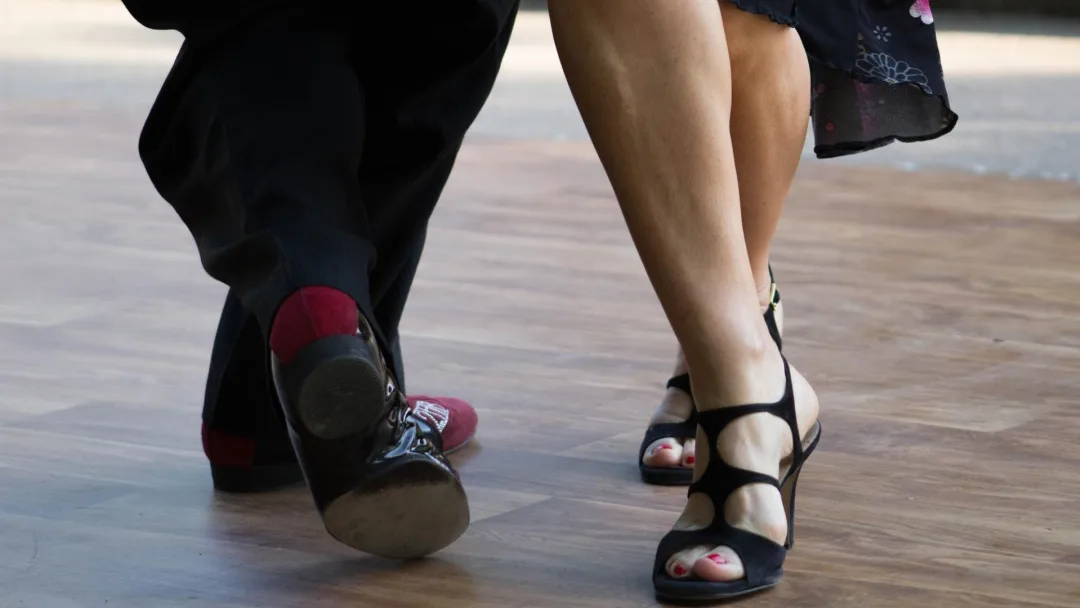
At a Practica, a short movement may be worth trying several times. But the freedom to practice doesn’t mean your partner automatically takes on your technical goal. Maybe you want to understand the start of a turn, while the other person is working on their balance. Only a shared intention turns a repeated attempt into a useful exercise.
Helpful feedback stays with a specific observation: “I still had my weight on the other foot when the next step began.” You can explore that in the next attempt. “You lead badly,” on the other hand, gives neither an observable moment nor a movement you can change. Describe your own impression instead of diagnosing the other person’s body.
A question like “Would you like to hear what I felt?” leaves room for consent or refusal. That applies even when you have more experience. When dividing tasks as a couple, it’s also important to name leading and following clearly: both roles provide information, neither automatically gets the teaching role. When you talk something through, release the dance hold and step out of other people’s path. A practice format allows for breaks, but not for blocking the floor.
That's right
Myths
Helpful feedback describes an observable movement instead of broadly telling the other person that they’re dancing incorrectly.
At a dance party, the song playing sets the shared task. You respond to the rhythm, accents and your partner, instead of repeatedly starting over at the same point. Of course, you learn along the way too: you notice whether a movement works without lengthy preparation and whether your repertoire suits the music. This learning happens in the flow of the dance.
So using a familiar figure several times is not automatically out of place. The difference lies in whether it remains musically integrated or whether you turn the dance into a technical experiment. As soon as you stop, explain and start again, the shared activity changes. Your partner does not have to agree to this change just because you are dancing together.
Even during a party, you can briefly try something out together by mutual agreement, as long as there is enough space and nobody is in the way. A longer analysis is better suited to a break or another practice session. This gives you a clear expectation for your evening: if you have a persistent technical question, an announced practice session is a better fit. If you want to connect familiar movements to changing music, free dancing gives you the right context. Both formats have their own benefits.
The Practica lets you focus more closely
You can try the same transition several times and consciously notice the differences. A failed repetition still gives you information: Had your weight already arrived, or did the next movement begin too soon?
A dance party gives you room to make connections
You connect familiar movements with the music and your partner's response. This helps you discover which transitions work without preparation and when a simple move fits the song better than an elaborate figure.
No, a practica can take place without a teacher. A supervised practice session can offer occasional guidance, while free practice relies more on your own observation. This does not mean there is a shared learning program: you work on what you already know and want to understand better.
Yes, you can practice some parts alone at a practica. Weight changes, balance, and small steps do not always require a partner. However, this cannot replace coordinating as a pair, and when practicing solo, you should still leave the shared space free for others.
No, a practica can take place with music. For a difficult transition, you can briefly step away from the musical flow and then start dancing in time again. Dancing all the way through lets you see whether the movement you worked out also fits the song's tempo and accents.
You can stop the move and continue dancing with a familiar one. A failed attempt does not require an immediate analysis of what went wrong. If you feel uncomfortable or something hurts, of course stop right away; staying in sync with the music never comes before your safety.