Go out dancing with a partner
On udansa connect, you can find dance partners in Paris to attend an event with. When you make plans, you can already agree whether you’ll still go if the event is rescheduled or skip it.

By Bernhard De LucaUpdated
On udansa connect, you can find dance partners in Paris to attend an event with. When you make plans, you can already agree whether you’ll still go if the event is rescheduled or skip it.
Outdoor music makes watching easy. As soon as you want to dance yourself, seemingly minor details matter: a seam underfoot or an unclear floor layout can change your planned visit.
At an open-air dance event in Paris, three things need to be distinguished: access to the venue, access to the event, and permission to join in dancing. An open-access space can be used for a performance. An event for the public may still require registration. And an open dance session may begin only after a stage program. None of these conditions can be inferred from the venue alone.
Public dance events also have a history in Paris: the first public Bal des pompiers is considered to be the ball held in 1937 at the Carpeaux fire station. This historical note does not, however, confirm a current date or the participation requirements of a new announcement. For your visit, what matters is the specific event, not the tradition behind its name.
So distinguish welcoming language from reliable details. “Everyone welcome” describes the intended audience, while “free dancing” describes the planned activity. Only information about registration, entry, and the dance session gives you a useful outline. You can find an overview of different formats at Going dancing in Paris. If your experience level is what matters most, the guide to your first dance party in Paris can help, but it does not replace a weather policy.

Read the announcement all the way through and note whether the event is open to the public, the floor surface, the weather policy, and the alternative venue. Include only details explicitly stated. If any key information is missing, combine your outstanding questions into a single message to the organizer.
Distinguish between “public,” “free of charge” and “no registration required”: these statements are not interchangeable. Note whether open dancing is actually planned and whether registration is required. A performance program alone is not an invitation onto the dance floor.
Distinguish a dedicated dance floor from paving stones, asphalt, or grass. Joints, rough patches, and yielding ground make turns on a weighted foot more difficult. Start with small steps and no quick changes of direction; a description of the surface material alone does not confirm that it is level or offers enough grip.
Note separately what happens in case of rain: the event continues, is interrupted, canceled, or moved. “Weather-dependent” does not yet specify a decision. A roof does not automatically protect you from wet ground or rain blowing in from the sides; during a thunderstorm, look for a safe indoor space.
Only accept a replacement venue if it is explicitly named for this event. Also note whether the same participation conditions apply there and whether a new admission time has been announced. A covered area at the original venue is not an automatically confirmed replacement.
Before setting out, check the specified official announcement channel and read the latest event update. An explicit cancellation or rescheduling supersedes the original announcement. Don’t rely on an old screenshot; without a verifiable decision, your plans to attend remain uncertain.
Step only onto the approved dance floor and begin with simple weight shifts. If your sole catches or slips, or your foot tilts at a seam, stop. Adjust your figures only after a safe start; an announced activity does not obligate you to dance along.
Do it this way
Not like this
Classification
Decision
Getting Started
“Entrée libre” indicates free admission, but does not by itself confirm an open dance session. The phrase describes admission, not use of the dance floor. Even with free admission, entry conditions or limited capacity may be specified. That is why an explicit statement about dancing is still important.
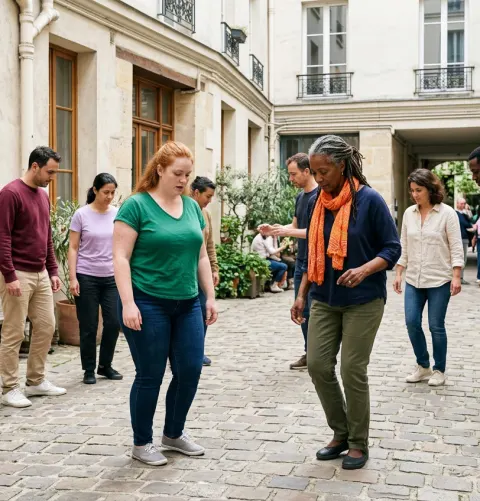
Small steps may be possible on dry, sufficiently level cobblestones, but fast turns are much more challenging. The key factors are the gaps, uneven heights, and how your soles grip the stones. Do not turn on a planted foot. If you have to keep compensating for uneven surfaces, watching is the safer choice.
Grass is not a reliably suitable surface for many turning figures. The ground may give way, shoes may sink in, and the surface may be wet even when it is not raining. A designated dance floor is different from the grass beneath it. If you cannot stand securely, you should avoid turns.
“Maintenu” means that the event is going ahead, but does not by itself confirm that the venue has not changed. An announcement may also include a change of venue. So read the entire message, including the location and entry time. A single word in a forwarded message is not enough to plan your route with confidence.
A cancellation due to weather does not automatically mean the same refund policy applies in every case. What matters are the booking terms in effect and the specific notice about the cancellation, relocation, or replacement date. Keep your booking confirmation and the cancellation notice. A relocation is not the same as a full cancellation.
Coming later only makes sense if the event is explicitly continuing or resuming. The rain stopping does not cancel a cancellation. Also, wet patches and softened ground may remain. What matters is the latest event notice and the actual conditions on the designated area.