Experience can be different
On udansa connect, you can find dance partners in Paris and explore what dancing together feels like, even when you have different levels of experience.

By Bernhard De LucaUpdated
On udansa connect, you can find dance partners in Paris and explore what dancing together feels like, even when you have different levels of experience.
Next to someone who moves with confidence, your own progress can suddenly feel tiny. But an awkward move can show whether you give each other room to learn or turn every attempt into a judgment.
Weight transfer means shifting your body weight from one supporting foot to the other. When dancing, it determines which foot is free for the next movement.
When you’re looking for a dance partner in Paris, the number of years they’ve taken classes tells you little about how you’ll dance together. Someone can know many figures and still react late to a weight shift. Another person may know only a few sequences but keep the rhythm reliably and move without pulling on the arms. Both are part of dance experience, but they are distributed differently.
What matters most for your compatibility are the skills you need at the same time: a shared pulse, clear preparation, and enough individual balance. A simple turn makes this tangible. The more experienced person allows time to transfer weight, while the less experienced person can carry the step on their own. If one person has to pull the other through the movement, the uncertainty isn’t resolved, just concealed.
A difference in skill level is manageable when you can maintain a shared, comfortable flow. That doesn’t mean identical steps or perfect execution. Small delays are fine as long as you can accommodate them without building up pressure. Height, age, and gender don’t offer a reliable shortcut here. Instead, notice whether you can resume dancing calmly after a moment of hesitation and whether both of you can control your own movement.
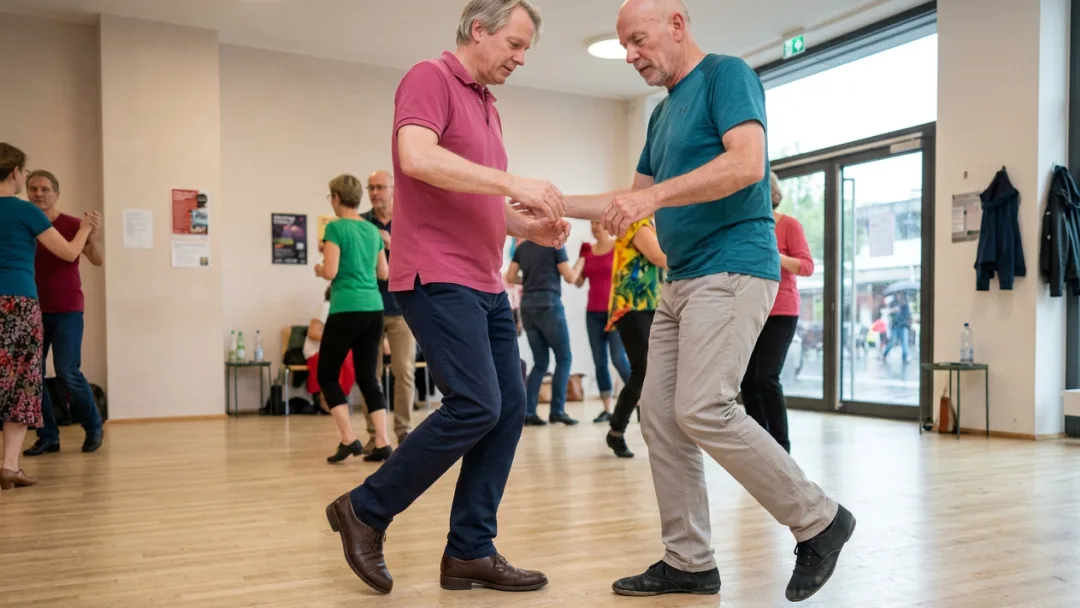
Having more experience doesn't automatically give your dance partner the right to judge every attempt. Unasked-for comments can draw your attention away from the music: instead of noticing a step, you end up waiting for the next judgment. Even technically correct advice is of little help if it comes at the wrong moment or addresses several problems at once.
Useful feedback separates observation from explanation. “Our hands move apart before the turn” describes something you can both notice. “You’re leading wrong,” on the other hand, already assigns a cause and blame. Maybe the preparation was too late, maybe the step was too big, or maybe you both contributed. A guess can remain a guess.
Consideration goes both ways. If you have less experience, you can’t expect your partner to explain every movement and constantly replace a lesson. If you have more experience, you need consent before dancing together turns into a correction session. If you can’t find a clear explanation for a technical issue, targeted private lessons in Paris may help. For language misunderstandings, there are separate tips on communicating with a dance partner who doesn’t speak French; they’re no proof of a lack of skill.
Yes, like this
Not like this
In the course filter, you'll find current classes and dates in Paris if you'd also like to work on your technique with guidance.
Feedback becomes useful when it describes something you can feel and leaves the other person room for their own perception.
A botched move doesn't mean you aren't a good fit as dance partners. What matters more is how you respond afterward. Can the more experienced person offer a simpler sequence without getting annoyed? Can the less experienced person say something was too fast without apologizing? Then there's room to work things out, even if your dancing still differs considerably.
Simplifying things shouldn't, however, benefit only one person over the long term. Someone who has been dancing longer can work on precision, musical expression and adapting. Someone who's new gets time to find their bearings and their own balance. This only works if both of you genuinely find this exchange interesting. Being constantly underchallenged is just as serious a sign as being constantly overwhelmed.
Pain, forced movements and demeaning comments aren't a necessary part of learning. They point to a problem with the way you're treating each other, not with beginners in general. Conversely, an enjoyable dance doesn't prove that every challenging exercise is already a good fit for you to do together. You might work well together on simple moves and hit a limit with more complex tasks. That limit describes how you're working together right now. It isn't a judgment on your worth as a dance partner, and it doesn't mean you have to adapt to the other person as quickly as possible.
Fewer moves, more attention
If you've been dancing for a while, you can observe your own clarity in a simple sequence: Does your cue come at the right time? Do you stay balanced? The challenge is genuine adaptation, not showing off your repertoire. You don't have to resolve every uncertainty your partner has.
Less routine, an important perspective
If you have little experience, you immediately notice which movements make sense to you and which ones surprise you. This awareness helps you dance together. You don’t need to know any technical terms, and you can stop a try before you struggle your way through it.
You’re not automatically holding them back, because even simple movements can be challenging for experienced dancers. What matters is whether they’re willing to work on clarity and adaptability. If they only want to practise new, complex sequences, you may not be able to offer enough for that purpose.
No, your dance partner doesn’t need to be able to explain mistakes technically. Dancing confidently and teaching clearly are different skills. They can tell you what they feel without knowing the cause. For a technical diagnosis, a lesson is more suitable than a guess delivered with confidence.
A move can work with other people because they unconsciously compensate for differences in timing or preparation. That doesn’t prove that only one of you is doing something wrong. A familiar partner may already recognise a small preliminary movement that isn’t yet clear to someone less experienced.
Yes, you can disagree as a beginner, especially if there’s uncomfortable pressure or an explanation that doesn’t match your experience. Experience doesn’t make anyone infallible. Distinguish your perception from a technical claim: “That pulls on my shoulder” is clear feedback, even without analysing the cause.