Ballroom Dancing6 minutes

Your Standard Ballroom Dance Course in Stuttgart: What Matters

By Mary De LucaUpdated

In short
  • A standard Latin dance course in Stuttgart combines several dances, with the exact selection depending on the course.
  • What matters are the dances listed and enough repetition between new rhythms and figures.
  • Good beginner instruction teaches weight changes, appropriate dance posture, and clear partner leading instead of just step sequences.
  • A social dance course may also include Discofox without teaching the full competition syllabus.

At the first change of music, a familiar step suddenly feels wrong. That’s exactly when you can tell whether you’re memorizing individual sequences or gradually understanding how different dances work.

DefinitionMulti-Dance Course

A multi-dance course is partner dance instruction that teaches several dances as part of the same course series. The term does not specify a fixed list of dances or a particular number of figures.

The dance list says more than the course name

If you want to learn ballroom and Latin dances in Stuttgart, the course title gives you a general idea of what to expect. It doesn't tell you whether you'll get to know many dances or practise just a few in depth. In competitive dance, ballroom includes the Slow Waltz, Tango, Viennese Waltz, Slow Foxtrot and Quickstep. Latin includes Samba, Cha-Cha, Rumba, Paso Doble and Jive. A social dance course doesn't have to cover this full programme.

For beginners, a selection can make sense, for example the Slow Waltz, Foxtrot, Cha-Cha and Rumba. This is just an example, not a binding course standard in Stuttgart. Discofox may be included as another social dance, but it isn't one of the ten competitive dances listed above. And in everyday course descriptions, Foxtrot isn't simply another name for Slow Foxtrot.

That's why, when choosing a course, it's helpful to take a quick look at the dances listed in the course description on udansa. A short list doesn't automatically mean fewer lessons: a lot of work on rhythm and connection as a couple can go into just a few dances. Conversely, a long list doesn't guarantee that you'll be able to dance them with confidence. If your only goal is to prepare for your wedding, the page about the wedding dance course in Stuttgart covers that specific focus.

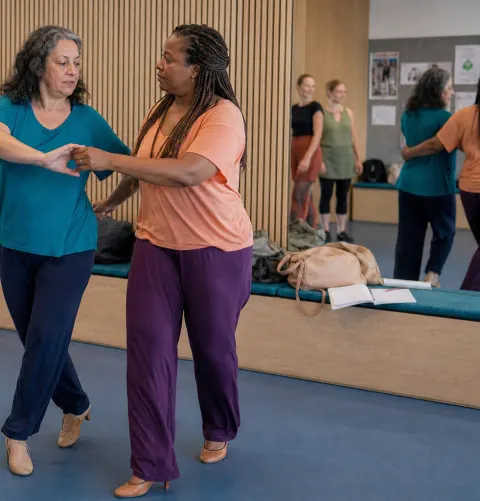
Dancers move during a social dance
Even when watching, you can tell whether the steps fit the music or simply proceed at a steady pace.

Dance changes combine repetition with distinction

When switching between dances, it is not just the song that changes. Slow Waltz organizes movement in triple time; Cha-Cha works with a split beat and a characteristic chassé. If you transfer the same step speed to both, you lose their distinction. So you learn something new while also having to consciously let go of the previous movement.

A clear lesson structure gives each dance a recognizable framework: listen to the music, take on the basic movement, repeat a familiar sequence, and only then add more. The dances can alternate within one lesson or be grouped across several lessons. Neither model is inherently better. More frequent changes help you practice matching the dance to its movements; longer blocks leave more time for movement details.

What matters is whether familiar material returns before the next challenge is added. New figures alone can quickly create the impression of progress, even though you still cannot find your way into the dance on your own. Tempo and difficulty are not the same either: a slower song can make preparation easier, but it still requires appropriate weight changes. The article on Quickstep speed and practice music explains how this works in a lively ballroom dance.

How to recognize a clear dance transition

Like this

  • Listen to the new rhythm first and pick it up with small steps
  • Before the new sequence, transfer your weight clearly onto one foot
  • Adjust the hand connection to suit the new dance hold
  • Dance a familiar basic sequence again after the switch

Not like this

  • Keep dancing the previous step sequence as soon as a new song starts
  • Jump into the new sequence with your weight on both feet
  • Keep the closed position during every open figure
  • String together only new figures with every change

You only understand a dance figure when you can dance it with the right rhythm and without pulling on your partner.

udansa editorial team for partner dancing

Posture and partner connection make what you learn useful

A basic sequence only becomes danceable together when both partners carry their own weight. Dance posture therefore does not mean forcing yourself stiffly into a shape. You stand tall, keep your shoulders relaxed and maintain the connection so that movement intentions can be felt. Your partner is not there to support you.

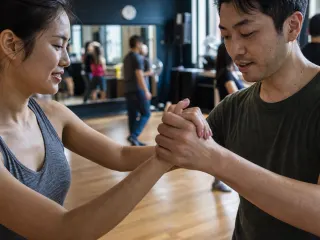
In ballroom dances, a stable closed hold helps you shape pathways and turns together. In many Latin figures, the partnership opens up, the hand connection changes and both partners move more independently for a while. The leading partner signals direction and timing without pulling on the arms. The following partner responds with their own steps instead of being pushed around. The article on leading position changes in Cha-Cha shows how to maintain a connection as you open up.

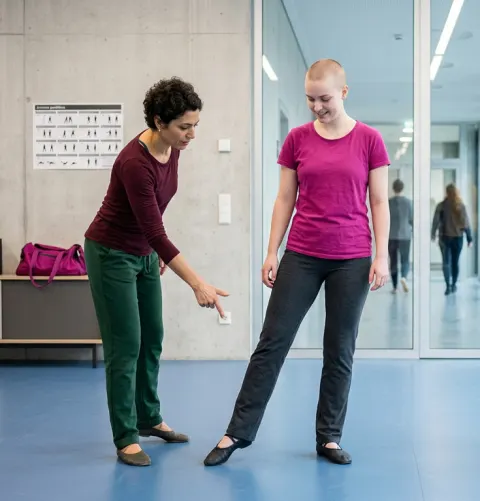
For your course, this means explanations of standing leg, preparation and connection are just as valuable as figures. Counting out loud supports the rhythm, and specific feedback makes it clear why a step falters. A course that revisits these fundamentals across several dances gives you transferable knowledge. You can then adapt a familiar sequence to the music, the space and your partner's movement instead of running through it regardless of the situation.

Two useful focuses in the multi-dance course

Breadth

Match More Music Styles

Several dances, starting with simple sequences

You want to find a suitable basic movement for different songs. A broad-based course helps you navigate triple meter, even steps and subdivided beats. Its value lies in recognizable basic patterns, even if your range of figures is initially small.

In-Depth

Understand Fewer Dances More Thoroughly

More Time for Connection and Movement Quality

You want to feel the differences in your body more clearly. A more focused course spends longer on individual dances and can repeat the same sequence with a different feel for rhythm or clearer leading. Its value lies in building confidence and precision, even if more dances are added later.

Frequently Asked Questions

  1. You don't need high heels to get started, but you do need secure shoes that allow controlled turns. Very grippy soles can make turning harder, while soles that are too smooth can make standing feel unstable. Dance shoes become useful as you gain experience, but they don't replace a stable transfer of weight.

Ballroom and Latin Classes in Stuttgart

On udansa, you'll find the latest classes and dates in Stuttgart for learning several dances together.

Multiple dances, one partner

On udansa, you can find dance partners in Stuttgart to practice waltz hold, Latin rhythms, and switching between the two together.

Multiple dances, one partner