Choosing a Class5 minutes

Contemporary Dance: Which Class in Stuttgart Is Right for You?

By Bernhard De LucaUpdated

In short
  • For contemporary dance in Stuttgart, look for classes whose floor work and improvisation component match your learning goal.
  • An introductory class covers weight shifts, basic floor contact and movement exercises without assuming you can do challenging rolls or jumps.
  • You don't need to be able to do the splits or have ballet training to get started, but you should choose a level of physical exertion that suits you.
  • Stuttgart's professional dance history doesn't tell you whether adult classes are currently available to book.

A movement can look easy while standing and suddenly require a lot of strength on the floor. At the same time, an open-ended task can feel unfamiliar even if it requires little physically: both are part of choosing a class.

DefinitionFloorwork

Floorwork refers to dance movements performed on the floor, as well as transitions between lying, sitting, kneeling, and standing.

The course name does not yet describe the way of working

If you're looking for a contemporary dance course in Stuttgart, you'll come across terms such as Contemporary Dance, Modern Dance or Dance Improvisation. These terms overlap in class, but they are not reliable synonyms. Contemporary can combine technical movement sequences, floor work and creative tasks. Modern Dance also refers to distinct dance traditions, while improvisation mainly describes a way of working.

A class might begin with mobilization and simple weight shifts, build a short phrase and then develop variations on it. Another might spend longer on an open-ended task and work with few set sequences. So when choosing, what matters is the kind of learning that shapes the class: following along and repeating, exploring independently or a combination of both.

Local dance history does not automatically explain the course offering. The Produktionszentrum Tanz + Performance was founded in 2000 in Stuttgart; its work is part of the professional scene, not evidence of adult classes available to book today. You can find current offerings and dates in the Stuttgart course filter on udansa. If you're joining a group later on, it also helps to understand the difference between general movement experience and foundational skills already developed by the class.
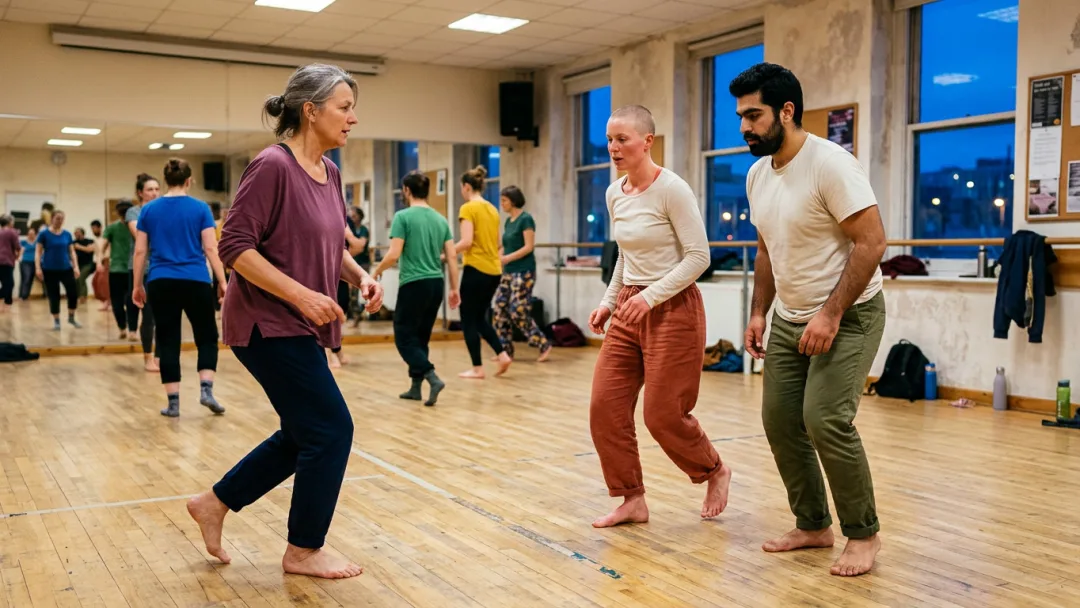
A visible shift in the points of support often explains more than a movement sequence danced all the way through.

Floorwork is technique, improvisation has a framework

Floorwork is often confused with spectacular rolls or acrobatic transitions. In beginner classes, however, floorwork often starts with simple questions: Where is your weight? Which part of your body is supporting you? How do you move from sitting to kneeling without throwing yourself onto a joint with momentum? Good explanations make these transitions easy to follow instead of just showing the finished movement.

Here, “letting go” does not mean releasing all muscle tension. You regulate tension so that one supporting arm can bear weight while the rest of your body remains mobile. Slow transitions can certainly be tiring because you control your weight for longer. Speed is therefore not a reliable measure of exertion.

Improvisation also does not mean doing just anything without direction. An exercise can set a direction of movement, a body part or a spatial boundary. “Move only along an imaginary line” creates a clear framework within which you make decisions. A good introduction offers manageable exercises and time to explore them. If the combination of technique and free movement tires you out at first, it helps to follow the principle of increasing dance exertion gradually, instead of trying to do everything from the start.

How to recognize the right lessons for you

Yes, like this

  • Shift your weight slowly between your hand, pelvis, and foot
  • Try a movement exercise with small variations
  • If you feel discomfort, make the movement smaller or skip it
  • Begin contact work only with mutual consent

Don't do this

  • Fall without preparing your knees or wrists
  • Force big movements right away for every open-ended task
  • Treat pain as a necessary part of training
  • Touch others or take their weight without checking with them

A small movement with a clear shift of weight is a useful foundation, even if you can’t manage the bigger version yet.

udansa Editorial Team

Your body needs suitable variations, not an ideal shape

For adult beginners, what matters is not how high a leg can go. More important are accessible ways to move and a level of exertion that suits your current ability. Depending on the exercise, floorwork can put strain on your wrists, knees or shoulders; quick changes of direction also challenge your spatial awareness and balance. Flexibility alone says little about this.

Suitable instruction offers alternatives: you stay in a higher position, skip a jump or replace a weight-bearing hand support with a different movement. These variations keep the task the same without requiring the same physical form. Pain is not a sign of a good exercise. If you have persistent discomfort or known injuries, a medical professional or physiotherapist should assess what level of exertion is suitable.

Your learning goal helps determine what to focus on. If you want to develop safe transitions to the floor, you need time to prepare and repeat them. If you want to create your own movements, room for improvisation is important. For one particularly challenging transition, targeted private lessons in Stuttgart may also be a good fit. The quality of the instruction is not shown by an impressive demonstration, but by whether you can understand the task through your own body and adapt it in a meaningful way.

Two approaches to the same movement

Technique

Understanding a Set Phrase

You learn through repetition and feedback.

A short movement sequence gives you clear points of reference: direction, order, and transitions are set. Through repetition, you notice where your weight isn't quite keeping up yet and how a different preparation changes the flow.

Improvisation

Find movement through a task

You learn through choice and variation.

A cue like “follow your elbow” allows for several solutions. You explore which direction, speed, and size feel right for you, and develop your own movement material from your choices.

Frequently Asked Questions

  1. Wear comfortable clothing that doesn’t dig in during floor work and covers your knees if needed. Working barefoot is common, but whether you wear shoes or socks depends on the exercise and the floor. Socks can help with turns, but may not provide enough grip for weight-bearing movements.

Contemporary Dance Classes in Stuttgart

On udansa, you can narrow down offerings under Modern Dance and Dance Improvisation based on your focus.

Share your movement journey

On udansa, you can find people in Stuttgart to practise movement phrases with or talk about Contemporary classes.

Share your movement journey