

Find your start in Ballet
Whether you want to experience the historical grace of ballet yourself or just want to try it out carefully: On udansa you will find the right courses for your start. Discover a community that shares your passion for dance.


The history of ballet is a fascinating journey through eras, countries, and social classes. It shows how an exclusive courtly privilege grew into a worldwide, high-precision stage art.
Classical Ballet refers to a centuries-old, academic dance form based on precise, defined body positions and the outward rotation of the legs. It evolved from European courts into a highly complex theatrical art.
The roots of ballet do not lie in the grand opera houses of our time, but in the magnificent palaces of the Italian Renaissance in the 15th century. Back then, the so-called balletto was not an independent stage event, but an integral part of courtly festivities. Wealthy princes used these elaborately staged performances to demonstrate their wealth, power, and political influence. The dancing participants were not professionals, but the nobles themselves, who moved in strictly choreographed, geometric formations.
When the Italian noblewoman Catherine de' Medici married the French King Henry II in the 16th century, she brought this art form to the French court. Under her patronage, the spectacle evolved further and combined music, dance, singing, and poetry. These early forms of dance were strongly influenced by the fashion of the time. Heavy, floor-length garments, voluminous hoop skirts, and stiff masks massively restricted the dancers' movement. It was primarily about representation, elegance, and adherence to strict court etiquette, not about athletic peak performance or expressive leaps.

Ballet owes its decisive step toward professionalization to King Louis XIV, the Sun King. He was a passionate dancer himself and founded the Académie Royale de Danse in Paris in 1661. With this, he finally moved dance out of the private chambers of the nobility and onto the public stage. Professional dancers now took over the roles, and the first systematic training began. Under the direction of choreographer Pierre Beauchamp, the five basic foot positions that are still valid today, as well as the principle of turning the legs outward, were recorded in writing.
With the move to the theater stage, the requirements for costumes also changed. To give dancers more freedom of movement for more demanding jumps and turns, the dresses were gradually shortened over the course of the 18th century and the masks were discarded. Ballet emancipated itself from being a mere decorative element of opera and developed into an independent art form that could tell stories without a spoken word. Anyone who attends their first ballet class for beginners as an adult today is training on exactly this historical foundation of the Paris Academy.
When watching a classical ballet, consciously observe the symmetry of the group. This geometric order is a direct legacy from the royal gardens of the Baroque era.
Dance is the art that reveals the human soul through the movement of the body, shaped by centuries of discipline.
In the 19th century, the creative center of ballet development shifted increasingly to Russia. Under the patronage of the Tsars and through the visionary work of French choreographer Marius Petipa at the Imperial Mariinsky Theatre in St. Petersburg, classical ballet reached the perfection known to this day. During this era, immortal masterpieces such as Swan Lake, The Sleeping Beauty, and The Nutcracker were created. Petipa combined French elegance and Italian virtuosity with the dramatic expressive power of Russian dancers.
The Russian school not only refined the technique of the soloists, but also elevated the corps de ballet, the dance ensemble in the background, into its own highly precise art form. Symmetrical formations and synchronized movements became the hallmark of this era. Through this synthesis of various European influences, the Russian school emerged, which is still considered the epitome of technical perfection and deep emotionality today. For everyone who would like to experience this fascinating world themselves today, a structured ballet class for adults offers the ideal framework to understand the historical connection between body control and aesthetics step by step.
Representation and status in the Baroque era
In the beginning, dance served as a means for the nobility to present themselves at court. The movements were flat, strictly geometric, and heavily regulated by heavy, restrictive garments.
Professionalization and artistic freedom
With the move into theaters, dance became a profession. Costumes became lighter, and movements became more dynamic, three-dimensional, and optimized for the audience's long-distance view.
Ballet originated in the 15th century at the Italian princely courts of the Renaissance. From there, it spread to France, where it received its academic structure in the 17th century.
Do you want to experience the fascination of classical dance yourself? Find the right course on udansa now.
 Ballet for adult beginners: Basics & postureStarting ballet is possible for adults of any age. Learn the most important positions and how to sustainably improve your body posture.
 Ballet Class Structure for Adults: From Barre to CenterThe structure of a ballet class for adults combines discipline with elegance. Learn how barre exercises, center work, and targeted stretching help you get fit.
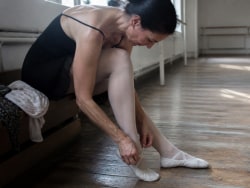 Ballet history, repertoire and realistic goalsDiscover the fascinating evolution of classical ballet from its royal court origins to the great masterpieces on world stages. Learn how to understand the repertoire and set healthy, motivating goals for your training as an adult.
 Famous Ballet Pieces: The 10 Essential ClassicsDive into the fascinating world of classical ballet. We introduce you to the ten most important masterpieces that every dance enthusiast should know.