World music4 minutes

Balkan dance music: Understanding and dancing odd time signatures

In a nutshell
  • Odd Balkan rhythms like the 7/8 or 11/8 time signature are based on a mix of short and long beats instead of a steady pulse.
  • When counting the bars, the eighth notes are grouped into pairs as short units and into groups of three as long units.
  • The Kolo dance step uses this structure by placing the longer step on the group of three and distributing the short steps across the pairs.
  • The secret to dancing lies in feeling the rhythm in your body and cushioning the steps elastically, instead of counting along rigidly.

Odd time signatures seem complex at first glance, but they carry an incredible energy within them. With the right feel for short and long beats, you will master every circle dance effortlessly.

What you need to get started

  • Openness to unusual, asymmetrical musical structures
  • Flat, flexible shoes for a good feel for the floor
  • A basic ear for percussion accents

Understanding the magic of asymmetrical rhythms

Traditional Balkan music fascinates with its unbridled energy, but it often sounds unfamiliar to Western European ears. While we grow up with even time signatures like 4/4 time, Balkan dance music is based on asymmetrical, odd rhythms. These rhythms are created by combining groups of two and three. Instead of counting evenly, short and long beats alternate. Once you have understood the principle, you will quickly notice that this structure develops its own unique, captivating dynamic.

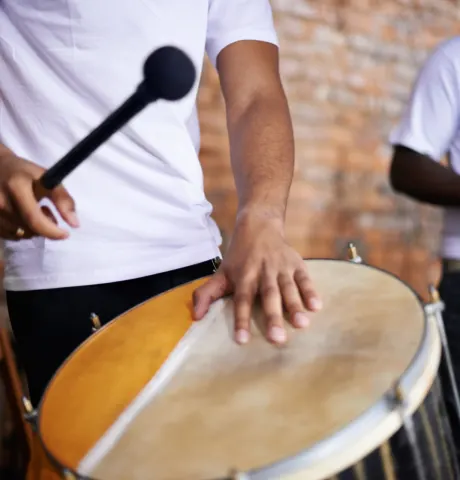
To learn how to dance to these odd time signatures, it helps to take a look at the instrumentation. As described in our guide on drums & strings in world music, percussion instruments like the tapan or darbuka set the rhythmic accents. A 7/8 time signature, for example, is not perceived as seven even beats, but as a sequence of "short-short-long" or "long-short-short". The long beat stretches the movement elastically and gives dances like the Kolo or Oro their typical springy character.

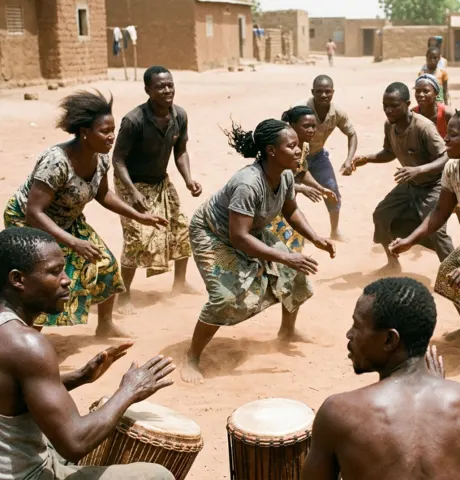
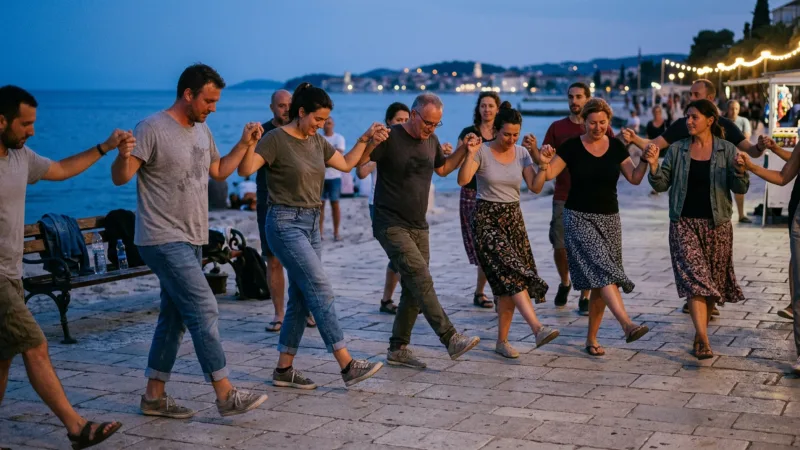
The energy of circle dancing is created by cushioning the steps together on the long beats of the music.
udansa tip

If you get out of rhythm during a Kolo, just stop for a moment and bounce along with the chain in your knees until you feel the heavy, long beat in your body again.

Mastering odd Balkan rhythms step by step

  1. Divide the pulse into groups

    Listen to a piece in 7/8 time and try to divide the fast eighth notes into groups. A classic Kolo dance music rhythm is usually divided into 3-2-2 (long-short-short) or 2-2-3 (short-short-long). Clapping helps to anchor the feeling for the heavy, longer beat.

  2. Speak the syllables out loud

    Speak the rhythm out loud before you move. Use syllables like "Ta-te-ti" for the group of three and "Ta-te" for the group of two. This way, udansa helps you internalize the irregular grid without having to do mental math.

  3. Emphasize the long beat

    Convert the longer beat of the triplet into an emphasized, slightly springy step. Use the shorter beats for quick weight shifts or small intermediate steps on the balls of your feet to stay in the flow.

  4. Swing along in the chain

    Join an existing dance chain. Hold your neighbors' hands loosely and adapt your knee movement to the group's collective up and down motion. The dynamics of the chain help you learn to dance odd rhythms without overthinking.

The most important do's and don'ts for folk dance

How it works

  • Keep your knees flexible and springy
  • Listen for the heavy drum beats
  • Let yourself be carried by the flow of the entire dance sequence

Better avoid

  • Counting every single one of the fast eighth notes rigidly
  • Keeping your legs stiff and stepping flat
  • Working against the pull of your neighbors in the circle

Your path to a confident Balkan rhythm

Before dancing

Preparation

On the dance floor

While

Frequently Asked Questions

  1. The Kolo is a traditional circle dance from Southeast Europe, usually danced in an open or closed chain. The dancers hold each other by the hands or belts and move sideways with quick, often asymmetrical steps.

udansa community

Find like-minded people on udansa

Here you can meet other dance enthusiasts who, just like you, are passionate about the fascinating and energetic rhythms of world music. Exchange ideas, start a folklore group, or find the right workshop in your area.

Sources

Practical experience from Eastern European folklore ensembles and musicological analyses of asymmetric rhythms, as of August 2026.