
Find your community on udansa
On udansa you meet like-minded people who share your passion for modern club beats. Discover exciting workshops and find the right dance partners to move to new rhythms together.


By Mary De LucaUpdated
On udansa you meet like-minded people who share your passion for modern club beats. Discover exciting workshops and find the right dance partners to move to new rhythms together.
Forget rigid step sequences and stiff postures. If you want to dance to Afrobeat and Dancehall, you don't just have to hear the rhythm, you have to translate it in isolation with every single fiber of your body.
To rhythmically master modern club beats like Afrobeat and Dancehall, you need to shift your focus away from the melodies and concentrate fully on the percussion. Both genres are based on a 4/4 time signature, which can be divided into eight counts (an 8-beat rhythm) for dancers. While Dancehall is often dominated by the driving "Dem Bow" rhythm with an emphasized syncopation, Afrobeat thrives on complex polyrhythms where different drums seem to play against each other. If you want to recognize the beat, first look for the heaviest, deepest drum in the background that provides the constant pulse. Only when this basic beat has become second nature can you start to move your body in isolation.
In contrast to classic partner dances, where the entire body acts as a single fixed unit, these urban styles require a precise separation of your body parts. Learning to dance and understand rhythm in Afrobeat means that your hips perform a different movement than your shoulders or your chest. These isolations are not coincidental, but follow exactly the different rhythmic layers of the music. While your feet hold the heavy bass beat on the floor, your arms and upper body can trace the faster, brighter percussion elements in the higher frequency range. This independence of the joints is the key to making the complex character of these world music rhythms visually visible.

Stand with your feet hip-width apart, bend your knees slightly, and let your pelvis sink down naturally. You will know it is working when you feel stable and grounded, and you can gently bounce in your knees.
Close your eyes and filter out the deep bass while you count steadily to eight. You have hit the beat when your head nod matches exactly with the heavy strikes of the drum.
Move your ribcage forward, backward, and to the side, while your pelvis remains completely still. You achieve isolation when your shoulders do not tense up and your breath flows freely.
Place your feet flat on the floor alternately on counts 1, 3, 5, and 7. You are on the beat when your steps underscore the heavy pulse of the music like an additional instrument.
Connect the steps of your lower body with the isolated movements of your chest into a fluid sequence. It works when the movements feel harmonious despite different speeds.
Dancing correctly
Avoiding mistakes
Preparation
Arrival
During
You can best identify the beat by focusing on the heaviest drum in the background. Count evenly from one to eight, with the heavy beats usually falling on the odd numbers.
Isolation exercises for the chest and hips are the most important foundation. Practice daily to move only one body part in isolation to the beat while the rest of your body remains completely still.
No, you do not need any prior experience. Since these are solo dances, you can learn the rhythmic foundations and isolations at your own pace without a partner.
Find the right course to train your isolations and rhythms under professional guidance.
Hip HopLimbach-Oberfrohna · Germany
HipHop 11 - 13 JahreFriday · 15:45 · Oct 9
Limbach-Oberfrohna
Hip HopOranienburg OT Lehnitz · Germany
Hip Hop 6-8 J.Monday · 18:00 · Oct 12
Kulturhaus Friedrich-Wolf
Hip HopLimbach-Oberfrohna · Germany
Hip Hop ab 14 JahreFriday · 16:45 · Oct 9
Limbach-Oberfrohna
 Recognizing the beat in dance music: How to hit every rhythmA sense of rhythm is not a secret, it is a matter of practice. Learn how to pick out the beat in dance music and move confidently in rhythm.
 Music for solo dance: The magical rhythms of world musicDive into the fascinating world of solo dance music. Learn how traditional instruments and modern beats can shape and inspire your dance without a partner.Music for solo dance: The magical rhythms of world musicDive into the fascinating world of solo dance music. Learn how traditional instruments and modern beats can shape and inspire your dance without a partner.
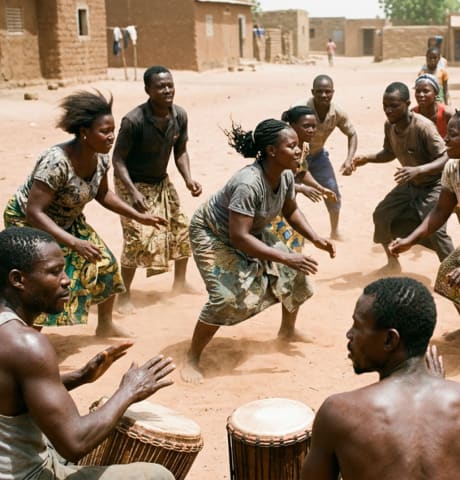 African drum rhythms for dance: The power of the djembeDive into the fascinating world of West African drum rhythms and learn how the djembe and bass drums guide the movements of traditional solo dance.
 Understanding Flamenco music: Rhythm and structure in danceLearn how the complex structure of Flamenco music guides your dance. Master the legendary 12-beat compás and learn how to improvise expressively to Soleá and Bulerías.
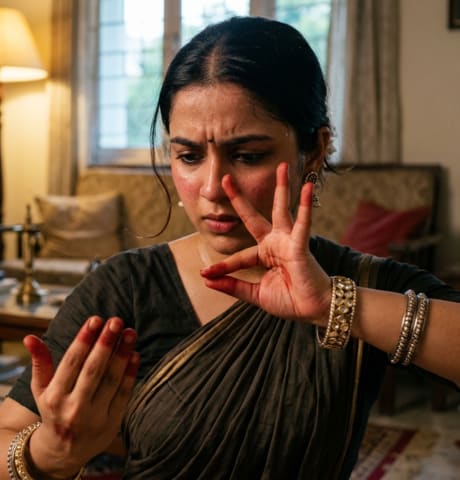 Indian classical dance music: Bharatanatyam rhythmsDive into the fascinating world of Indian classical dance music. This guide explains the complex rhythms of Bharatanatyam and Kathak, as well as the art of rhythmic syllables.
 Drums & Strings: World Music Instruments in DanceLearn how traditional instruments like the djembe, oud, and darbuka shape the rhythm and character of solo dances around the world.
 Dancing polyrhythms: A guide for solo dancersLearn how to dance complex polyrhythms from world music by isolating different body parts. This guide shows you the path to perfect rhythmic independence.
 Which solo dance suits me? The big rhythm testFind out which solo dance truly suits your personality with our big rhythm test. Discover your dance home between folklore, polyrhythms, and club beats.