
Find your rhythm together
On udansa you will find like-minded people who share your passion for rhythm and movement. Discover exciting courses for solo dance and connect with a worldwide community.


By Mary De LucaUpdated
On udansa you will find like-minded people who share your passion for rhythm and movement. Discover exciting courses for solo dance and connect with a worldwide community.
Music moves us all in different ways. Find out with our scientifically inspired self-test which rhythm really makes your soul vibrate and which solo dance suits you perfectly.
Every person carries their own internal metronome. While some fall into a trance at the dull, steady bass of a kick drum, others only truly blossom when complex, intertwined drum rolls challenge the body. In the realm of music for solo dance, there are no fixed partner dance conventions. You are completely free in how you translate the vibrations of the instruments into movement. This makes it all the more important that your chosen musical style reflects your rhythmic personality.
The world of solo dance ranges from earthy, historic folklore beats to highly complex polyrhythms and modern, synthetic club beats. Anyone who simply takes any course without prior knowledge is often quickly frustrated. A structured mind might despair at the absolute freedom of improvisation, while an improvisation-loving free spirit feels trapped in rigid rhythmic patterns. With our targeted rhythm test, you can find out where your dance home lies in just a few minutes.
You love the connection to nature, to old traditions and to stable, reliable rhythms. For you, music must breathe and tell a story that is deeply rooted in the earth. Your movements are often fluid, powerful and close to the ground.
Try out traditional folklore dances or take a look at the energetic movements of oriental dance. Earthy, ritual dances will also immediately give you a feeling of home and deep satisfaction.
Simple beats bore you quickly, you are looking for an intellectual and physical challenge. Your brain loves to dissect music and translate different rhythm tracks into movement simultaneously. You possess a high level of coordination.
Sign up for an Afrobeat course or test the rhythmic precision of Flamenco. Complex drum workshops, where you learn to isolate your body at different speeds, are also perfect for you.
You need the razor-sharp, driving pulse of the present to lose yourself completely in the dance. Synthetic sounds, deep bass, and urban dynamics spur you on to peak performance. For you, dancing is pure energy and an outlet for everyday life.
Search for courses in Hip Hop, House Dance, or modern fusion styles like Folktronica. Here, you can move completely freely to electronic beats and live out your own urban identity on the dance floor.
| Criterion | Folklore type | Polyrhythmic type | Club type |
|---|---|---|---|
| Dominant instruments | Acoustic instruments, flutes, frame drums | Djembe, congas, complex percussion, clapping patterns | Synthesizers, drum machines, deep sub-basses |
| Rhythmic structure | Straight, repetitive bars with a strong emphasis on the one | Overlapping rhythms, syncopations, off-beats | Monotonous four-four time, driving "four-on-the-floor" pulse |
| Movement character | Earthy, centered, often circular or ritually flowing | Isolated, highly coordinated, rhythmically offset | Urban isolations, bouncy, energetic and free |
| Typical dance examples | Belly dance, traditional folk dance, circle dances | Afrobeat, Flamenco, traditional African dance | House dance, Hip Hop, Folktronica, street dance |
The classification is based on the typical musical structures of the respective genres.
As soon as you know your test result, you can start your dance journey in a targeted way. If, for example, you discover that you are a polyrhythmic explorer, it is worth taking a look at the fascinating structure of West African dances or the precise footwork in Flamenco. In our guide on Drums & Strings in Dance, you will learn more about how different instruments control these complex movements.
For the club enthusiasts among us, modern styles like Hip Hop or House offer the perfect scope. Here, the focus is on the isolation of individual body parts that adapt to the driving beat. No matter what type you are: use your test result as a compass to specifically search for trial classes and workshops. The beauty of solo dance is that you can get started immediately without a partner and focus entirely on the music.
A solo dance test analyzes your subconscious reactions to musical structures, tempos, and instruments. As a result, it filters out exactly the styles that harmoniously match your natural movement biography from the huge selection of dance styles.
Yes, absolutely. Many solo dances like African dance or Flamenco are based on very grounded movements and require no prior knowledge. Getting started is possible at any time, as you can focus entirely on your own body.
Polyrhythms are multiple overlapping rhythms with different time signatures. When you dance these, you move your hips in a three-four time, for example, while your feet maintain a steady four-four time.
Discover the right course for your rhythmic personality and get started right away.
Hip HopOranienburg OT Lehnitz · Germany
Hip Hop 6-8 J.Monday · 18:00 · Oct 12
Kulturhaus Friedrich-Wolf
ZumbaLimbach-Oberfrohna · Germany
ZUMBA® Fitness ClubTuesday · 18:45 · Oct 27
Limbach-Oberfrohna
Hip HopOranienburg OT Lehnitz · Germany
Hip Hop ab 9 J.Monday · 19:45 · Oct 12
Kulturhaus Friedrich-Wolf
 Understanding Flamenco music: Rhythm and structure in danceLearn how the complex structure of Flamenco music guides your dance. Master the legendary 12-beat compás and learn how to improvise expressively to Soleá and Bulerías.
 Drums & Strings: World Music Instruments in DanceLearn how traditional instruments like the djembe, oud, and darbuka shape the rhythm and character of solo dances around the world.
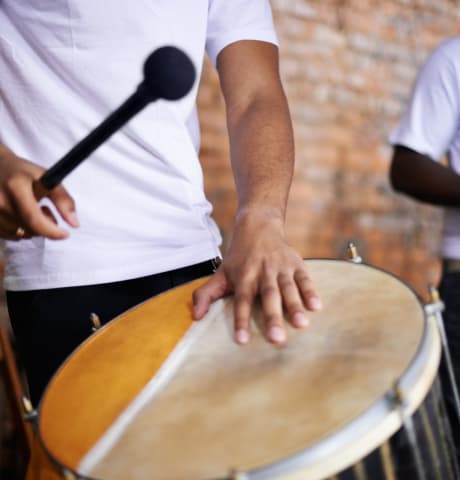 Belly Dance Music: Rhythms and Instruments in FocusDive into the fascinating world of oriental dance music and learn how typical drum rhythms shape your dance. A practical guide for rhythmic understanding.
 Music for solo dance: The magical rhythms of world musicDive into the fascinating world of solo dance music. Learn how traditional instruments and modern beats can shape and inspire your dance without a partner.
 Folktronica Dance Trends: The New Passion for Organic BeatsTraditional rhythms merge with electronic beats. Learn everything about the trend towards Folktronica and Organic House in solo dance.
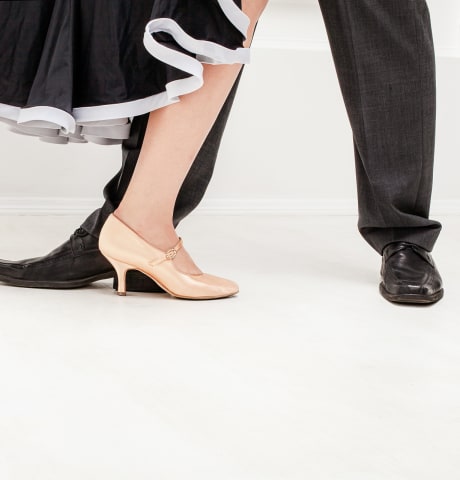 Irish Dance music: Reels, Jigs, and the rhythm of the feetDiscover how your feet become a percussion instrument in Irish step dance. We explore the difference between Reels and Jigs, plus the captivating rhythms of folk music.
 Sufi music and whirling dance: The hypnotic rhythms of the SemaImmerse yourself in the world of Sufi music and the ritual whirling dance of the dervishes. Discover how the hypnotic rhythms of the Sema guide mind and body into a trance.
 The best solo dance music playlist: Ideas for your practiceFind the perfect rhythms for your dance practice at home. This handpicked selection guides you step by step from simple warm-up beats to complex polyrhythms.
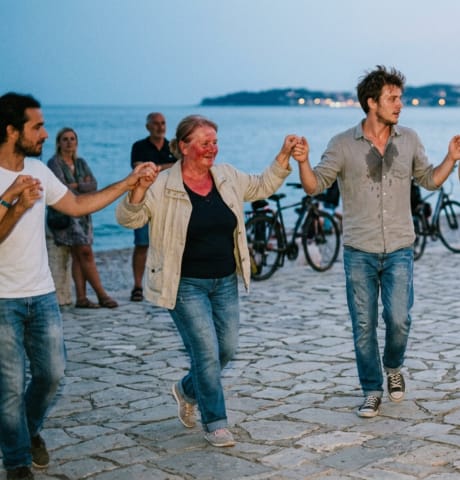 Balkan Dance Music: Understanding and Dancing Odd RhythmsOdd rhythms in Balkan folklore often seem mysterious. With this simple guide, you will learn to count and dance to the rhythms of Kolo and Oro with ease.Belly Dance Music: Rhythms and Instruments in FocusDive into the fascinating world of oriental dance music and learn how typical drum rhythms shape your dance. A practical guide for rhythmic understanding.