
Discover the world of rhythms together
On udansa, you will find like-minded people who share your passion for oriental dance music and fascinating rhythms. Find dance partners, courses, and exciting events near you now!


By Bernhard De LucaUpdated
On udansa, you will find like-minded people who share your passion for oriental dance music and fascinating rhythms. Find dance partners, courses, and exciting events near you now!
The fascinating world of oriental dance only truly unfolds when you understand the mysterious language of its drums. This guide opens the door for you to the magical structures of oriental music.
Darbuka rhythms are the traditional percussion patterns of the goblet-shaped Arabic hand drum, which form the structural basis for oriental dance. They consist of an artistic combination of deep and bright beats.
The foundation of every choreography and improvisation in oriental dance is understanding the drum beats. Unlike Western pop music, where a continuous four-four time signature often dominates, oriental dance music thrives on an enormous variety of patterns. To grasp these structures, dancers must be able to distinguish between the two main tones of Arabic percussion. The deep, warm tone in the center of the drum is called Dum, while the bright, whipping strike on the edge is known as Tek. The interplay of these two sounds creates the characteristic patterns that set the entire body in motion.
Anyone who learns to listen for these basic beats precisely can not only accompany the music, but truly embody it. Each rhythmic pattern conveys its own mood and demands a specific movement language. While heavy, earthy beats pull the hips downward, bright, fast embellishments invite fine accents or soft veils. Understanding this dynamic is the key to breaking free from rigid step sequences and interpreting the music intuitively. A good introduction to the world of rhythmic structures is also offered by our guide on recognizing the beat in dance music.
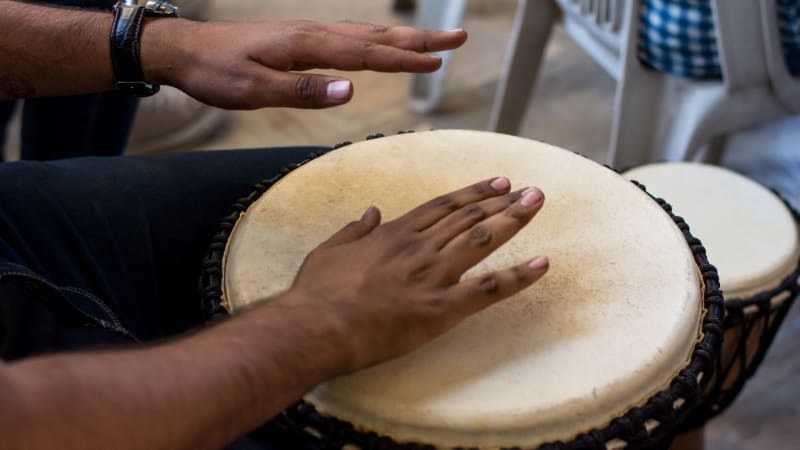
Among the numerous rhythms in oriental music, a few classics stand out that appear in almost every dance set. The most well-known is probably the Maqsum, a lively four-four time signature that is considered the backbone of modern and classical oriental dance music. It impresses with its balanced mix of deep and high beats and elegantly propels the dancer forward. Closely related, but significantly heavier and more sustained, is the Saidi. This rhythm, which traditionally originates from Upper Egypt, emphasizes the center of the beat with two consecutive Dum strokes and is often associated in dance with proud, earthy steps or the traditional stick dance.
In contrast, the Chiftetelli provides for soft, flowing, and hypnotic movements. This usually slow eight-four time signature leaves plenty of room for expressive solos, undulating movements of the upper body, and controlled pelvic circles. The fast Ayoub shows a completely different temperament, a two-four time signature that, with its driving, trance-like character, is often used for whirling turns and energetic highlights. The variety of these rhythms shows that oriental dance music is a constant interplay of tension and relaxation.
Correct
Wrong
Only when you no longer just hear the rhythm, but feel it on your skin, does oriental dance truly come to life.
A special art in oriental dance is the direct interaction with live instruments or their recorded interpretation. The darbuka, also known as the tabla, is the goblet-shaped hand drum that sets the rhythm. Experienced dancers react to every subtle accent of the drum with precise hip saccades, shimmies, or sudden stops. A dynamic dialogue emerges, where the dancer becomes the visible part of the percussion. Every tremor of the drum is reflected in a fine muscle vibration of the body.
Additionally, many dancers use zills, called sagat in Arabic, as an instrument of their own. These small metal cymbals, which are attached to the thumb and middle finger, serve not only as rhythmic accompaniment but also provide brilliant accents. Playing with zills requires a high level of coordination, as the rhythm of the hands must run independently of the movements of the hips and feet. Those who master this art merge completely with the music and give the dance a fascinating, lively depth. If you are interested in the origins of such rhythmic developments, take a look at the history of dance music.
The heartbeat of dance music
The darbuka is the queen of oriental percussion. Its fast rolls and sharp accents demand sharply isolated hip movements, crisp stops, and energetic shimmies from the dancer.
The soul of oriental dance
Melodic instruments like the oud, nay, or violin invite soft, serpentine movements. Here, dancers follow the flow of the notes with elegant arm movements and gentle waves.
The Dum is the deep, bassy tone produced by a strike in the center of the drum. The Tek, on the other hand, is the bright, sharp sound created at the outer edge of the drum.
The Saidi rhythm is characterized by two consecutive Dum strikes in the middle of the measure. This makes it sound very powerful and grounded, which is why it is traditionally used for folkloric dances.
Zills are attached to the thumb and middle finger of both hands with elastic bands. They should fit snugly, without restricting circulation, so that they do not slip while dancing.
Start by clapping along or speaking the rhythm while sitting down before you try to move to it. Only when the beat is internalized can the steps and hip movements be coordinated effortlessly.
Find the right course to turn the fascinating rhythms of the Orient into movement.
Couple danceLimbach-Oberfrohna · Germany
PaartanzkreisFriday · 18:15 · Oct 9
Limbach-Oberfrohna
Couple danceLimbach-Oberfrohna · Germany
TanzkreisFriday · 18:30 · Oct 9
Limbach-Oberfrohna
 Recognizing the beat in dance music: How to hit every rhythmA sense of rhythm is not a secret, it is a matter of practice. Learn how to pick out the beat in dance music and move confidently in rhythm.
 History of dance music: How rhythms moved the worldDive into the fascinating development of dance music and understand how historical rhythms have shaped the dance styles we enjoy today.
 Music for solo dance: The magical rhythms of world musicDive into the fascinating world of solo dance music. Learn how traditional instruments and modern beats can shape and inspire your dance without a partner.
 Learn to dance Afrobeat and master the rhythmLearn how to decode the infectious 8-beat rhythm of Afrobeat and Dancehall. With this guide, you will master the necessary isolations step by step.
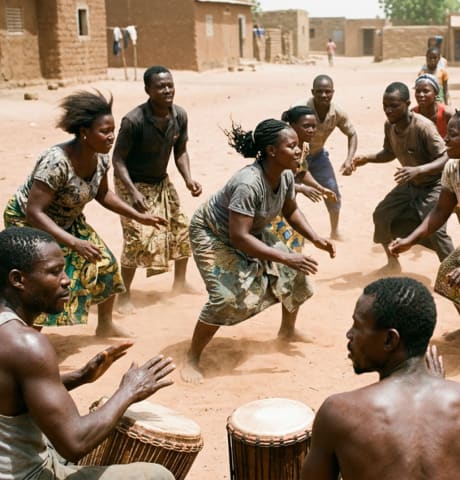 African drum rhythms for dance: The power of the djembeDive into the fascinating world of West African drum rhythms and learn how the djembe and bass drums guide the movements of traditional solo dance.
 Understanding Flamenco music: Rhythm and structure in danceLearn how the complex structure of Flamenco music guides your dance. Master the legendary 12-beat compás and learn how to improvise expressively to Soleá and Bulerías.
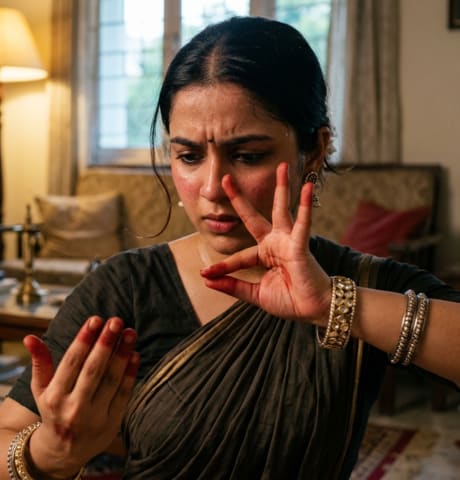 Indian classical dance music: Bharatanatyam rhythmsDive into the fascinating world of Indian classical dance music. This guide explains the complex rhythms of Bharatanatyam and Kathak, as well as the art of rhythmic syllables.
 Drums & Strings: World Music Instruments in DanceLearn how traditional instruments like the djembe, oud, and darbuka shape the rhythm and character of solo dances around the world.
 Dancing polyrhythms: A guide for solo dancersLearn how to dance complex polyrhythms from world music by isolating different body parts. This guide shows you the path to perfect rhythmic independence.