Footwork basics5 minutes

The 6-step in breaking: The footwork foundation for beginners

In a nutshell
  • The 6 Step is the most basic sequence of steps in floor-based breaking, and it consists of six precise steps in a circle.
  • It forms the fundamental basis of footwork, and it is the starting point for almost all complex floor combinations.
  • Compared to the faster 3 Step or 4 Step, the 6 Step allows beginners a particularly controlled weight transfer.
  • Low hips and hands placed flat on the floor ensure the necessary balance throughout the entire rotation.

Getting started with breaking on the floor begins with a single, legendary sequence of steps. With the 6 Step, you lay the foundation for your own style and learn to move smoothly on the floor.

Definition6 Step

The 6 Step is the fundamental movement pattern in breakdance footwork, where the dancer rotates once around their own axis on the floor in six steps. It trains the coordination between hands and feet in floor-level space.

The heart of floor-based dancing in breaking

Anyone starting with breaking quickly realizes that dancing on the floor is not just about wild acrobatics. Before learning spectacular spins, so-called footwork forms the dancing heart on the floor. The absolute cornerstone here is the 6 Step. It is considered worldwide as the most important foundation for developing a feel for space, weight distribution, and rhythm in floor-based dance. Almost every complex combination and many transitions into freezes build on this circular movement sequence.

For a successful start, it is advisable to prepare your joints well. A stable foundation requires strength in the wrists and flexibility in the hips. If you want to work specifically on your fitness, you will find valuable tips in the guide on strength training for breakdance. The 6 Step trains the coordination of arms and legs like no other move while you move flat across the floor.

How the movement sequence in a circle works

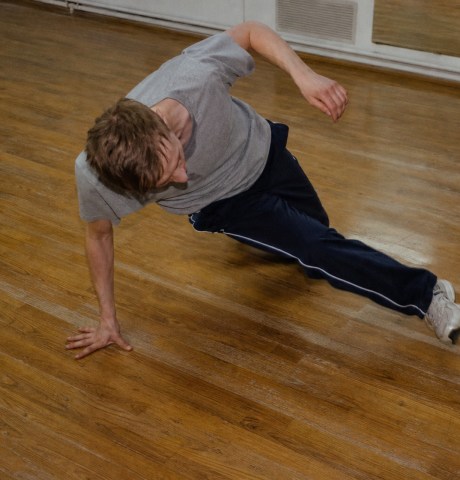
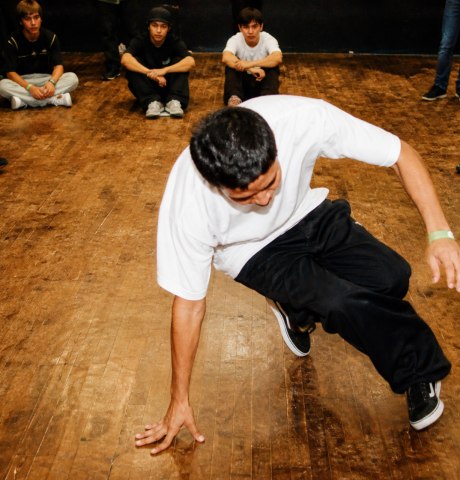
The structure of the 6 Step is mathematically logical: six precise steps guide you in a circular motion once around your own axis. The move starts in the classic push-up position or a deep squat. From there, one foot after the other is placed in a specific position, while the hands alternately catch the body weight and clear the path. Since you are constantly rotating around your center of gravity, you automatically learn how to shift your weight efficiently without losing your balance.

In contrast to more demanding patterns like learning the 3 Step in breakdance, which stands out due to its speed and wide leg swings, or the compact 4 Step, the 6 Step offers an even, rhythmic weight distribution. Because the movement is spread over six individual steps, the tempo remains controllable for beginners. Each step has its fixed station in space, which makes memorizing the pattern significantly easier.

The clear path to your first footwork success

Correct

  • Place your hands flat on the floor with your fingers spread
  • Keep your hips low to the ground during the turn
  • Execute each of the six steps cleanly and individually
  • Distribute your weight evenly between your hands and feet

Incorrect

  • Support yourself only on your fingertips
  • Stretch your buttocks high up into the air
  • Skip steps inaccurately or take shortcuts
  • Overload your wrists by jumping too far

If you haven't mastered the 6 Step, you don't have a foundation on the floor. It is the base from which all other footwork variations can truly unfold.

Breaking trainer, Berlin

Tips for clean execution and posture

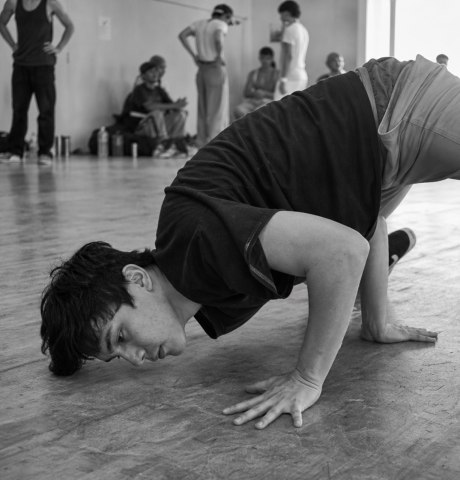
To dance the 6 Step fluidly, the posture of your pelvis is crucial. Many beginners tend to stick their buttocks too high into the air, which blocks the flow and costs unnecessary energy. Keep your hips low, but do not let them sink to the floor. Your knees should always remain bent and close to the ground. Place your hands flat on the floor, with your fingers slightly spread to provide the largest possible surface area. This protects your joints and gives you the necessary balance for changes in direction.

As soon as the six steps are memorized, you can start to slowly increase the tempo and perform the move to the beat of the music. Make sure not to string the steps together too hastily. Each individual step should be clearly defined before the next one follows. Over time, the six isolated movements will become a fluid, circular motion that runs as if by itself.

Two ways through floorwork footwork

Constructive

Controlled 6 Step

The ideal introduction for beginners

The 6 Step distributes the rotation over six even steps. This gives you maximum control, protects your balance, and is perfect for developing a feel for the rhythm on the floor.

Dynamic

Faster 3 Step

Advanced floor tempo

Variations like the 3 Step or 4 Step require larger jumps and faster weight shifts due to fewer intermediate steps. They already assume a solid core stability.

Frequently Asked Questions

  1. The 6 Step is the absolute standard in footwork. It has six even steps, while the 3 Step and the 4 Step complete the circle in fewer steps, which requires faster weight shifts.

Streetdance and Hip Hop courses near you

Find the right dance school to learn your basics under professional guidance.

View all matching courses

Meet other b-boys and b-girls on udansa

Find motivated training partners in your city on udansa who want to work on their footwork basics with you in the studio or at the park.

Meet other b-boys and b-girls on udansa