Breaking basics5 minutes

Learn the Baby Freeze: Your first freeze in breaking

In a nutshell
  • The Baby Freeze is the ideal first freeze for breaking beginners, as it offers maximum stability through the three-point support of head and hands.
  • The key to holding it lies in the precise placement of the elbows against the hips and thighs, which allows the body weight to be supported skeletally.
  • Regularly warming up your wrists protects against strain during your first attempts at balancing on the floor.

The Baby Freeze is the absolute foundation for every aspiring B-Boy and B-Girl. It is the first moment where you outsmart gravity and prove that acrobatics is primarily a matter of technique.

DefinitionFreeze

In breaking, a freeze refers to an abrupt, static pose where the dancer holds an often acrobatic position for several seconds to emphasize the beat of the music.

The perfect introduction to the world of gravity

Getting started in the world of floor acrobatics can seem intimidating to many beginners at first. Between spectacular spins on your head and seemingly weightless jumps, you quickly find yourself wondering where to even begin. The answer is almost always: with the Baby Freeze. This move is the perfect breakdance freeze for beginners because it uses an incomparably stable three-point support. Your head and both hands touch the floor, which distributes your weight optimally and minimizes the risk of falling. Unlike extreme feats of strength like the airchair or the handstand freeze, you use the pure physics of your own skeleton here.

Why geometry works for you

The Baby Freeze is not about holding your entire body weight in the air with raw muscle power. Instead, you build a stable bone structure out of your arms, on which your pelvis and legs are gently set down. As soon as your elbows lock into the right places on your hip and thigh, your body carries itself almost automatically. This makes this move the ideal first milestone to gain confidence in your own balance and to overcome the fear of the headstand.

Three points carry the weight: If you position your hands and head in a stable triangle, you will find your balance immediately in the Baby Freeze.

Step by step into a stable balance

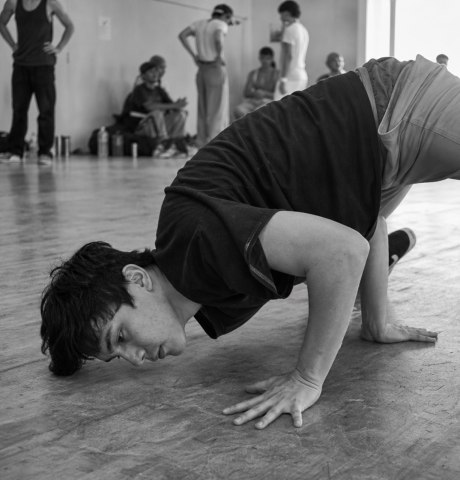
To successfully master the baby freeze, a precise guide for the baby freeze is crucial. The setup begins in a deep squat. Place your hands flat on the floor about shoulder-width apart, with your fingers pointing slightly outwards to relieve pressure on your wrists. Now, bend your arms at a ninety-degree angle, similar to a half push-up. The decisive trick lies in the placement of the elbows: one elbow presses firmly into the hip of your strong side, while the other elbow acts as a support on the outside of your thigh, just above the knee. That is your stable base.

The gentle transition into the air

As soon as this connection is established, lean your upper body slowly forward and place your temple gently on the floor. Make sure not to strain your neck: the head only serves as a third point of support, not as the main weight-bearing point. Now, lift your feet off the floor in a controlled manner. To be able to hold the baby freeze stably, tighten your core firmly and bend your legs. One leg usually points upwards while bent, while the other lies loosely bent underneath.

Secure foundation against typical beginner mistakes

Correct

  • Place your hands flat and turn your fingers slightly outwards
  • Anchor your elbow firmly into your hip bone
  • Shift your weight forward slowly and in a controlled manner
  • Relieve your cervical spine by gently resting your temple

Wrong

  • Balancing on your fingertips or clenching your fists
  • Letting your elbows float uncontrollably in the air
  • Jumping into position with momentum and losing your balance
  • Pressing your entire body weight directly onto the crown of your head

The Baby Freeze is the gateway to weightlessness in breaking. Anyone who understands how to use their elbows as supports immediately loses the fear of doing a headstand.

Breakdance instructor, Berlin

How to incorporate the move into your first combination

Anyone who masters the foundation of the Baby Freeze lays the groundwork for the entire repertoire of basic breaking freezes. As soon as you understand how the weight distribution works, you can start to make the transition more dynamic. An excellent way to make the entry more fluid is to combine it with a controlled descent from a standing position. The classic kick down in breaking is perfect for this, as it brings you elegantly from top rock to the floor level.

From static holding to creative flow

A freeze in breaking is never an isolated trick, but the triumphant final point of a movement combination. Once you can hold the Baby Freeze securely for a few seconds, try to approach it directly from your footwork. For example, you can slide into the position from a spin or directly from a seated position. This not only trains your coordination, but also gives you the necessary self-confidence to later attempt more demanding variations like the classic Shoulder Freeze.

Comparing the two pillars of the Baby Freeze

Support side

The hip-elbow seat

The supporting foundation at the hip

The active side where you support your weight. Here, the elbow locks firmly into the pelvic bone to carry the pelvis stably above the floor.

Playing side

The thigh stop

Securing balance at the knee

The balancing side, where the free elbow stabilizes the outside of the thigh. It prevents tipping sideways while holding.

Frequently Asked Questions

  1. For the Baby Freeze, you primarily need good core tension and healthy wrists. Extreme strength is not required, as the bone structure of the arms supports the weight.

Discover breaking courses near you

Find the right dance school on udansa and learn the basics from experienced instructors.

View all suitable courses

Find your crew for Breaking

Whether you are looking for like-minded people for the cypher or a structured course for your first steps on the dance floor: on udansa you will meet the community that helps you move forward.

Find your crew for Breaking