
Find your Samba crew on udansa
On udansa connect, you meet like-minded people who share your passion for Brazilian rhythms, and discover the best training opportunities in your area.



By Bernhard De LucaUpdated
On udansa connect, you meet like-minded people who share your passion for Brazilian rhythms, and discover the best training opportunities in your area.
Samba no Pé in the carnival demands absolute perfection, a fast-paced rhythm, and an incomparable stage presence. Find out with our test if you already have what it takes to be a real Passista.
The role of the passista is the absolute pinnacle of the Brazilian carnival. While the crowd celebrates on the sidelines, the solo dancers perform at the head of the samba schools to the rapid beat of the drums. But the path there requires far more than just a beautiful costume. Anyone who wants to shine as a passista must master solo Samba dancing at an extremely high level. It is about pure endurance, lightning-fast footwork, and a charisma that electrifies even an arena with tens of thousands of spectators.
To find out where you stand on this path, this special samba passista test will help. It is not a theoretical knowledge test, but an honest assessment of your personal samba carnival level. Because unlike classic competitive dance, where fixed step sequences and harmony as a pair are judged, the passista is completely free in the spotlight. Here, every second determines the impact of your dance.
You have a solid foundation in Samba no Pé, but you should still work on your speed and your stamina. Focus your training on clean weight shifts before you increase the tempo.
Your footwork is fluid and you can keep the tempo well. Now it is time to refine your presence and your arm movements to appear even more confident and elegant on stage.
You have everything that makes a true passista: speed, a sense of rhythm, and a stunning charisma. You are ready for the most demanding choreographies and the spotlight at the carnival.
| Criterion | Beginner (Samba no Pé) | Advanced (Solo) | Passista level |
|---|---|---|---|
| Basic tempo | Up to 100 BPM | Up to 120 BPM | Over 130 BPM |
| Hip technique | Foundations visible | Good isolation | Perfect, fast isolation |
| Charisma | Focused | Friendly and stable | Captivating and energetic |
| Stamina | Low (short sequences) | Medium (one full song) | High (several songs nonstop) |
The requirements are based on the typical standards of Brazilian samba schools during Carnival.
Once you have completed the samba passista test and have your result in black and white, the real work begins. If your goal is to become a true Samba-Passista, you should adjust your training accordingly. It is not enough to just master the steps. Work on your stamina, because a performance in the carnival demands everything from your body. Use mirrors, record yourself on video, and refine your facial expressions and posture.
Another important step is exchanging ideas with others. Find like-minded people, attend specialized workshops, and network within the scene. Through udansa, you can quickly connect with groups that are also dedicated to the Brazilian way of life. Regardless of whether you are still working on the basics or are already ready for the big stage, training together will get you to your goal faster.
A passista is a highly skilled solo dancer in the Brazilian carnival who dances in front of or between the floats of a samba school. They represent the school through outstanding technique, speed, and elegance in Samba no Pé.
To become a samba passista, you must master Samba no Pé at an extremely fast tempo, possess excellent physical fitness, and have a strong stage presence. Many samba schools also require a demanding audition.
The typical tempo at the carnival is often between 130 and 150 beats per minute. This requires extremely fast footwork and perfectly trained hip movement to avoid losing your balance.
Find the right course now to take your solo technique to the next level.
BallroomMeißen · Germany
Tanzkreis | PROFESSIONALTuesday · 20:15 · Oct 27, 2026 - Jan 5, 2027
“Ein Haus für Vieles” - Saal Tanzkurse
BallroomMeißen · Germany
Fortgeschrittenen-Kurs | ADVANCEDTuesday · 18:30 · Nov 10, 2026 - Jan 19, 2027
“Ein Haus für Vieles” - Saal Tanzkurse
BallroomMeißen · Germany
Tanzkreis | PROFESSIONALThursday · 19:20 · Jan 7 - Mar 25, 2027
"Atelier Federleicht" - Saal Tanzkurse
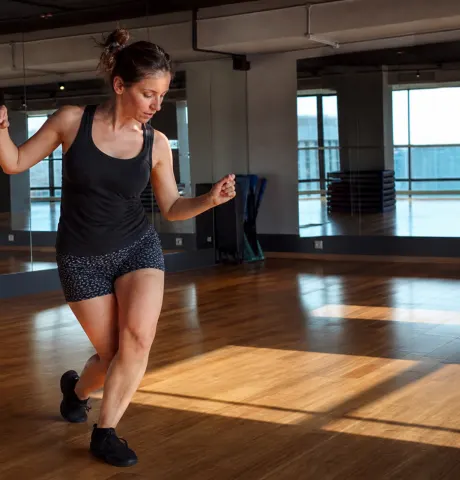 Dancing Samba solo: The guide for Samba no Pé and show danceDancing Samba solo brings the pure joy of life from Brazil directly to you. Learn everything about the technique of Samba no Pé and how to master the carnival dance.
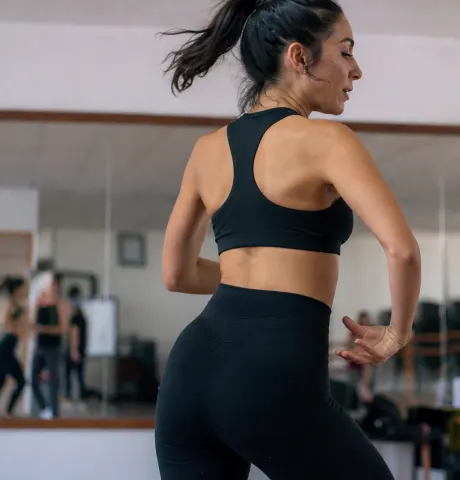 Learn Samba hip movement: Technique for solo dancersDiscover the secrets of Brazilian Samba hip technique. This guide shows you how to move your pelvis independently and master the signature Samba wave with targeted isolation exercises.
 Samba arm movements: Guide to elegant stylingBring elegance to your solo dance. Our guide shows you step by step how to perfectly coordinate your arm movements and dance with style in Samba no Pé.
 Samba Carnival Rio Trends: The Evolution of PassistasThe carnival in Rio de Janeiro is constantly reinventing itself. Learn how modern passistas are revolutionizing the samba runway with innovative costumes and urban dance styles.
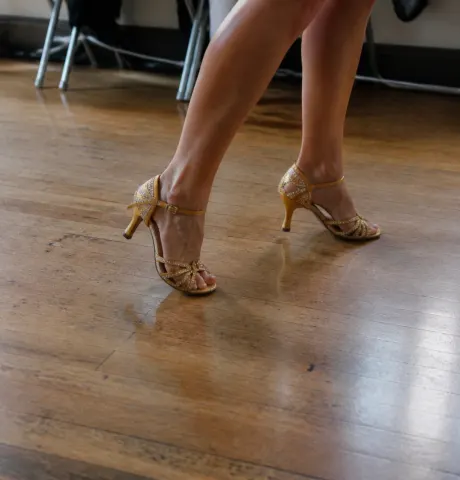 Samba solo dance shoes: The best heels for CarnivalThe right shoe makes the difference between brilliance and pain during Samba no Pé. Learn in our guide how to choose the perfect Samba heels for Carnival.
 Samba Solo Warm-up: Guide for home trainingPrepare your body optimally for the fast pace of this Brazilian solo dance. This structured warm-up guide protects your joints and activates your muscles for training at home.
 Samba Fitness Workout: Solo dance as cardio trainingSamba Fitness combines the joy of Brazilian dance with a sweat-inducing cardio workout. Learn how to train solo and effectively improve your endurance.