
Find like-minded people for your Samba-adventure
On udansa you will find like-minded people who share your passion for Brazilian rhythms, as well as suitable dance courses in your area to take your solo Samba body movement to the next level.



By Bernhard De LucaUpdated
On udansa you will find like-minded people who share your passion for Brazilian rhythms, as well as suitable dance courses in your area to take your solo Samba body movement to the next level.
The smooth, wave-like movement of the hips is the trademark of Brazilian Samba. If you want to master it, you do not need innate flexibility, but a deep understanding of the biomechanics of your own pelvis.
Samba hip isolation describes the ability to move the pelvis in all directions independently of the upper body. This movement coordination is the fundamental element for creating the typical, fluid character of solo Samba.
Anyone trying to imitate the typical movement of Brazilian passistas for the first time usually fails due to a simple blockage: we try to jerk the pelvis back and forth using pure muscle power from the waist. However, the real Samba hip technique is based on a delicate interplay of weight transfer, knee work, and targeted pelvic tilting. It is a three-dimensional movement composed of a forward and backward tilt (anterior and posterior tilt) as well as a lateral shift. Only when these components mesh fluidly does the wave-like, effortless image emerge that makes Samba no Pé so unique.
To learn the Samba hip movement, we must look at the involved joints and muscle groups in isolation. The engine of the movement does not lie in the hip bones themselves, but in the flexion and extension of the knees in interaction with the ankle joint. When you bend one knee, the hip on that side automatically drops, while the other leg remains straight and pushes the hip side there up and back. This anatomical coupling ensures that the hip follows the movement of the legs instead of working against them in isolation.

The biggest stumbling block on the way to smooth hip technique is a lack of dissociation. This means that the upper body moves unintentionally with the pelvis. In Samba no Pé, however, the chest remains still in space like a stable anchor, while the fire burns underneath. To develop this Samba solo body feeling, targeted isolation exercises are essential. One of the most effective exercises is "pelvic circling" in extreme slow motion with an absolutely fixed upper body. To do this, stand in front of a mirror, place your hands on your ribcage, and try to move only your pelvis in a flat circle.
Another important exercise for Samba hip isolation is the targeted activation of the oblique abdominal muscles and the quadratus lumborum muscle. These muscles actively pull the pelvis upwards towards the ribs. By alternately pulling up the left and right side of the pelvis while your feet remain flat on the floor, you activate exactly the muscles that are later responsible for the vertical component of the Samba movement. Once you have mastered these basics, getting started with general Samba dancing will also be much easier for you.
Correct
Wrong
In Samba, the hip is not an instrument of force, but the result of a perfect weight shift. If you want to flow, you have to learn to let go in your pelvis.
Once you have mastered the isolation while standing, it is time to transfer the movement to the legendary basic step. In Samba no Pé, weight is shifted extremely quickly, which requires precise coordination. The key lies in the timing of the hip extension: the hip always swings back and out at the exact moment the foot touches the floor and the knee extends. Many beginners tend to move the hip too early or too late, which makes the dance look choppy and stiff. Take your time and practice the movement sequence without music first to train your muscle memory.
A smooth transition is only possible if you never fully lock your knees. A permanent, slight bend in the knees acts like a shock absorber and gives your pelvis the necessary room for the circling and tilting movements. Make sure that your toes point slightly outwards to give the hip joints more anatomical space for rotation. Over time, you will notice how the initially strenuous muscle work transforms into a natural, rhythmic swing that harmonizes perfectly with the heartbeat of the drums.
Initiating movement from below
The hip moves as a direct result of the legwork. By bending the knee, the hip side drops, and by extending it, it is pushed up and back. The movement appears soft and organic.
Targeted pelvic control
The muscles in the lower back and abdomen actively control the pelvis. This isolation allows for extreme changes in direction and accents in show dance, but it requires strong deep core muscles.
The hip movement in Samba no Pé is created by the interaction of knee flexion and pelvic tilt. When you bend one knee, that side of the hip drops, while extending the other leg pushes the opposite hip up and back.
Yes, absolutely. The fluid movement is not a question of genetics, but of coordination and muscle memory. Through targeted isolation training and stretching exercises for the hip flexors, anyone can learn this technique.
The most common mistake is moving the hips spasmodically with the waist, without using the knees. Also, moving the upper body along with it or fully locking the knees blocks the natural flow of the movement.
Take your hip technique to the next level with professional guidance in the studio.
BallroomMeißen · Germany
Tanzkreis | PROFESSIONALTuesday · 20:15 · Oct 27, 2026 - Jan 5, 2027
“Ein Haus für Vieles” - Saal Tanzkurse
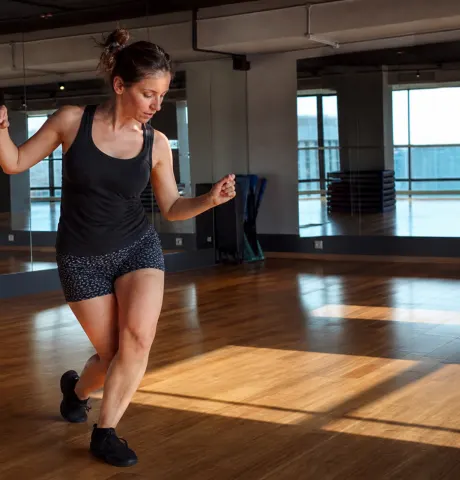 Dancing Samba solo: The guide for Samba no Pé and show danceDancing Samba solo brings the pure joy of life from Brazil directly to you. Learn everything about the technique of Samba no Pé and how to master the carnival dance.
 Dancing Samba: From Samba no Pé to competitive danceDancing Samba is pure joy of life. Learn everything about the fiery rhythm, the first steps, and how to get started successfully in our beginner's guide.Dancing Samba solo: The guide for Samba no Pé and show danceDancing Samba solo brings the pure joy of life from Brazil directly to you. Learn everything about the technique of Samba no Pé and how to master the carnival dance.
 Samba arm movements: Guide to elegant stylingBring elegance to your solo dance. Our guide shows you step by step how to perfectly coordinate your arm movements and dance with style in Samba no Pé.
 Samba Carnival Rio Trends: The Evolution of PassistasThe carnival in Rio de Janeiro is constantly reinventing itself. Learn how modern passistas are revolutionizing the samba runway with innovative costumes and urban dance styles.
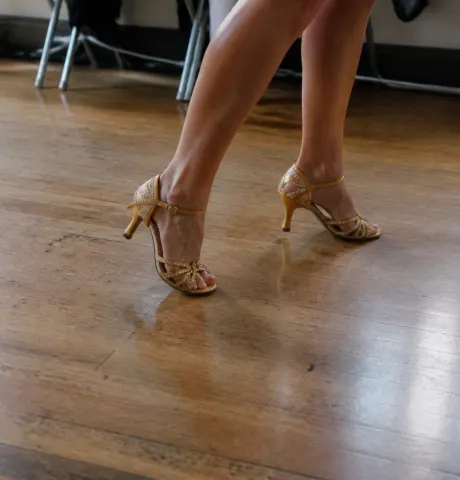 Samba solo dance shoes: The best heels for CarnivalThe right shoe makes the difference between brilliance and pain during Samba no Pé. Learn in our guide how to choose the perfect Samba heels for Carnival.
 Samba Solo Warm-up: Guide for home trainingPrepare your body optimally for the fast pace of this Brazilian solo dance. This structured warm-up guide protects your joints and activates your muscles for training at home.
 Samba Fitness Workout: Solo dance as cardio trainingSamba Fitness combines the joy of Brazilian dance with a sweat-inducing cardio workout. Learn how to train solo and effectively improve your endurance.
 Dancing Samba at high speed: 5 tips for fast temposDancing Samba at high speed requires the perfect blend of precise technique and mental calm. Learn how to master the rapid pace.