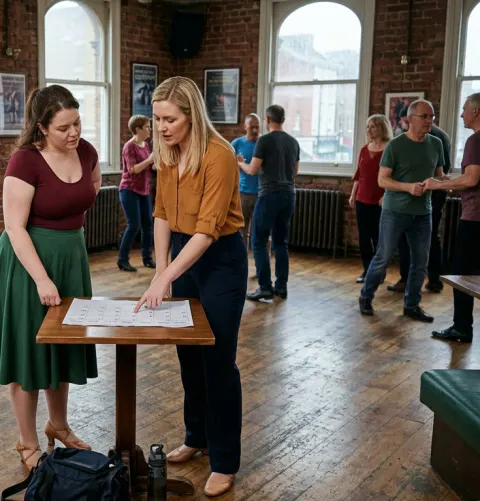
Dancing together takes communication
On udansa, you can find dance partners in London to arrange regular dancing with. Talk about what place these meetups should have in your daily lives, too.

By Mary De LucaUpdated
On udansa, you can find dance partners in London to arrange regular dancing with. Talk about what place these meetups should have in your daily lives, too.
A lovely dance together doesn't say much about whether your calendars line up. Disappointment often comes later, when a casual suggestion for one person has already become an evening blocked off in the other's calendar.
Commitment in a dance partnership means that a confirmed agreement applies to both of you until it is explicitly changed or canceled. It doesn’t obligate you to accept every new invitation.
When you dance regularly with the same person in London, you first build a recurring connection. That does not mean you have to commit to a particular amount of time: for you, “regular” might mean taking a class together, while the other person might also expect to go to every social dance night. These differences can easily go unnoticed while both of you have plenty of time.
That’s why an arrangement that works distinguishes between possible time slots and confirmed plans. “I’m usually free that evening” describes availability. “We’re meeting for the class” is a commitment. This distinction keeps you from setting aside an evening that the other person does not yet consider a plan.
Getting there is also part of making it a regular thing. Take into account not only the time spent dancing, but also the journey there and back, and the transition from work or caregiving to meeting up. Spending the same amount of time on the dance floor does not automatically mean putting in the same effort. Meeting near one person’s usual route through their daily routine can make sense if the other person is consciously happy with that arrangement.
The general guide to dance partners in London can help you understand the different kinds of partnerships. For an existing connection, what matters most is whether the agreed routine is genuinely manageable for both of you in everyday life.

A cancellation can be disappointing without being disrespectful. Illness, caregiving, or a change to your workday cannot always be anticipated well in advance. You act reliably when you let the other person know about a change you are aware of and do not make them set off or wait unnecessarily. You do not owe them a detailed explanation of your personal circumstances.
It helps to distinguish together between a canceled date and a replacement date. A replacement date only exists once you have made a new commitment. It is neither automatically owed nor already agreed just because someone writes, “we’ll make it up another time.” That way, a canceled evening does not turn into an open obligation that creates pressure later.
The other person can still go to a shared dance evening. For a course, whether they can attend without you depends on the format. The overview of dance courses without a regular partner explains the difference. Your personal cancellation also does not cancel a booking or determine whether you get a refund.
If cancellations happen repeatedly, the pattern matters more than any single reason. A time slot that consistently does not work calls for a different arrangement. Promise less and follow through on what you promise offers more certainty for planning than frequent commitments that keep falling through in everyday life.
Say yes like this
Not like this
On udansa, you can find the latest classes and dates in London and compare them with your shared availability.
A regular dance partnership doesn't require you to be there every time, but it does need a clear answer about what you can both expect at your next meeting.
Dancing together regularly does not automatically mean exclusivity. At an open dance night, either of you can also dance with other people, while a course you booked together remains a regular date. Different connections only conflict when they violate explicitly agreed plans or boundaries.
Misunderstandings often arise from imprecise language. “We’re going together” could mean arriving together, but it could also suggest an expectation to dance with each other for the whole evening. A clear sentence spells out what you mean: “I’d like to go to the dance night with you and also ask other people to dance from time to time.” That gives the other person a realistic idea without making them responsible for managing your free time.
Nor does gender determine what commitments apply between you. In a same-sex dance partnership, expectations come from what you agree on, not from the makeup of the couple.
A partnership can change over time, too. A new work schedule can mean fewer dates together without making dancing feel any less enjoyable. Naming a break or clearly ending things is fairer than simply not replying. Being committed also means having the freedom to end an agreement rather than keeping it in name only.
For a largely predictable routine
A reserved time slot saves you from having to negotiate schedules again. You can plan other things around it. The arrangement stays fair if vacations, illness, and exceptions are explicitly allowed for, and the time together doesn’t become a way to check attendance.
For changing work schedules and commitments
You arrange each meeting based on your actual availability. This makes regular contact possible without a fixed day of the week. For that, each meeting needs clear confirmation, so you can tell which suggestion is still open and which evening is already reserved for the two of you.
As often as you can both commit to consistently without regularly pushing aside other commitments. A less frequent, reliably scheduled session can be more sustainable than frequent meetups that are constantly canceled. What matters is whether the agreed rhythm still works for both of you.
In principle, you can also attend on your own, as long as the class format allows it and you haven't agreed otherwise. Having a regular dance partner doesn't mean you have to stay away together. If you booked together, the booking terms still apply regardless of your personal arrangement.
Distinguish between temporary cancellations and an arrangement that doesn't fit their everyday life in the long term. If they cancel repeatedly, you need a more realistic rhythm or a break. Otherwise, frequent rescheduling without a new commitment leaves you on standby even though you don't have a shared date.
You don't have to keep a list of your dance contacts. What matters is whether this changes your agreed meetups or affects an explicitly agreed exclusivity. An arrangement to dance together doesn't give the other person a general right to know how you spend your free time.
Be clear that you don't want to continue meeting regularly, and say which dates you've already agreed on still stand. A brief explanation without assigning blame is enough. A vague “Maybe later” leaves the other person unsure whether they should continue keeping time free for you.