Come alone, learn together
On udansa, you can find partner dance classes in London to get started. With udansa connect, you can chat with people who also want to come to class on their own.

By Bernhard De LucaUpdated
On udansa, you can find partner dance classes in London to get started. With udansa connect, you can chat with people who also want to come to class on their own.
The uncertainty often begins before the first step: You want to learn to dance, but have no one to bring along. What matters is how the class pairs people up, not your relationship status.
Role balance refers to the numerical ratio of leading and following participants in a partner dance class. It affects how many couples can practice at the same time.
For a dance course without a partner in London, three details need to be kept separate: you can register on your own, there is a place for your role, and your participation is confirmed. A form for individuals initially answers only the first question. You may remain on the waiting list until a suitable placement becomes possible. That is why what a confirmation subject to a partner requirement means is also relevant if you book on your own.
English phrases like No partner required or Come on your own indicate that you do not need to bring your own dance partner. By themselves, they do not guarantee a particular rotation schedule or a place in every role. Singles welcome initially describes access for individuals, and is not a reliable statement about relationship status or dating intentions.
What matters is a binding confirmation of an individual place under the conditions of the course format. Before booking, read the participation terms, role arrangements, and information about partner rotation together. That way, the organization of partner exercises will not be left unclear. For an overview of the classes as a whole, see the guide to dance courses by learning goal in London.
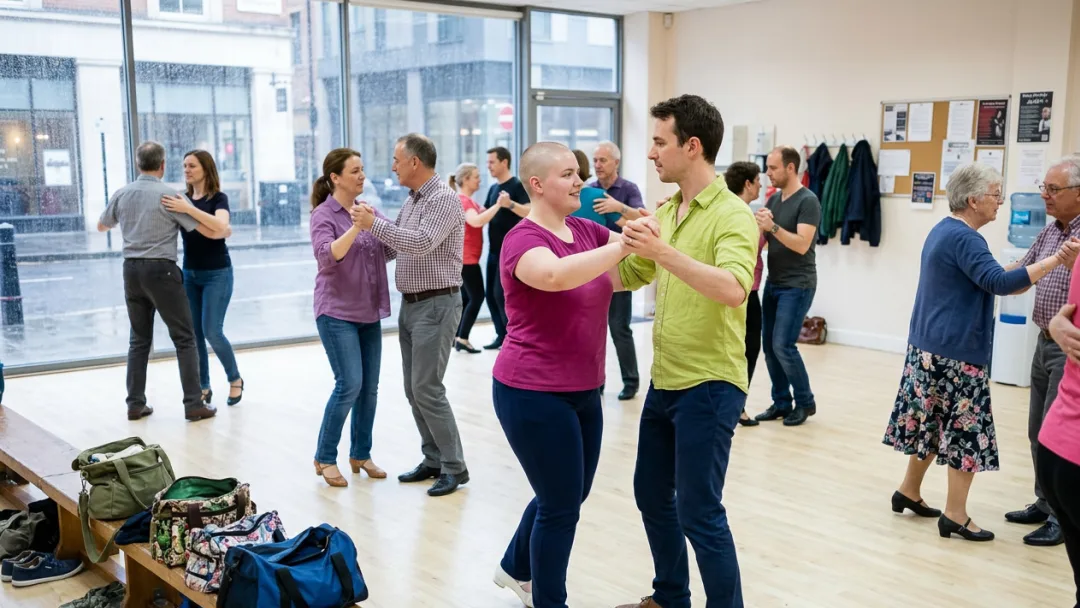
In English-language course listings, the dance roles are often called Lead and Follow. As the Lead, you prepare movement suggestions: the direction, timing and space need to be clear to your partner. As the Follow, you take in this information and move while maintaining your own balance. Following does not mean being carried or going along with every impulse without question.
These tasks do not depend on your gender, height or relationship status. A woman can lead, and a man can follow. However, whether you can choose your role freely or try both in class depends on the course format. A role-open class may explicitly include switching roles, while signing up as a Lead or Follow may apply for the entire course.
A simple situation shows why assigning roles matters for the organization: two people want to lead, but neither wants to follow. Both are present, yet they do not form a pair with the intended roles. A role-specific waiting list can help balance this out. It says nothing about whether you are welcome as a person. So, when getting started, what matters is a clear role assignment, not a supposedly suitable mix of men and women.
So, yes
Not like this
In the course filter on udansa, you'll find the latest classes and dates in London to get started with partner dancing.
An individual spot describes your registration, a dance role describes your task, and partner rotation describes how the class is organized.
During a rotation, practice pairs are reshuffled in response to a signal. For example, one role stays in place while the other moves on to the next person. This is one possible way to organize a class, not a general rule for all partner dance classes. Some formats instead pair individual participants with the same person for a longer time.
The change has a specific learning effect: a clear movement cue has to come across even with a new partner. Different step lengths and levels of contact make it clear where you have been silently adapting to each other. After a change, you therefore start with a small basic step and light contact, rather than immediately asking for the most difficult figure.
A fixed pairing, on the other hand, offers continuity. You can repeat a transition and work on the same uncertainty. This can make things easier, especially at the beginning, without requiring you to become a regular dance pair outside class. So signing up individually does not automatically mean changing partners.
During a rotation, a brief greeting is part of starting over, and a thank-you ends the practice round. At first, the contact is limited to this task. If you later want to practice regularly outside the course, looking for a practice partner in London is a separate step.
You can feel different impulses
You encounter different step lengths and ways of establishing contact. This helps you notice whether you’ve understood a movement or only know one person’s habits. The brief encounters also require you to adjust again and again.
Familiarity makes repetition easier
Even if you sign up individually, a course can pair you with a regular practice partner. You can work on the same transition several times without starting over each time. The downside is that, at first, it remains unclear how well the movement works with other people.
You can both participate individually, as long as the format allows individual sign-ups and places are available for the roles you choose. Traveling together does not automatically make you a fixed dance couple. If partners rotate, you will also practice with other people; if roles are assigned, you may not be paired together.
No, you do not have to accept any physical contact that feels uncomfortable to you. You can decline a closer hold, increase the distance, or sit out an exercise. A light hand connection is enough for many fundamentals. Your boundaries apply regardless of whether a partner change is coming up.
Depending on how the class is organized, one person can sit out briefly, practice alone, or rejoin when partners rotate. During a break, you can repeat the rhythm and weight changes without a partner. An uneven distribution of roles therefore does not automatically make the course pointless, but it may shorten your time practicing together.
You can learn both roles if the class format includes role switching. In a course with roles booked in advance, you will initially stick with the role you signed up for during partner exercises. This makes it easier to organize pairs and gives you repetitions of the same task. Learning both roles is a learning goal of its own, not an automatic part of every individual sign-up.