Try out movement ideas together
On udansa connect, you can find people in London to try out Contemporary movements with and exchange impressions from class.

By Bernhard De LucaUpdated
On udansa connect, you can find people in London to try out Contemporary movements with and exchange impressions from class.
Remembering a long sequence and understanding a transition to the floor are different kinds of success. If you know which one you're looking for, your class search gets a clear direction.
A movement phrase is a connected sequence of movements with a recognizable beginning and end. It can be set in advance or created during an improvisation exercise.
If you're looking for a contemporary dance class in London, Contemporary describes a broad field, not a uniform class plan. A class might begin with standing exercises, move into floorwork and end with a longer phrase. Still, it isn't automatically a choreography class. What matters is how the sequence is used: as an exercise in a movement principle, or as material whose sequence and composition you learn.
In technique training, movement is broken down and put back together. For example, you explore how weight travels from your foot into your hand, how your torso prepares for a turn or how you get back up after a deep lunge. Repetition allows for focused corrections. Technique doesn't mean performing every movement as big or as tense as possible. Yielding in a controlled way and maintaining clear contact with the floor can also be technical goals.
Terms like technique, release-based or floorwork offer clues about this kind of work, but they don't guarantee an identical class format. Release-oriented work uses, among other things, breath and the release of unnecessary tension. The overview of dance classes by learning goal helps you consider this technical focus separately from the general class level.
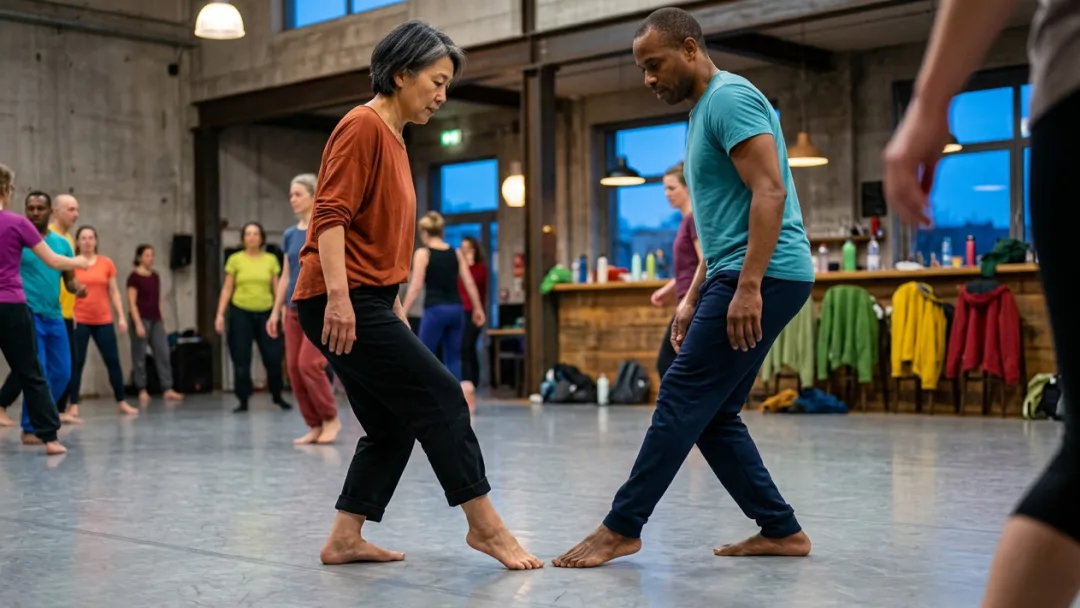
Improvisation does not mean you have to stand in front of the group without any guidance. A task might be to begin every movement with your elbow, switch between two levels, or respond to another person’s direction. The flow takes shape in the moment, but your attention has a clear framework. You learn to notice possibilities and translate decisions into movement instead of recalling a demonstrated sequence.
Choreography-focused classes, on the other hand, provide a sequence or develop material together that is then set. Repetitions are used to remember the material, work on precise transitions, and shape the choreography. For example, you might work on making an accent stand out or holding a pause. A phrase can be taught using counts, but also through breath, sound, or movement cues. Musicality, then, does not only mean marking every beat with a step.
The same movement can appear in all three approaches. A spiral through the torso can be explored technically, varied through improvisation, or repeated as part of a choreography. When you focus mainly on the outer shape while copying a movement, it is easy to overlook the impulse that initiated it. The guide to common observation mistakes when copying dance movements explains this distinction in more detail.
A useful classification
Common misconceptions
On udansa, you can find current classes and events in London, including under Modern Dance and Dance Improvisation.
Remembering a sequence, understanding a transition, and finding your own movement are three different learning outcomes.
An impressive performance does not show how the lessons leading up to it were structured. Stage choreographies can combine technique, improvisation and set material, while a course may deliberately focus on just one aspect. So for your search, a specific goal is more useful than a particular look: you want to understand floor transitions, develop movements yourself or confidently perform a longer sequence.
London also has a history of contemporary dance for the stage: in 1969, the Contemporary Ballet Trust took over the former drill hall where The Place was established. Dance Umbrella was founded in 1978. These names are part of dance culture and, by themselves, do not indicate any participation requirements or teaching focus. The cultural background is covered in Dance theatre in London and its history.
For classes on udansa, it is also important to note: Modern Dance can be a related search category, but it is not automatically synonymous with every approach to Contemporary. Dance Improvisation describes a way of working, not a guarantee of any particular technique. Current courses and dates in London are listed in the course filter on this page. If the focus of a class is unclear, check whether it centers on movement principles, your own development or learning set material.
The sequence stays the same, while your execution develops
You know which movement comes next, so you can focus on dynamics, direction of gaze and transitions. The shared template makes differences in execution visible, without you having to come up with your own material first.
The starting idea stays, the progression takes shape
You might start with a direction or a part of the body and decide for yourself how to continue. The task narrows your options so you can notice individual choices and develop your own phrase from them.
You don't need ballet experience for a Contemporary course that explicitly has no prerequisites. However, some technical approaches use positions or terms from other dance forms. Previous experience can make things easier to understand, but it doesn't replace learning weight release, floor transitions, and the specific movement quality.
Wear comfortable clothing without hard fastenings that won't get in your way when sitting or rolling. Long, soft trousers can protect your skin during floorwork. Dancing barefoot is common; loose socks can slip on smooth floors, so they aren't automatically the better choice.
No, floorwork can be part of the class, but not every Contemporary class includes it. Floorwork means working on the floor and transitioning between lying down, sitting, and standing. What matters is controlled contact, not falling as quickly as possible; painful strain isn't a necessary part of the movement.
You don't need a regular dance partner for solo-focused Contemporary classes. Partner exercises may still be included, such as mirroring or responding to movement cues. Physical contact and sharing weight are additional ways of working that need to be guided, and aren't implied by the general course description.