Work on the Groove together
On udansa connect, you can find people in London to practise Hip-Hop basics with or go over a routine you’ve learned.

By Bernhard De LucaUpdated
On udansa connect, you can find people in London to practise Hip-Hop basics with or go over a routine you’ve learned.
A sequence you learn quickly can feel like a success, even if you still get stuck without a model to follow. Conversely, a class with just a few steps may seem uneventful, but it can change the way you dance to all kinds of songs.
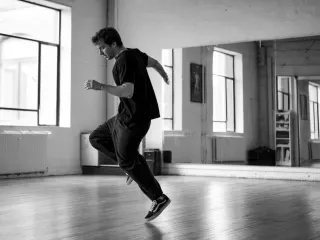
In Hip-Hop dance, groove refers to the rhythmic quality of your movement, or how your body picks up the pulse and accents of the music. This can include repeated bouncing and swinging weight shifts.
If you’re looking for Hip-Hop classes in London, English terms are initially clues to what you’ll learn. Foundations, Basics, Grooves and Social Steps suggest that basic movements are explained and repeated. This may mean working with a small set of movements for a long time, rather than learning a new sequence every class.
For example, a bounce comes from a repeated springing motion in which your knees and body work together rhythmically. With a rock, the swinging shift of weight changes. It’s not just about the visible form: you learn when to release your weight, where to land and how the movement fits the music. This gives familiar steps a quality of movement that can easily be missing when you simply copy them.
Foundations classes are therefore not automatically a stepping stone you should get past as quickly as possible. Even with experience, you can refine your timing and coordination there. Short combinations can be part of the class, as long as they help make the basic principle clear. You can find how this fits with other learning goals in the dance classes in London.
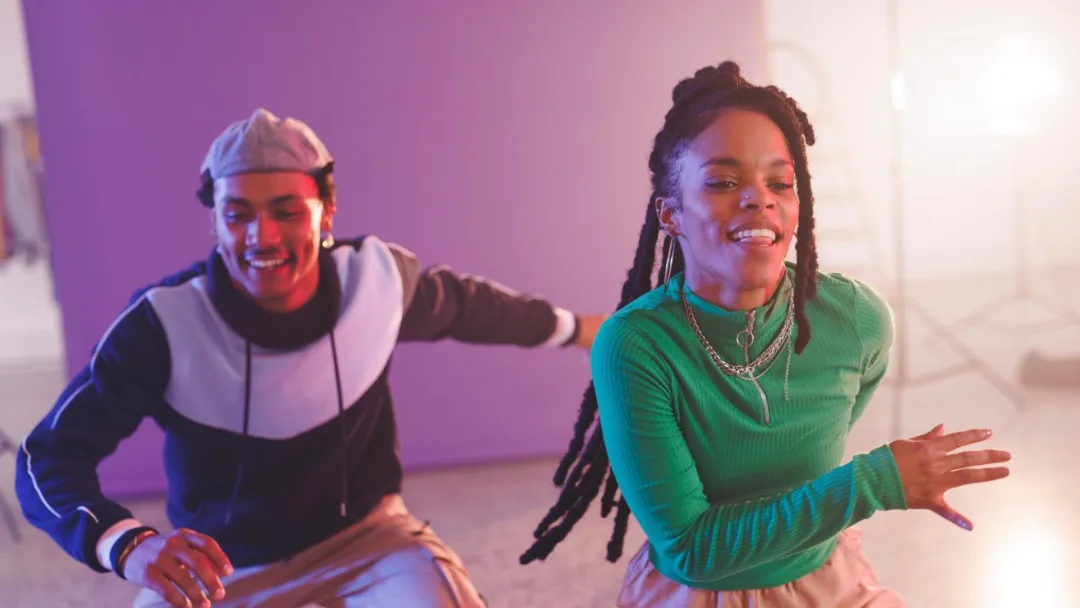
In freestyle, you decide while dancing what happens next. That doesn’t mean an instructor sends you off without guidance. Terms like Improvisation, Exploration or Freestyle Drills can point to focused tasks: dancing a step in different directions, responding to a particular sound or switching between two familiar movements. A small amount of material may be enough.
With Choreography, Routine or Combo, on the other hand, the sequence is set. You learn a passage in sections, connect transitions and hit accents at agreed points. This trains you to pick up movements, remember them and execute them. References to Performance or Camera may also put extra emphasis on presentation. Commercial is often used for this too, but it doesn’t refer to a fixed curriculum.
Both forms can include the basics. The difference lies in the task: choosing for yourself or performing a set sequence. Difficulty copying moves also doesn’t automatically mean you have rhythm problems. The guide to copying dance moves explains why it’s easy to miss weight shifts and the direction of your gaze.
Correct
Myths
In the course filter on udansa, you'll find current classes and dates in London to get started.
A sequence you've learned shows you what you can recall; a different song shows you what you can apply.
For a beginner Hip-Hop course in London, a clear connection between the content and your learning goal matters more than an impressive final video. If you want to dance independently to different songs, fundamentals and guided improvisation will help. If you want to master a finished sequence, a focus on choreography is a better fit. These goals can complement each other: you can learn a sequence and later use individual moves from it freely.
The differences also become clear when you repeat things. In fundamentals classes, a step often stays the same while the tempo, direction or accent changes. When learning choreography, the sequence stays the same while transitions become more precise and movements clearer. Freestyle combines the material you already know with choices you make in the moment. You don't need the biggest possible range of steps for that, just accessible moves and enough space to try things out.
A course description is a clue, not a guarantee of what every class will cover. Descriptions of activities such as groove training, variation exercises or learning a routine are especially informative. Performance art is a separate topic: Breakin' Convention began in 2004 as a hip-hop theatre festival at Sadler's Wells. For this historical context, see the overview of dance culture and venues in London.
Progress through intentional variation
You dance a familiar step to different music and change direction or accent. The success lies in finding a suitable solution yourself while keeping the groove.
Progress through remembered connections
You combine steps, transitions and pauses into a set sequence. Success means dancing the sequence with increasing independence and consciously shaping its musical details.
You don't need a regular dance partner for a typical Hip-Hop group class. You mostly practice on your own, even when everyone is working on the same task. Partner exercises or group formations may be part of the class, but they don't make it a partner dance class.
Commercial often refers to presentation-focused classes with an emphasis on choreography, and may combine different styles. The term alone doesn't guarantee systematic Hip-Hop foundations. More specific details include whether grooves are explained, set routines are developed, or expression and performance are practiced.
You don't have to agree to being recorded and having the recording published just to learn a choreography. A camera isn't necessary for the learning process. If you make your own practice video, other participants should only be in the frame with their consent. A recorded course finale isn't proof of the quality of the teaching.
You can start with guided freestyle if the exercises are accessible to beginners. Repeating a small movement and changing its rhythm is enough to get started. It's helpful to choose a class that explains the basics and builds on them to help you make your own choices, rather than immediately asking you to perform long solos.