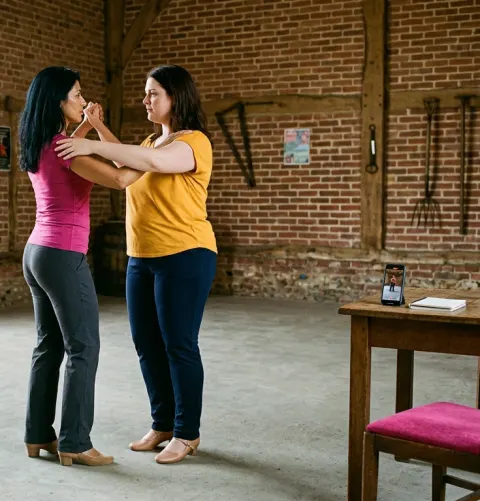
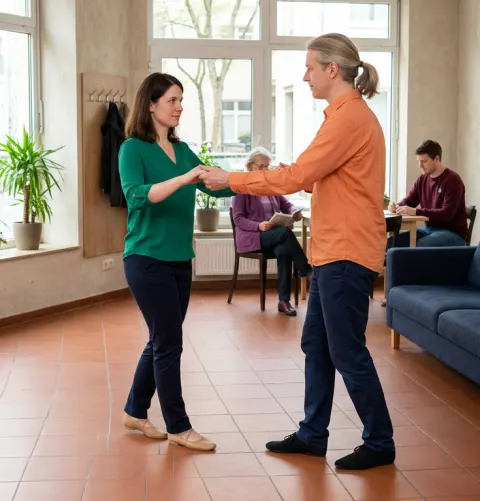
Dance together with commitment
On udansa, you can find dance connections in Rome who want to learn together regularly. You can search for people whose ideas about a committed partnership match yours.

By Bernhard De LucaUpdated
On udansa, you can find dance connections in Rome who want to learn together regularly. You can search for people whose ideas about a committed partnership match yours.
You can get along well while dancing and still expect different things. Disappointment often arises when a casual “Let’s dance together” is a commitment for one person and just a possibility for the other.
Dance exclusivity refers to an agreement to dance only with each other within a specific context. For example, it may apply to a shared choreography without ruling out other dances or connections.
If you're looking for a regular dance partner in Rome, it first comes down to what your commitment means to each other. Taking a class together, working on technique in addition, or mainly dancing together are different forms of consistency. None is automatically more binding than the others. What matters is whether you both mean the same thing by the commitment and actually have room for it.
As dancers, repetition creates common ground: you recognize familiar movement cues, remember transitions, and can keep working on a challenge without starting from scratch each time. That takes attention. Frequent contact where one person is constantly exhausted is less conducive to this than a smaller, sustainable commitment.
Consistency means making something a recurring priority, not being available at all times. Work, rest, and other interests remain part of your everyday life. You can both enjoy the same dance and still want to put different amounts of energy into it. That's a difference in expectations, not a judgment about the other person's motivation.
The format also shapes the commitment: A practice evening has a different purpose from a dance party. Learning together and going out together shouldn't therefore be silently treated as the same thing.

Dancing with someone you know well can feel reassuring. You know their stride, how they respond to a lead, and the way they prepare movements. That leaves you with more attention for the music or technical details. This familiarity is a real advantage of having a regular dance partner.
However, it can also hide the fact that you already know a figure by heart. If the next movement always follows the same sequence, it can be hard to tell whether the lead was clear or the other person anticipated what was coming. Changing partners can make these habits visible, because a different person does not automatically share the same expectations.
“Committed” and “exclusive” therefore describe two different agreements. You can prefer to learn together and still switch partners during social dancing. Likewise, it can make sense to practice a shared choreography mostly with the same person, since distances and transitions need to be precisely coordinated. Either approach is understandable as long as you both know what the arrangement is.
Changing partners, in itself, says nothing about the quality of your partnership. What matters is whether you see it as part of learning, a free choice when going out, or a departure from a specific agreement. That meaning should not have to emerge only after someone feels hurt.
Yes, like this
Not like this
Use the course filter to find classes and dates in Rome for you to learn together.
A regular dance partnership is easier to understand when you name not only your wishes, but also the limits of your commitment.
“We want to improve” sounds like a shared goal, but can conceal conflicting expectations. Maybe you want to dance familiar figures confidently to the music, while your partner wants to learn as many new sequences as possible. The first goal calls for repetition and fine-tuning, the second initially for new patterns. Both wishes are legitimate, but they demand your attention in different ways.
An observable learning goal makes the difference clear: completing a transition without hesitation, keeping the basic step in time, or dancing a short sequence without pulling each other around. It describes an outcome, not just ambition. When choosing the right dance lessons in Rome, this distinction helps because working on technique and learning figures can have different focuses.
The timeframe you can foresee is also part of the commitment. If you live in Rome or are moving there, your day-to-day life may be based there in the long term, while career changes can still remain uncertain. A regular dance partner does not have to promise unlimited availability. An honest statement about what you know and what remains uncertain is more reliable than “forever.”
Your partnership can change along with you. Reaching one learning goal can make room for a new focus, and a pace that once worked may later become too much. Being committed then means keeping your expectations out in the open, rather than letting them drift apart unnoticed.
Commitment through a concrete goal
You want to develop a choreography or take a course together. This gives your partnership a clear focus and a provisional endpoint. You can still pursue other dance interests alongside it, as long as they leave enough room for the project you agreed on.
Commitment Without a Fixed End Goal
You want to dance together over a longer period without working toward a performance or exam. Progress then also shows in more confident transitions and more relaxed coordination. A new focus can emerge as your skills or interests change.
No, fixed dance partners do not need to have the same level of experience. What matters is that both can learn in their shared focus area and accept their different paces. If one person already knows the figures well, they can work on musicality while the other practices the sequence.
Yes, you can have several fixed dance partnerships, as long as you have not agreed to exclusivity. Different partnerships can be for different styles or projects. Your time and energy are still limited: any additional commitment should not depend on a schedule you have already filled completely.
Yes, a fixed dance partnership can work without a competition goal. Dancing confidently to the music, leading or following comfortably, and linking familiar figures more smoothly are learning goals in their own right. Having a shared benchmark helps you recognize progress without measuring results by rankings or exams.
Yes, a temporary stay can work with a fixed dance partnership if you are open about the timeframe you have together. The commitment then applies to that period. This is different from an unspoken expectation that your partnership will continue unchanged after a move.