


Get your connection moving
On udansa connect, you can coordinate the meeting point and practice time with your existing dance connection in Rome. A concrete agreement turns a casual suggestion into a plan.

By Mary De LucaUpdated
On udansa connect, you can coordinate the meeting point and practice time with your existing dance connection in Rome. A concrete agreement turns a casual suggestion into a plan.
A friendly connection can sometimes stay at “We should practice sometime” for weeks. A manageable practice session lowers the barrier: you don’t need an elaborate training plan, just an agreement you can both count on.
For practicing together in Rome, it is not enough to check whether a space looks free. Being able to access a space does not mean you are allowed to dance there. A passageway, waiting area or event space does not become a place to practice just because no one is there at the moment. An agreed use of the space covers your time, the music and the type of movement. If you are paying to use it, agreeing how to split the costs is also part of your arrangement.
The space you need depends on the steps. Small weight shifts need less room than steps that travel across the floor. Also think through turns and side steps: arms, bags and furniture must not stick into your movement area. The floor should be level, dry and free of tripping hazards. Shoes with very grippy soles make turns harder, while shoes and a floor that are too slippery together make it harder to stop safely.
A dance event does not automatically replace this agreement. The difference between a practice night and a dance party explains why longer repetitions do not fit into every format. For your own session, a familiar task is enough. If you have different levels of experience, practicing without taking on a teacher role can be a helpful boundary: you practice together instead of teaching each other new technique.
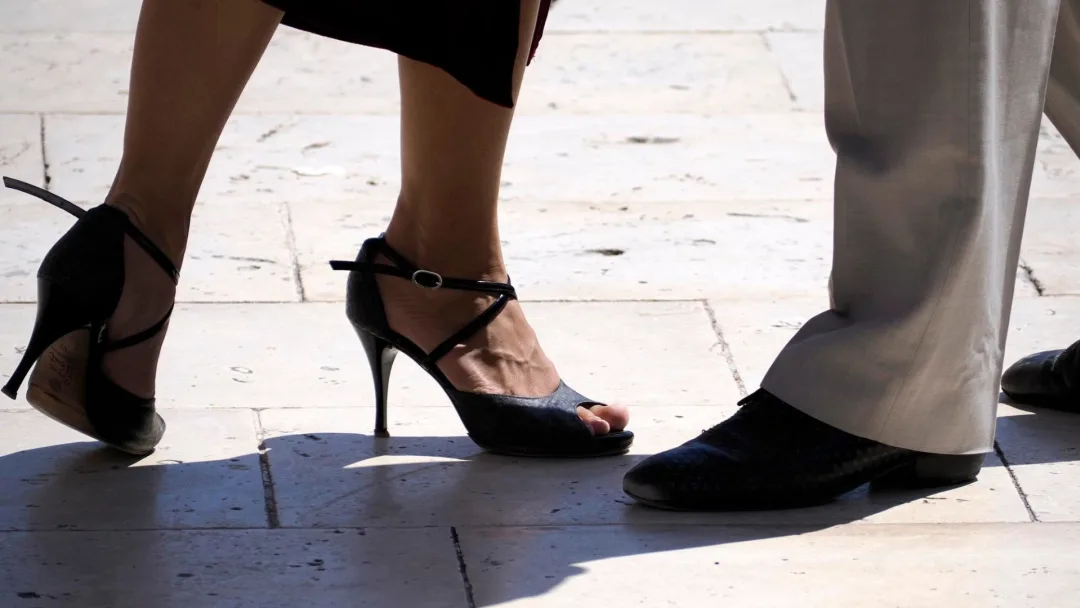
Give two specific options with dates and your total available time, including travel. Your dance partner chooses one; you both take your travel time into account instead of choosing a convenient location for just one of you. Once your time windows line up, decide on the venue.
Ask the person responsible for the room all at once about permitted dance use, music, access and usage times. Record any costs and how they will be split, if applicable. A room is only an option once you have this agreement, not just because there is an open slot in the calendar or the door is unlocked.
Choose a familiar sequence and define the problem as an observable task, such as continuing in time together after a turn. “Dance better” is too vague. Also decide on your dance roles for this task so you both prepare the same version.
For example, plan 45 minutes: five to arrive and move, ten without music, twenty with music, five for a break and five to wrap up. This is a planning example, not a training prescription. Set the end time so cleanup stays within the permitted usage period.
Summarize the date, start time, end time, exact address, entrance, your role, and the music you’re bringing in one message. Include a way to contact you on the day of arrival. Ask for a brief confirmation of this specific plan so that two different arrangements don’t end up in place.
Leave bags outside the dance floor and start with slow, small movements. First, try the chosen sequence without music and without large turns. If the shoes, floor, or space aren't suitable, scale the task back to safe weight shifts or end the session.
Dance short run-throughs and change just one thing each time, such as your shared start signal. Afterwards, describe what actually worked instead of listing every mistake. Stop dancing at the planned time, tidy up the room, and note one point to practice later.
If you want to learn new steps later, you can find suitable options in Rome using the course filter.
Yes, like this
Not like this
Preparation
Start
Wrap-up
The goal should be verifiable in a short, familiar passage. “Continue without an extra step after the turn” is easy to observe, while “gain more confidence” is not. Focus on just one thing per run-through. That way, you can tell which change helped, instead of discussing posture, rhythm, and every figure at the same time.
Start at a tempo at which you can both perform the sequence with control. First count without music, then choose a suitably slow song. Dancing faster only makes sense once the transitions stay stable. If you feel overwhelmed, shorten the passage instead of pulling your partner through the movement.
Yes, you can count out loud together to practice weight changes, pathways, and transitions. This makes it easy to hear and agree on the start and the step sequence. Later, you’ll need audible music to practice dancing with the musical phrases. Dancing as a couple while wearing separate headphones, on the other hand, makes direct communication and sharing a reliable musical reference more difficult.
Starting later does not automatically extend the permitted end time. Shorten the session and leave time for a proper finish, including tidying up. It’s better to skip an extra run-through with music than to rush through several tasks. Extending the session requires both your dance partner’s agreement and the appropriate permission to use the room.
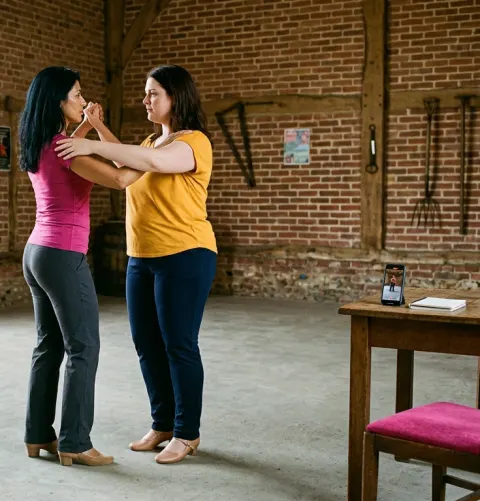
Only film if you both agree and the room’s rules allow recording. A short recording of the selected passage is enough to spot, for example, an extra step. Don’t include other people in the frame without asking them first. Also agree on whose device the recording will stay on. Agreeing to be filmed does not automatically mean agreeing to have the video published.
 Get to Know Rome and Find Your Dance Community
 How to Write Your Dance Partner Profile for Rome
 How to Message a Dance Partner in Rome
 New to Rome: Meet People Through Dance
 Find a Dance Partner in Rome for Your Holiday
 German-Speaking Dance Partners in Rome
 Dance partners for beginners in Rome: practise as equals


