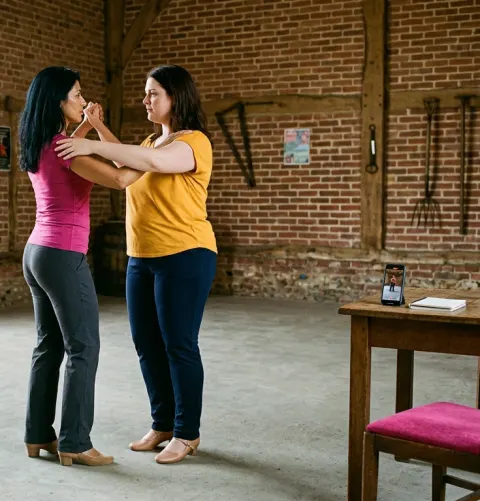
Making time together takes commitment
On udansa, you can find dance partners in Rome to discuss available practice times and expectations for committed meetups.

By Bernhard De LucaUpdated
On udansa, you can find dance partners in Rome to discuss available practice times and expectations for committed meetups.
For a practice session, you don’t just keep the evening free: you pack your shoes, put other plans on hold, and get ready to learn together. So it’s okay to bring up repeated cancellations, even when the reasons are understandable.
A cancellation does not automatically make your dance partner in Rome unreliable. Illness, caregiving responsibilities, or an unexpected work assignment can prevent a meetup. What matters is what happens afterward: Do they send a clear message? Do they acknowledge the time you set aside? Do they suggest a realistic alternative? You don't have to judge the personal reason to explain how it affects your practice.
Also distinguish a cancellation from a tentative commitment. “Maybe I can make it” is not a confirmed appointment. If you set off based on that, you first need to agree on what counts as a commitment. A helpful rule is: a meetup is confirmed only when both of you have explicitly agreed on the date and time.
Consistency matters for partner practice: after a break, you often need to recall movement sequences before you can work on transitions. So you can't always make up for a missed meetup with a longer session. An practice night instead of a dance party only works as a replacement if you both commit to it. If one person can't commit to free time slots right now, classes in Rome with a fixed course schedule may offer more structure. However, that doesn't replace your cancellation rules.

Note the most recently confirmed plans, when each was canceled, and the specific impact on you. Distinguish canceled commitments from casual suggestions. That way, you can say “I was already on my way” instead of “You always cancel.”
Bring up the pattern when no cancellation is happening: “The last two confirmed meetups fell through. As a result, we’re missing out on practicing together regularly. I’d like us to make our plans more reliable.” Leave room for a response without asking for a justification or private details.
Agree on a shared way to communicate and a cancellation deadline that falls before you set off. For example: „As soon as you know you can’t make it, message me directly there.“ In a last-minute emergency, the priority is to send a message as soon as possible, not to meet an impossible deadline.
Agree that the person who cancels suggests the next realistic date. Both of you explicitly confirm the date and time; without confirmation, the proposal remains open. You don't set aside time for it yet or head out on the assumption that it's happening.
For example, agree that your next three confirmed meetups will be a trial period, not a universal benchmark. Write down your rules in a short message. After that, what matters is whether cancellations came in time and alternative suggestions were actually feasible, not whether every meetup could take place.
Briefly confirm that you received the cancellation and switch to your own practice plan. For example, repeat weight shifts or a familiar sequence of steps without a partner. Partner-dependent leading, counterbalance, and new lifts cannot be adequately replaced when practicing alone, so postpone these topics.
When your rules take effect, keep up the rhythm. If confirmations remain pending or last-minute cancellations without a replacement happen frequently, reduce your meetups or agree on a break with a date to check in. Until then, don’t automatically reserve any more evenings, without ending the partnership for good.
If your informal practice sessions often fall through, use the course filter to find current classes and dates in Rome and keep your learning on a regular schedule.
Do this
Not like this
Agreement
Putting it into practice
Decision
Send a short message that sets a limit on how long you'll wait, then leave. For example: “I'm at the meeting point and will wait another ten minutes. If I don't hear from you, I'll leave.” That length of time is just a personal example. Talk about the no-show later, rather than sending more and more messages.
No, a cancellation doesn't need private details to be valid. You can still expect a clear message and reliable follow-up. “I can't make it today” is enough information. For your plans, it's more important whether the next suggestion is realistic than whether you find the personal explanation convincing.
Discuss room costs you've already paid separately from your personal disappointment. For existing bookings, the booking terms and your prior agreement about costs apply. A cancellation doesn't automatically give you the right to a refund from your dance partner. For future bookings, agree beforehand on who makes the booking and how non-refundable costs will be split if someone can't make it.
Stick to the specific impact and the time you have available, rather than debating whether you're too sensitive. “I don't want to travel there again for nothing” is a reasonable boundary. The other person doesn't have to feel just as upset as you do. A workable agreement can still protect both of you from setting aside time for unconfirmed plans.
You can practice with someone else if that fits your existing agreements about switching partners. Don't present the replacement as a threat or use it to make your partner jealous. For the current situation, it's enough to let them know matter-of-factly that you'll use the time you freed up for something else. Your general expectations are a separate conversation.
Set a clear time frame for the break and a date to check in. For example: “I won't schedule any practice sessions together until our conversation on the date we agreed on.” This makes the situation clear: no sessions are reserved for now. A check-in date doesn't mean you've automatically agreed to meet up again.