Dance partner5 minutes

Queer dancing in Dresden: Role diversity and partner choice

By Mary De LucaUpdated

In short
  • When queer dancing in Dresden, dancers determine their role as lead or follow regardless of gender.
  • Women who want to lead should look for dance classes with inclusive language that does not assign fixed roles to men and women.
  • A quick agreement before stepping onto the dance floor clarifies who leads, who follows, or if roles will be switched during the dance.
  • At social dances, clearly stating your dance role creates a sense of security and prevents misunderstandings.

In partner dance, technique determines successful movement, not gender. If you want to lead as a woman or are looking for a same-sex dance partnership, you will find your way onto the dance floor in Dresden through role awareness and clear communication.

DefinitionLead and Follow

Lead and follow describe the two functional roles in partner dance, where one person guides the direction and steps and the other reacts to them. The roles can be chosen freely, completely independent of the gender of the dancers.

Women in leading and the freedom in partner dance

Classic role patterns in partner dance assign leading to the man and following to the woman. For many female dancers, this division fits neither their own body awareness nor their personal expression. With queer dancing in Dresden, the focus is on the dance role, detached from biological gender. Anyone who takes on the leader role as a woman experiences space, timing, and musical interpretation from an active perspective.

Women who lead control the shared movement through a clear frame, a stable core, and reliable signals. This does not require superior physical strength, but a fine understanding of balance and spatial awareness. When two women dance together, a partnership-based dialogue often emerges on equal terms, where both sides can precisely empathize with the requirements of the other's position.

To find suitable courses and like-minded people in Dresden, it is worth taking a look at modern dance styles. While traditional ballroom and Latin areas often still request registrations in pairs based on gender, scenes centered around Lindy Hop or Argentine Tango are frequently more open to free roles. The Dixieland Festival Dresden for dancing also regularly brings together swing enthusiasts, for whom flexible dance roles have a long tradition.
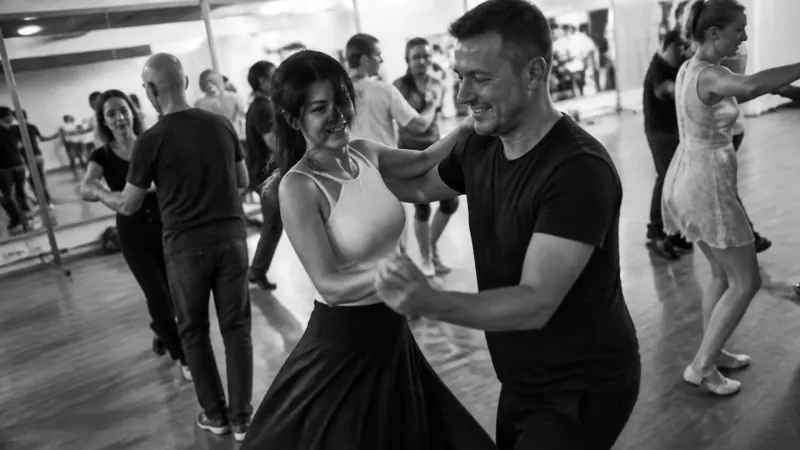
Clear role agreements and a stable framework enable successful leading without clichés.

Identifying suitable offers for open dance roles

Anyone looking for a same-sex dance course in Dresden will encounter different teaching styles among course providers. Not every studio automatically moves away from classic terms like gentleman and lady. A targeted check in advance saves time and prevents unsuitable classes. Look for the terms lead and follow instead of man and woman in course descriptions.

Before booking, ask specifically how the registration of same-sex couples is handled: Are dance roles chosen freely, or does the system strictly require mixed-gender couples? Dance schools with a modern teaching approach dispense with gender-specific regulations and allow both partners to alternate leading in the same course or to learn a fixed role regardless of gender.

The independent dance scene in particular offers inspiration for this: Through the pioneering work of Mary Wigman and Gret Palucca, Dresden looks back on a deep tradition of free expression, which lives on today in places like the Villa Wigman or the Festspielhaus Hellerau. This free-spirited approach is also reflected in partner dance: Anyone who finds out about the Swing dance partner network in advance will see how naturally role switching can work at socials.

Roles in dance classes and at socials

How to succeed

  • Ask about the role policy before registering
  • Define dance roles via lead and follow
  • State your desired role immediately when asking someone to dance
  • Give impulses from the torso instead of using pure arm strength

Common mistakes

  • Simply hoping that the school is flexible
  • Using classic terms like lady and gentleman
  • Silently assuming that you will be led
  • Trying to pull your partner with your arms

Dancing is a non-verbal conversation. Who sends the signals and who responds is not a question of gender, but of the agreement made.

Dance instructor for partner dance

Communication and confidence at dance events

If you dance as a leader or in a same-sex couple, you may occasionally encounter traditional expectations at open dance evenings and socials. With clear communication, you can master any invitation situation with confidence. Ask your partner directly when inviting them: Do you lead or follow? This simple question makes it clear from the very first second that roles are negotiable.

When leading as a woman in Dresden, an upright posture and open body language prove effective. If you stand at the edge of the dance floor and watch the dancers, you already signal activity through your orientation. If you want to dance specifically as a leader, you can approach other dancers directly instead of waiting for someone to approach you.

Even historic venues like the Ballhaus Watzke in Dresden show that ballrooms are lively places for exchange. At social dances, it is perfectly common today to clearly define boundaries: If someone asks you to dance and automatically assumes they have to lead you, say kindly: I am dancing exclusively as a leader today. This creates respect and ensures relaxed rounds on the dance floor.

Two tasks in a dance dialogue

Leading

The role of the leader

Structure, spatial awareness, and clear signals

As the leading person, you take responsibility for direction, timing, and the safety of both dancers on the floor. You provide reliable signals from your core, but leave your partner enough room for musical independence.

Following

The role of the follower

Presence, balance, and fine perception

As the following person, you read your partner's impulses, maintain body tension, and actively implement the guided movement. You are by no means passive, but actively shape the dynamics and expression within the given space.

Frequently Asked Questions

  1. Look for terms like lead and follow instead of gentleman and lady in the course descriptions. Studios with a contemporary approach allow individual registration without specifying biological sex or offer classes with free role choice.

Suitable dance courses in Dresden

Find dance courses in Dresden with open roles and flexible partner choice.

Find dance partners without gender roles

Create a profile and choose directly whether you want to lead, follow, or dance both. This way, you will meet other dancers in Dresden who share your choice of role.

Find dance partners without gender roles

Read more