Tango Argentino5 minutes

Tango Community in Frankfurt: Milonga and Connections

By Mary De LucaUpdated

In short
  • In Frankfurt, you can discover Argentine Tango as a shared practice through classes and milongas.
  • At a milonga, the Cabeceo invites you to dance together through eye contact and an affirmative nod.
  • If you came alone, you can observe first, introduce yourself, and join in when the opportunity feels right.
  • Lack of eye contact or an absent nod count as a no and are respected without asking again.

A milonga is both a dance evening and a place to meet: you don’t need to arrive with a regular partner to find your way around. It helps to pay attention to the customs and not interpret every invitation the same way.

DefinitionCabeceo

Cabeceo is an invitation to dance through eye contact and an agreed-upon nod. Only a clear response makes it mutual consent.

The Argentine Tango community grows through recurring encounters

If you want to get to know Argentine Tango in Frankfurt, you won't find just one fixed group. Instead, you can build connections through different opportunities. Classes teach movement and musicality, while a milonga gives you space to put what you've learned into practice through social dancing. There are also conversations on the sidelines, listening to music together, and seeing familiar faces again at future evenings. This is how a sense of familiarity grows step by step, without needing a regular dance partner before your first visit.

It is important to distinguish Argentine Tango from the tango in the standard dance program: this is a social dance culture with changing encounters and its own milonga etiquette. You can read an overview of the styles and events you can find in Frankfurt in Tango in Frankfurt. The city page also lists opportunities to take part, such as Tanztag Rhein-Main, but it does not confirm any particular customs of the tango scene. So if you have a specific class or evening in mind, it is worth asking directly rather than assuming that what applies at one venue applies everywhere.

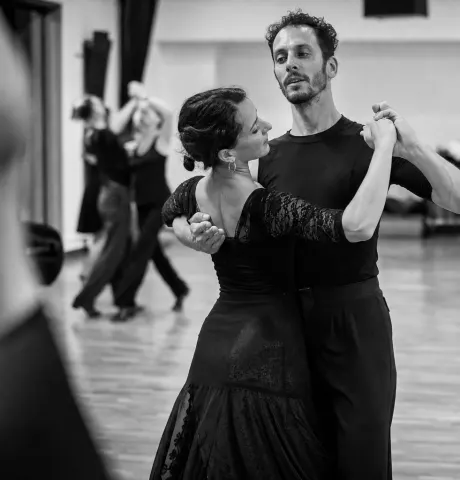
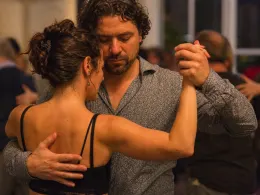
A consciously exchanged glance creates clarity before both step onto the dance floor.

Cabeceo connects invitation and consent

At many milongas, the cabeceo is a discreet way to invite someone to dance. The person extending the invitation makes eye contact and waits for a clear response. A returned glance and a nod can express consent; if there is no response, the invitation is not pursued. The advantage is that no one has to turn someone down publicly in front of the group, and both people can manage the situation themselves.

However, the cabeceo is not a rigid code that is used the same way everywhere. Some people use it consistently, while others pair it with a brief verbal invitation. At the beginning, observe how people interact, and ask politely if you are unsure. A yes applies to this dance, not automatically to more dances or personal closeness. If you want to learn more about general etiquette at social dance events, you can find tips in the article about etiquette at a social dance in Frankfurt. Be mindful of what applies to the specific event.

Reading the cabeceo without being pushy

How to say yes

  • Make eye contact and respond with a small nod
  • If you're unsure, ask politely out loud
  • Observe the evening's customs first

Not like this

  • Interpret eye contact alone as a definite yes
  • Simply ignore the lack of a nod
  • Apply a milonga rule to every evening

A cabeceo is only an invitation when both hold eye contact and return the nod.

Dance instructor for Argentine Tango

Arriving alone is one way to get started

Going to a Milonga alone doesn’t mean you have to dance alone all evening. You can first sit down at the edge of the room, take in the music and how things work, and introduce yourself to the host when the opportunity arises. A quick mention that you’re new makes it easier for others to know and gives you a chance to ask about local customs. If there’s a class beforehand or an open introductory session, that can make the first step even easier.

Before you go, it’s helpful to check three things: Is the evening suitable for beginners? Can you come without a regular partner? Is there someone you can turn to with questions? You can compare current Tango classes in Frankfurt using the course filter on udansa; for Milongas, check the details provided by the organizer. Give yourself permission to just watch at first, if that’s what you feel like doing. Taking a short break at the edge of the room doesn’t mean you don’t belong. It gives you time to get a feel for the music, the space and the customs.

Invitation through eye contact or conversation

Eye contact

The Cabeceo stays subtle

The invitation and acceptance are visible from a distance.

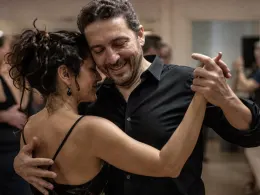
Eye contact and a nod give both of you time to accept or decline an invitation. This can be especially pleasant when you want to start dancing without interrupting the music.

Conversation

Direct address creates closeness

A short sentence clarifies the situation right away.

A friendly verbal invitation can be appropriate when eye contact doesn’t happen or when you’re already talking. It’s just as respectful, as long as a no is accepted without discussion.

Frequently Asked Questions

  1. No, you don't have to be an advanced dancer, but expectations vary depending on the evening. Check in advance whether beginners are welcome, and ask a course provider about suitable opportunities to practice. That way, you can get a feel for the atmosphere without feeling out of place on the dance floor.

Tango classes in Frankfurt

If you’d like to practice milonga etiquette first, compare suitable Tango classes in Frankfurt.

Your first Tango evening begins with curiosity

On udansa, you can compare Tango classes and dance connections in Frankfurt. That way, you can find the right introduction before attending your first Milonga.

Your first Tango evening begins with curiosity