Salsa guide5 minutes

Salsa in Munich: Your guide to the scene

By Bernhard De LucaUpdated

In a nutshell
  • Salsa in Munich is primarily danced in the Cuban style or the linear Cross-Body style.
  • Good Salsa courses are characterized by regular partner rotation and a focus on clean leading and following technique.
  • In summer, when the weather is nice, Salsa is danced openly at locations such as the Dianatempel in the Hofgarten.
  • For beginners, comfortable clothing and shoes with smooth, spin-friendly soles free of street dirt are sufficient.

Salsa combines precise rhythm with a relaxed joy of life. For a successful start in the Munich scene, what counts most is choosing the right style, clear leading signals, and the courage for your first social dance evening.

DefinitionCross-Body-Lead

Cross-Body-Lead refers to a fundamental Salsa figure where the leader clears the way for the partner to switch dance positions along a straight line. It forms the foundation for all linear styles, such as New York or L.A. Style.

Styles and teaching formats in direct comparison

Anyone starting Salsa in Munich will primarily encounter two major lines: Salsa Cubana and linear styles like New York or L.A. Style. The Cuban variant is danced in a circular motion and emphasizes earthy turns, while cross-body styles are led on a straight line. Both dance styles require a clear sense of the basic step on eight counts, where beats four and eight serve as short pauses. For your start in Munich, it is worth checking out a trial lesson in both styles beforehand to find out which body feeling suits you better.

To make effective use of trial training and lessons, you should look for a structured course design. A reputable Salsa course does not just explain fixed step sequences, but teaches the principles of leading and following from the very first lesson. Good instructors regularly rotate dance partners during the lesson so that no one relies on familiar habits. This trains responsiveness and removes the inhibition beginners feel towards free social dance.

Anyone who keeps the basic step clean and on beat will effortlessly master every turn, even on a crowded dance floor.

Moving from the dance studio to the open dance floor

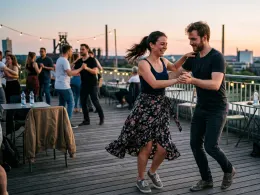
The transition from the studio to an open dance floor is best achieved through so-called socials or open evenings. In summer, Munich offers a special opportunity for this under the open sky: when the weather is good, people spontaneously dance on the marble floor at the Dianatempel in the Hofgarten. Such casual meeting places are ideal for practicing dancing as a couple without pressure and for getting to know other dance enthusiasts.

When starting with social dance, a simple basic rule applies: no one expects perfection. If you ask someone to dance, the basic steps are perfectly sufficient as long as you keep to the tempo of the music and pay attention to your dance partner. Leaders in particular should refrain from forcing complicated figures from class onto a crowded dance floor. Anyone who focuses on attentive eye contact, a relaxed posture, and clean basic turns instead will quickly find like-minded people in Munich.

Learn properly instead of risking frustration

How to get started successfully

  • Change dance partners regularly in class
  • Lead turns from the torso instead of pulling with your arms
  • Wear shoes with clean, pivotable soles
  • Keep an attentive eye on the space around you

Typical beginner mistakes

  • Only practicing with a familiar person
  • Pulling your partner into position with your arms
  • Forcing turns with blunt rubber soles
  • Recklessly dancing figures into other couples

Salsa is not about stringing together as many moves as possible, but about feeling the music together in time and giving each other space.

Dance instructor for Latin American dances

Equipment and preparation for social dance evenings

If you want to dance Salsa long-term, the right equipment makes a noticeable difference. Special dance shoes with a smooth-gliding chrome leather sole protect your knees and ankles during fast turns. However, this footwear is out of place on street surfaces or delicate indoor floors: for outdoors, well-maintained sneakers with a smooth rubber sole are sufficient. If you want to try out different styles, you can also find out about traditional partner dance forms via the Kocherlball or test new directions with a trial class.

When choosing your dance evenings, pay attention to whether an open trial class is offered beforehand. Such introductory lessons help you get used to the acoustics and the dance floor before the regular party begins. With patience, regular practice, and curiosity about the community, you will build up a solid repertoire step by step that will safely guide you through every Salsa night.

Two styles define the dance floor

Cubana

Salsa Cubana in the room

Circular and rhythmically emphasized

The Cuban style is characterized by circular movements, relaxed leading, and earthy step patterns. It is perfect for spontaneous dancing without rigid lines.

Line

Cross-body and linear style

Guided along a line

Linear styles emphasize clear spatial axes, precise turns, and an upright posture. Here, figures are executed along an imaginary narrow line.

Frequently Asked Questions

  1. Comfortable everyday clothing and flat shoes with smooth soles are perfectly fine for your first trial lesson. Special dance shoes with chrome leather soles are only worth it once you start practicing turns and more demanding footwork regularly.

Find Salsa courses in Munich

Find current offers for beginners and advanced dancers in Munich here.

Find your Salsa partner now

Find dance partners, courses, and open dance opportunities for Salsa in your area on udansa. Compare schools or find someone directly for your next course visit.

Find your Salsa partner now

Read more