Urban Dance4 minutes

Hip Hop in Munich: The guide to urban dance

By Bernhard De LucaUpdated

In a nutshell
  • For Hip Hop and Streetdance in Munich, choose specialized urban dance studios instead of classic partner dance schools.
  • Urban courses teach solo dance in a group and do not require a dance partner.
  • Beginner training sessions teach basic bounces, body isolations, and a sense of rhythm before moving on to complex choreographies.
  • Good studios are characterized by joint-friendly sprung floors, clear level divisions, and sound basic technique.

Hip Hop means freedom, grounding, and individual expression: If you are looking for suitable training opportunities in Munich, you benefit from completely different criteria than in classic partner dance.

DefinitionBounce

Bounce refers to the basic, springy up-and-down movement in Hip Hop, which is maintained continuously from the knees and ankles in time with the beat. It forms the foundation for all urban dance steps and gives the movements their typical flow.

Urban styles require their own training concept

Anyone looking for Hip Hop in Munich will quickly realize: urban dance follows completely different principles than classic dance school lessons. Instead of Waltz, Foxtrot, or rehearsed standard step sequences for dance couples, it is about solo dance, isolations, a sense of rhythm, and the so-called bounce. In Munich, many newcomers look in vain at traditional providers because urban dance forms require their own training concepts. You do not need a fixed dance partnership, but rather concentration on your own body and the groove of the music.

Urban styles cover a broad spectrum from Old School Hip Hop and New Style to Popping, Locking, Krump, or House. Each style requires different coordinative foundations. Anyone starting in Munich should clarify before their first booking whether a course focuses more on fixed choreographies or emphasizes free improvisation. Both form the foundation of urban dance culture.
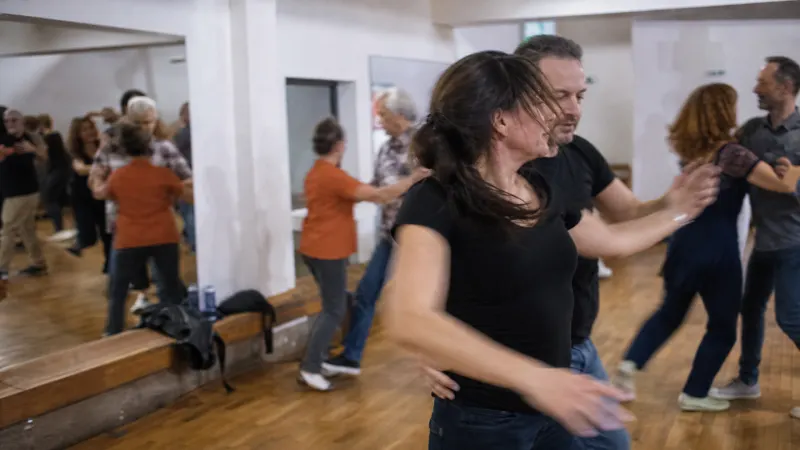
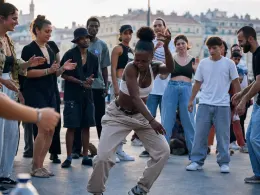
Low centers of gravity and controlled body tension form the foundation for authentic Hip-Hop movements.

Foundation instead of pure show effects in training

Probably the biggest difference between urban dance classes and traditional partner dance offerings lies in the relationship between form and freedom. While posture and partner coordination are at the forefront in ballroom dancing, Hip Hop requires a deep rooting in the ground, the so-called grounding effect. Joints remain bent, the weight rests low, and the beat drives the movement from the inside out.

Good training for street dance always consists of three pillars: warm-up with strength and stretching exercises, teaching the basic steps including isolation training, and putting these elements together into a sequence. Serious instruction explains where a step comes from and how the dynamics work, instead of just demonstrating movements without comment. If you are still looking for your preferred style, a look at the guide to choosing a course will help you better understand the differences between modern formats.

Studio selection and training in comparison

Training properly

  • Bring clean indoor sneakers with good cushioning
  • Look for sprung floors and joint-friendly parquet
  • Practice basic steps and isolations thoroughly first
  • Choose courses with separate skill levels

Common mistakes

  • Dancing on the dance floor in street shoes
  • Training on un-sprung concrete or tile floors
  • Forcing complex video clip choreographies right away
  • Starting in large mixed groups without any basics

Urban dance does not start with spectacular tricks, but with an understanding of how the beat flows through your own knees.

Dance instructor for urban dance styles

What you should look for when choosing a studio

Before you decide on an offer, a targeted trial session is worth it. During your visit to the studio, pay particular attention to the flooring: a sprung wooden or parquet floor absorbs jumps and protects your joints in the long term. Hard concrete or unsprung PVC are unsuitable for demanding urban choreographies. A large mirror is just as important so that you can check your isolations and lines yourself.

Ask in advance how the levels are divided. A true beginner course should not require any prior experience and should explain the basics step by step. Also ask about the instructors' philosophy: is it about drills for performances or about individual musical development? If you want to prepare specifically before your first class, you will find practical questions for your first studio appointment in the guide to trial sessions.

Choreography or freestyle: two sides of urban dance

Choreography

Structured sequences

Precision and group focus

Fixed choreographies train memory, synchronicity, and the precise execution of beats on point. They are ideally suited for learning complex step combinations in a structured way.

Freestyle

Spontaneous improvisation

Individual expression

Free dancing promotes your own musicality, sense of rhythm, and individual style. In the circle of dancers, the so-called cypher, spontaneous expression emerges without predetermined step patterns.

Frequently asked questions

  1. Wear loose, comfortable clothing made of cotton or functional fabric, as well as clean sneakers with flat soles. Make sure that the shoes do not leave marks on the studio floor and provide sufficient cushioning for jumps.

Urban dance courses in Munich

Find current beginner and advanced courses for Hip Hop and street dance in your area.

You rarely dance urban dance alone

Find like-minded people for sessions together in Munich and sign up for suitable courses directly in the community.

You rarely dance urban dance alone