Go together, dance freely
On udansa, you can find dance events in Paris for an evening together. The event details help you figure out which format is right for dancers and friends who want to watch.

By Mary De LucaUpdated
On udansa, you can find dance events in Paris for an evening together. The event details help you figure out which format is right for dancers and friends who want to watch.
A group night can quickly go off track when some expect an evening of conversation and others can hardly leave the dance floor. A quick chat beforehand saves you from feeling like you’re constantly waiting for each other.
At a dance evening in Paris, three things need to be distinguished: access to the event, taking part in a guided segment, and staying during open dancing. Admission for guests does not necessarily mean that accompanying people will get a seat. An announced dance floor, in turn, says nothing about whether it's pleasant to talk nearby. So what matters for your group isn't just which dance is on the program, but how dancing and breaks fit together in terms of space and timing.
Historically, dance in Paris also referred to different situations: the Cancan developed into a revue number at the Moulin Rouge after it opened in 1889. Watching a performance and watching from the sidelines of an open dance floor are different ways of sharing a visit. The overview of dance evenings in Paris helps you distinguish between these expectations.
Open dancing doesn't mean you have to dance to every song. In a guided session, however, exercises may build on one another, so constantly joining and leaving can interrupt the flow. If you only want to take part in some of it, you need a suitable transition, such as the end of the guided session. If you come across unfamiliar wording, the tips on French event descriptions can help. When planning for the group, what matters is whether the announced segments really leave room for everyone's different preferences.
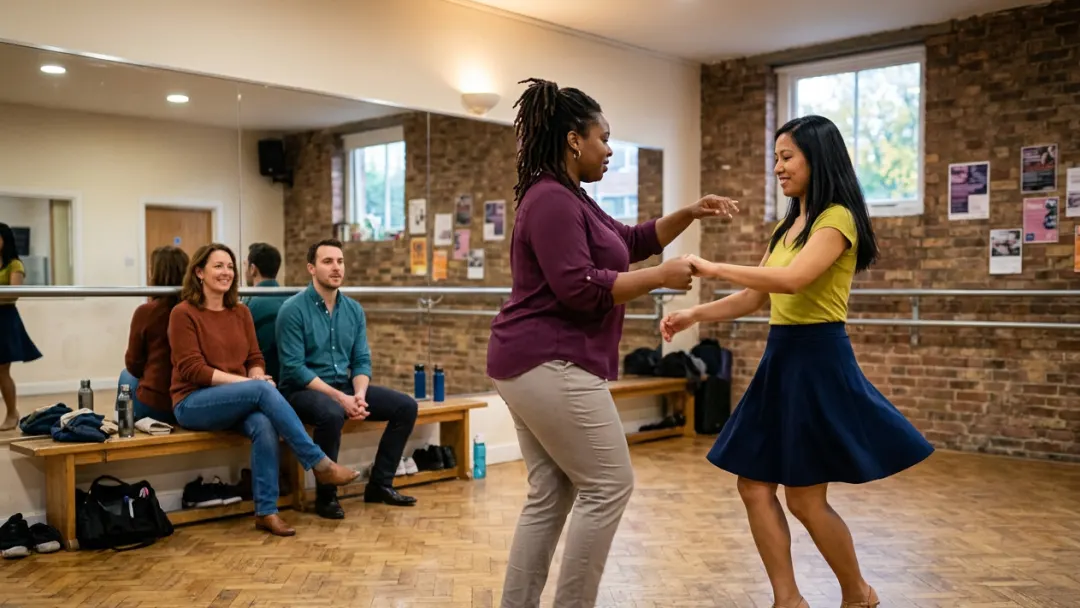
Let each friend contribute a short sentence: dance throughout, join in occasionally, or just watch. Add whether chatting together should be part of the evening. This makes it clear who enjoys a break and who might feel left out.
Go through the details on udansa together, including admission, instructor-led sections, open dancing, and coming along as a spectator. Clearly distinguish explicitly stated options from missing information: If seating isn’t mentioned, a relaxed evening as a spectator isn’t guaranteed.
Choose an evening whose announced segments match the wishes you’ve collected. If some people only want to dance at certain times, an open dance session is more suitable than a continuously guided block. If essential details about the accompaniment are missing, choose an offering that is described more clearly.
Agree on a shared start time and a later time to meet up. In between, everyone can dance or take breaks for different lengths of time. If someone is only watching, discuss specifically who would also like to spend time with that person, without turning it into a mandatory schedule for keeping them company.
Enter the room with the group and get oriented away from the dance floor first. Leave bags in a designated area and keep walkways clear. Then dancers can get started while others find a place to settle.
Use the agreed-upon meetup time for a real break together, not just a wave across the dance floor. Say clearly whether you want to keep dancing afterward. If you want to leave early, you can say goodbye without having to look for everyone in the middle of a dance.
After the evening, note which parts worked for you: arriving together, watching, or free dance time. Make a specific request for your next visit. “More time for a break together” helps your group more than a blanket judgment about the whole evening.
Do
Not like this
Preparation
Orientation
Looking back
Friends who are only watching may still need a ticket, because entry and taking part in dancing are not the same thing. Unless an exception is explicitly stated, you shouldn’t expect free entry. The admission fee may cover the entire event, regardless of how often someone actually steps onto the dance floor.
An odd-sized group doesn’t have to miss out on a shared night of dancing. You don’t have to dance in pairs exclusively within your group during every song. If you only want to dance with each other, one person can choose to sit out. However, this shouldn’t turn into a permanent waiting line for the same friend.
Joining later only works if the advertised entry arrangements and event schedule allow it. It’s easier to find the group again during an open dancing session than in the middle of a guided exercise. Send the latecomers the agreed meeting point, and don’t have them search for you on the dance floor.
A table reservation only makes sense if the event offers tables and reservations in the first place. A dance night isn’t automatically a sit-down group outing. If long conversations are important to you, you’ll need a suitable area to hang out. Simply standing right next to the speakers is unlikely to meet that need.
You can change your plans and skip the dancing. Let your friends know as early as possible whether you still want to stay or would rather leave. Agreeing to a shared night out doesn’t mean you have to dance too. At the same time, a clear answer helps the group plan their next breaks together without having to guess.
You should leave the dance floor for a longer conversation. Groups standing around take up space and can block dancers’ paths. Finish your dance, go with your friends to the agreed area to hang out, and talk there. That way, a conversation break won’t become an obstacle in the middle of an ongoing dance.