Movement Practice5 minutes

Contemporary Dance in Shanghai: How Classes Work

By Bernhard De LucaUpdated

In brief
  • Contemporary dance in Shanghai often combines body awareness, technical exercises, and free movement phases.
  • You practice weight shifts, floor work, and changes of direction instead of repeating a fixed sequence of steps throughout.
  • Improvisation usually follows clear prompts or rules, so you can find your own movements within a framework.
  • Class structure varies by course; check the level, prior experience, and balance of technique and improvisation.

A class can feel unexpectedly open, even though every exercise has a clear structure. When you understand why technique and free exploration alternate, you can focus on the movement instead of searching for the one right choreography.

DefinitionImprovisation

Improvisation is the spontaneous development of movement within a task or a set framework. In class, it doesn't mean that you simply do whatever you like without any guidance.

An hour shifts between arriving and exploring

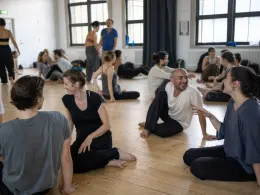
The exact structure depends on the teacher and the course. The class often begins with arriving in your body: you mobilize your joints, notice your breath and shift your weight before adding bigger movements. This may be followed by technical exercises, such as changes of direction, spirals, simple jumps or transitions to the floor. The teacher does not just teach you a form, but also draws your attention to how a movement comes about.

During an improvisation phase, you explore a movement question. It might relate to space, tempo, body parts or contact with the floor. Toward the end, selected movements are sometimes linked together or discussed as a group. Not every class includes all these elements, and choreography does not have to be the goal. In Shanghai, the China Shanghai International Arts Festival, held every autumn, also showcases contemporary dance as a stage art. This is a different setting from a class: the focus is on experiencing and exploring movement choices for yourself.

A clear movement task leaves room for your own solutions without you losing your bearings in the sequence.

Technique and improvisation serve different purposes

Technique creates possibilities, improvisation brings them into relation. An exercise in shifting your weight can show you how to move from standing into a turn or guide a movement safely to the floor. An improvisation that follows invites you to try out this principle at your own pace and in your own direction. There is not necessarily just one right way to do it. What matters is that you understand the task and work with it consciously.

If you confuse improvisation with doing whatever you like, you overlook its framework. A teacher might, for example, ask you to change only one quality of movement or respond to an impulse. This limits your options while leaving room for personal solutions. Technique, in turn, is not just a collection of correct postures: it helps you make transitions more conscious and physically understandable. If an instruction feels unclear, ask for a demonstration or a simpler variation. To find the right level of challenge, you can also refer to the information about dance course levels in Shanghai.

Understanding movement exercises: how to get it right

Like this

  • Explore a small movement quality, such as soft or direct
  • Shift your weight to the floor in a controlled way, then rise again
  • Pick up an impulse and try your own variation
  • Use pauses to notice your breath and tension

Avoid this

  • Turn every task into a finished choreography right away
  • Rush through floorwork without checking the transition
  • Copy the teacher instead of exploring the quality of the movement
  • Ask for the next step as soon as there is a pause

I prefer to offer a clear movement prompt rather than a ready-made solution, so everyone can find their own way within it.

Contemporary dance educator

You can tell the focus from the class description

The name “contemporary dance” alone tells you little about how a class is structured. Some classes place more emphasis on basic movement principles and coordination, while others make more room for improvisation. For your choice, the class description is therefore more important than the assumption that there is one standard method everywhere. Look for details about floor work, choreography, free movement, and prior experience. If you prefer to learn by watching, ask how movements are explained and whether verbal cues are accompanied by demonstrations.

This question is especially helpful if you’re new to a class in Shanghai or are still figuring out the language of instruction. A description should make clear whether the teacher explains and demonstrates movement tasks and answers questions. Also check whether the class is listed as suitable for beginners and how it accommodates different levels of movement experience. For help with the language used in class, see the overview on assessing the language of instruction in Shanghai. This way, you can compare concrete learning conditions instead of drawing conclusions about the entire class from a style label.

Two ways to develop movement

Exercise

A prompt sets the direction

You explore a specific movement quality.

A teacher might invite you to shift your weight slowly or guide a movement through the space. This limited focus helps you notice details and discover variations.

Openness

You develop your own material

You decide how to respond to the prompt.

During a free movement phase, you connect movements yourself and notice what feels right. A focus you choose, such as your breath or gaze direction, can help guide you without dictating the movement.

Frequently Asked Questions

  1. Exceptional flexibility is not a requirement for every class. Exercises can be adapted to suit your range of motion, and body awareness is often more important than being able to stretch deeply. If you’re unsure, ask beforehand how the class accommodates different abilities.

Modern Dance and Improvisation Classes in Shanghai

Compare current classes in Shanghai and see whether the technique, improvisation and level match your learning goals.

Your movement has room to grow

On udansa, you’ll find contemporary dance classes and improvisation sessions in Shanghai. Compare the class descriptions and choose a starting point whose level and teaching style suit you.

Your movement has room to grow